Back

Who we are

With research staff from more than 60 countries, and offices across the globe, IFPRI provides research-based policy solutions to sustainably reduce poverty and end hunger and malnutrition in developing countries.

Elodie Becquey

Elodie Becquey is a Senior Research Fellow in the Nutrition, Diets, and Health Unit, based in IFPRI’s West and Central Africa office in Senegal. She has over 15 years of research experience in diet, nutrition, and food security in Africa, including countries such as Burkina Faso, Chad, Ethiopia, Ghana, Kenya, Mali, and Tanzania.

Back

What we do

Since 1975, IFPRI’s research has been informing policies and development programs to improve food security, nutrition, and livelihoods around the world.

Where we work

Back

Where we work

IFPRI currently has more than 600 employees working in over 80 countries with a wide range of local, national, and international partners.

TOPIC

Artificial Intelligence (AI)

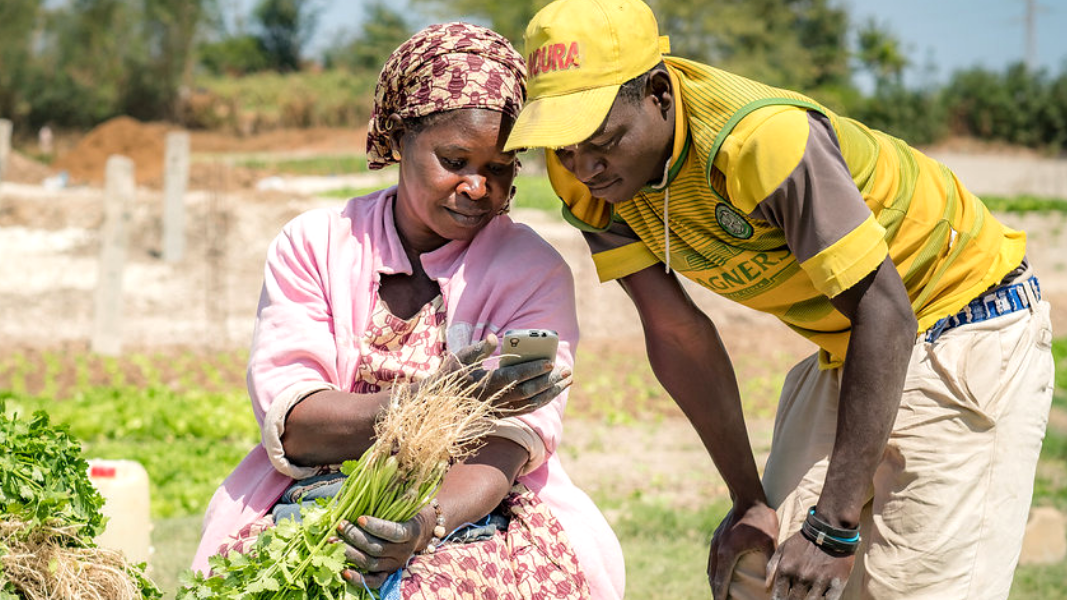
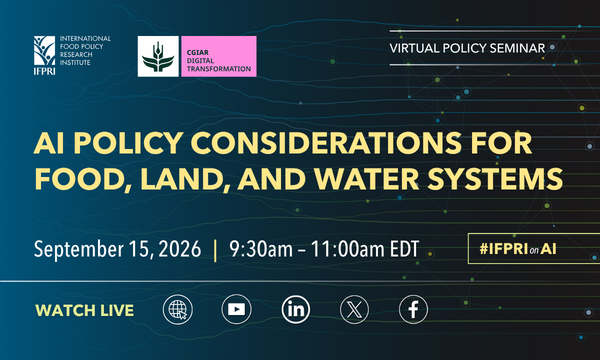
Artificial intelligence (AI) is poised to play a transformative role in advancing sustainable, resilient, and equitable food systems. AI refers broadly to models trained on data that can detect patterns, make predictions, generate insights, and support decision-making. This large umbrella includes methods ranging from machine learning and natural language processing to generative AI.

For agricultural research and policy, AI brings both opportunities and risks. It can expand the evidence base for decision-making, unlock new ways of analyzing complex systems, and improve how producers, researchers, and policymakers interact with data and models. Yet, without careful stewardship, AI can exacerbate inequalities, embed biases, or divert resources away from proven approaches.

As a global research organization, IFPRI has an obligation to improve access to data and research findings to emerging AI knowledge systems, while strengthening its research capacity and ensuring that these technologies are used responsibly to support inclusive and sustainable development.

IFPRI’s role is fivefold:

  • Building competencies and research skills. IFPRI applies AI across disciplines, from foresight modeling, econometrics, and natural language processing to remote sensing, data collection, and qualitative analysis. Building AI literacy among researchers and staff is key to strengthening institutional capacity.
  • Demonstrating use cases that center people. IFPRI explores AI applications across food systems—from farm-level decision support to policy analysis. We apply human-centered participatory design that augments rather than replaces trusted processes and institutional knowledge through transparent and explainable AI approaches.
  • Promoting responsible stewardship and investment. IFPRI analyzes how AI funding and investments shape food systems. Through strategic partnerships with governments, nongovernmental organizations, and the private sector, we help direct resources toward inclusive, evidence-based, and scalable applications.
  • Advancing digital public goods and open knowledge systems. IFPRI develops and shares FAIR (findable, accessible, interoperable, and reusable) datasets and open-access publications that serve as foundational resources for the global food policy research community. These digital public goods enable AI ecosystems to develop more relevant and context-appropriate AI applications for food systems.
  • Advancing ethics and responsible governance. IFPRI examines the ethical, legal, and social dimensions of AI in food systems. Our work informs policy frameworks and promotes innovation that is equitable, transparent, and accountable.

Illustration created using MidJourney AI
Resource thumbnail

Journal Article

Geospatial analysis enables combined poultry–fish farm monitoring in the fragile state of Myanmar

2025Belton, Ben; Fang, Peixun; Liu, Shuo; Zhang, Kaifeng; Zhang, Xiaobo
Details

Geospatial analysis enables combined poultry–fish farm monitoring in the fragile state of Myanmar

Food security is challenging to measure in fragile contexts. Here we combine data from previous field surveys with remotely sensed images and apply deep-learning techniques to estimate changes in the number and area of chicken houses on integrated chicken–fish farms and the supply of chicken meat and eggs from 2010 to 2023 in Yangon region, Myanmar. Yangon’s poultry sector grew ~10% annually from 2010 to 2020 but contracted ~8% annually from 2020 to 2023.

Year published

2025

Authors

Belton, Ben; Fang, Peixun; Liu, Shuo; Zhang, Kaifeng; Zhang, Xiaobo

Citation

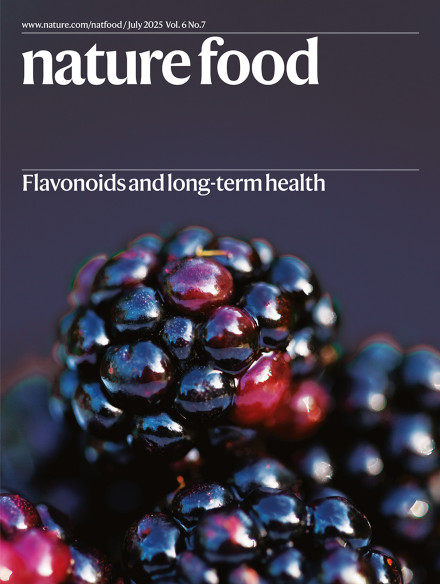
Belton, Ben; Fang, Peixun; Liu, Shuo; Zhang, Kaifeng; and Zhang, Xiaobo. 2025. Geospatial analysis enables combined poultry–fish farm monitoring in the fragile state of Myanmar. Nature Food 6(July 2025): 664-667. https://doi.org/10.1038/s43016-025-01192-1

Country/Region

Myanmar

Keywords

Asia; South-eastern Asia; Fish Farms; Food Security; Poultry Farming; Spatial Data; Fish Culture; Fragility

Language

English

Access/Licence

Open AccessCC-BY-4.0

Project

Digital Innovation

Record type

Journal Article


Blogs


Events


News


Our experts

Aulo Gelli

Senior Research Fellow, Poverty,
Gender, and Inclusion

Jawoo Koo

Senior Research Fellow, Natural
Resources and Resilience

Yanyan Liu

Senior Research Fellow, Markets,
Trade, and Institutions