



Rice productivity and profitability in Myanmar: Assessment of the 2025 monsoon season
We analyzed rice productivity and profitability data for the 2025 monsoon season from the Myanmar Agriculture Performance Survey (MAPS), conducted at the beginning of 2026. The survey covered plots managed by 2,734 rice producers across all states and regions of the country. As no MAPS survey was conducted during the 2024 monsoon season, we compare performance changes with those observed in 2023. Our findings reveal the following:
1. National rice productivity, measured on farmers’ largest plots, declined by an average of 8 percent during the 2025 monsoon compared to 2023. This lower productivity was primarily driven by reduced incentives for production as shown by reduced labor inputs, with more farmers adopting broadcasting methods, as well as an increased incidence of natural shocks, notably floods and heavy rains.
2. The Delta agro-ecological zone, the country’s principal rice-producing area, experienced a 7 percent decline in rice productivity in 2025 compared to 2023, while the Coastal agro-ecological zone recorded the largest decline among all zones, with yields falling by 22 percent. This sharp reduction was partly driven by poor performance in Rakhine State, which was largely cut off from commercial input and output markets in 2025, considerably reducing the use of modern inputs in rice production.
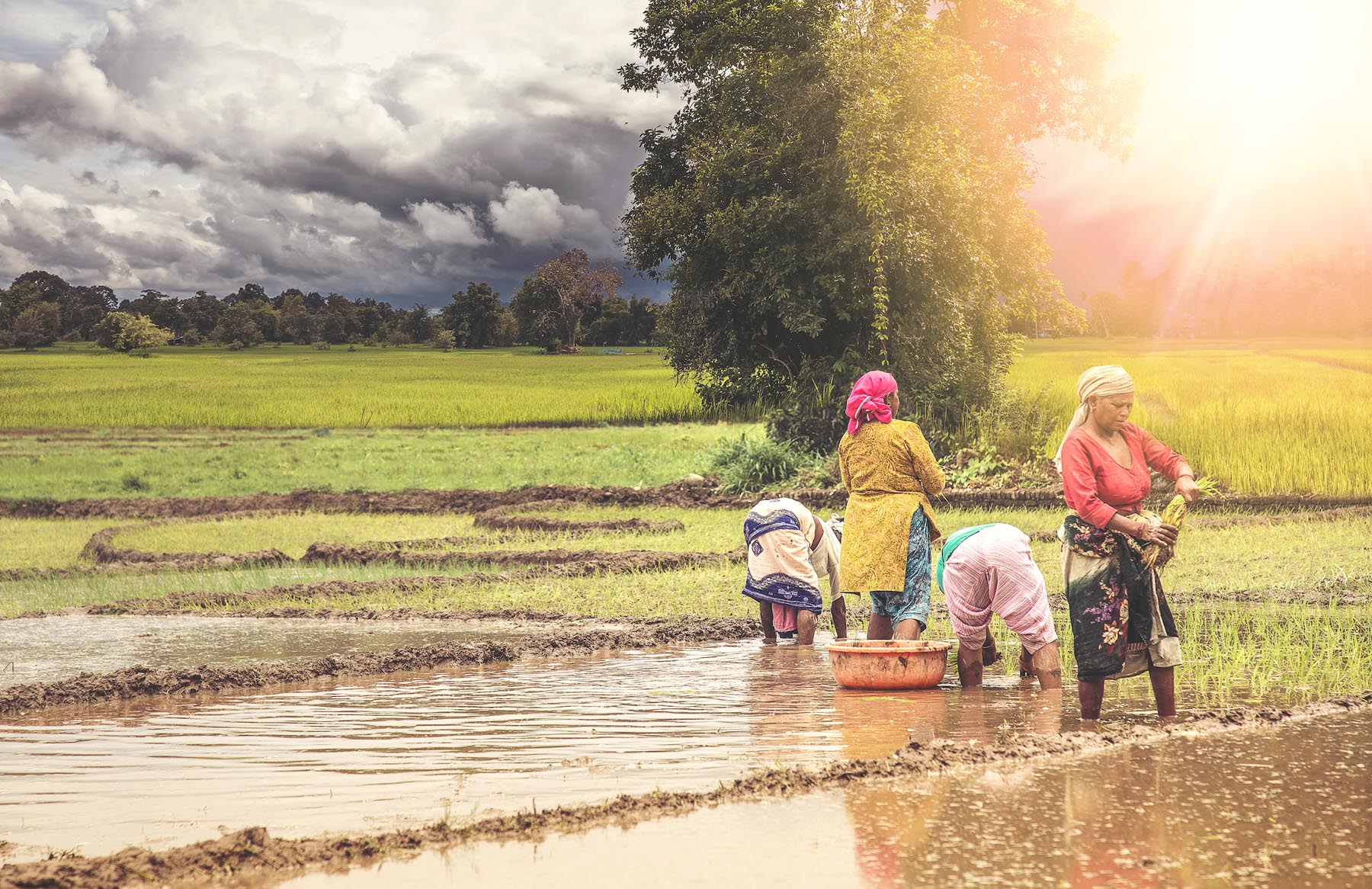
3. Thirty-six percent of paddy farmers reported being affected by climatic or other production shocks during the 2025 monsoon season. Floods, reported by 10 percent of farmers, and heavy rains, reported by 15 percent, had significant adverse effects on yields. Among affected farmers, paddy yields declined by 34 percent and 15 percent, respectively.
4. Significant changes in rice cultivation input costs were observed between the 2023 and 2025 monsoon seasons. Prices of urea, the most important chemical fertilizer used by rice farmers, increased by 23 percent, while mechanization costs, measured through plowing costs, increased by 55 percent. Wages recorded the sharpest increases, likely reflecting escalating rural labor scarcity. Wages increased by 88 percent for men and 83 percent for women. Overall input expenditures per acre of rice cultivated increased by 63 percent.
5. Farmgate paddy prices declined by 6 percent, reflecting changes in international rice prices between the 2023 and 2025 monsoon seasons.
6. Given rising input costs and declining paddy prices, paddy farming profits declined substantially and reached their lowest level in the last six years. Nominal profits per acre fell by 40 percent between 2023 and 2025.
7. Commercially obtained inputs are significantly associated with higher rice yields. A doubling of commercial input expenditures is associated with a 34 percent increase in yields, while a doubling of chemical fertilizer use is associated with a 9 percent increase in yields, ceteris paribus. The use of organic fertilizer is also positively and significantly associated with higher yields, with users obtaining yields that are 4 percent higher on average.
The outlook for paddy production in 2026 appears highly uncertain due to several factors:
1. The Iran war: High fuel prices, as well as constrained fuel availability resulting from the Iran war, are likely to complicate transportation, irrigation, and agricultural mechanization, thereby affecting preparation for the next monsoon season. Fertilizer prices have also risen sharply and are expected to remain elevated for the foreseeable future (Arita et al. 2026), with likely negative consequences for use rates and profitability for paddy production during the 2026 monsoon (USDA 2026).
2. Weather conditions: Adverse weather conditions, as observed during the 2025 monsoon, can significantly affect yields. Most climate models predict El Niño conditions during the second half of 2026. These conditions are typically associated with drier-than-average rainfall, which could lead to lower rice yields.
3. Evolution of insecurity: Insecurity is associated with reduced access to agricultural inputs and higher input costs where inputs remain available, thereby reducing profitability for farmers in these areas.
4. Labor scarcity: Labor availability is expected to remain constrained during the next monsoon season due to significant out-migration (linked to the Military Service Law).
These findings point to three key implications for Myanmar’s rice sector:
1. Ensuring access to agricultural inputs: Myanmar’s rice sector is highly commercialized, and access to commercial inputs is crucial for its performance. Risks associated with the Iran war, particularly regarding fuel and chemical fertilizer availability and prices, pose serious challenges for the functioning of the sector. While some commercial inputs could potentially be partially substituted with local production factors, such as agricultural labor replacing mechanized operations or organic fertilizers substituting for chemical fertilizers, a lack of access to these commercial inputs would nevertheless have major implications for rice production and national food security. Where feasible, encouraging such substitution may help mitigate some of these impacts.
2. Expanding access to climate-resilient seeds and other climate-smart agricultural technologies: As farmers are increasingly relying on self-preserved paddy seeds, there is an urgent need for them to have access to and to promote improved, high-yielding, and stress-tolerant rice varieties. Our findings show that farmers affected by floods and droughts experience substantially lower yields than unaffected farmers. Given the expected increase in weather-related shocks associated with climate change, as well as anticipated El Niño conditions, wider adoption of adapted seed varieties as well as other climate-smart agricultural technologies will be critical.
3. Ensuring profitability in rice farming: Rice farming profitability was severely stressed in 2025. This raises concerns about production incentives for the upcoming monsoon season, particularly as input costs continue to rise while rice prices – at least internationally – remain stagnant. Adjustment of the dual exchange rate system that currently depresses output prices would be beneficial. Ensuring adequate rice availability in the country may also require expanded access to credit schemes, or targeted input voucher programs for poorer smallholders, to sustain production and national food security.
Authors
Aung, Zin Wai; Minten, Bart
Citation
Aung, Zin Wai; and Minten, Bart. 2026. Rice productivity and profitability in Myanmar: Assessment of the 2025 monsoon season. Myanmar SSP Working Paper 78. Washington, DC: International Food Policy Research Institute. https://hdl.handle.net/10568/183098
Keywords
Asia; South-eastern Asia; Rice; Agricultural Productivity; Profitability; Monsoon Climate; Wet Season; Farm Inputs