
Modeling Tools
Overview
IFPRI has pioneered work on rigorous economic simulation modeling of food systems to inform decision making by national governments, funding partners, and other stakeholders. IFPRI-led models analyze impacts of policy and investment options on nutrition, poverty, social inclusion, climate change, and the environment under real-time shocks (such as COVID-19 and the conflict in Ukraine) and under alternative future scenarios (including different socioeconomic and climate change trajectories). Three complementary modeling systems focus on different geographic scales (subnational to global), time scales (near-term to several decades), and sectoral scales (agriculture sector to economywide).
IFPRI’s Modeling Systems
RIAPA
RIAPA (The Rural Investment and Policy Analysis data and modeling system) is IFPRI’s primary tool for forward-looking, country-level analysis. RIAPA has features that make it ideal for tracking the economywide impacts of policies, investments, or economic shocks at national and subnational levels over the near-to-medium term. RIAPA tracks changes in growth and employment across and beyond the food system, as well as poverty and food security at the household level.
MIRAGRODEP
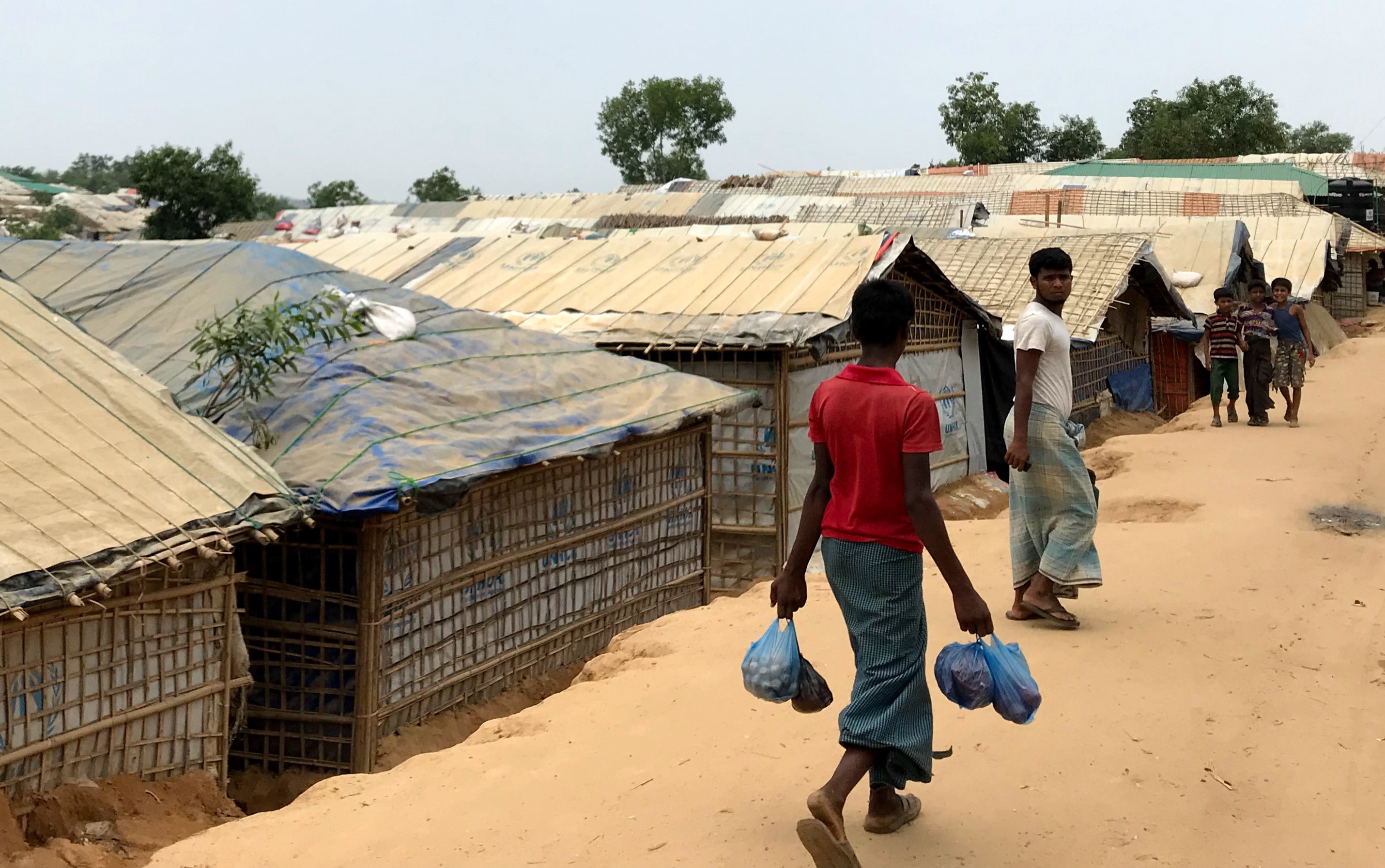
MIRAGRODEP is a global Computable General Equilibrium (CGE) model that captures international economic linkages through the international trade of goods, as well as through the movement of people and capital. MIRAGRODEP provides a rich set of indicators for each region, which allows measurement of the impact of policy changes on both macroeconomic aggregates and inequality indicators over the near-to-medium term.
IMPACT
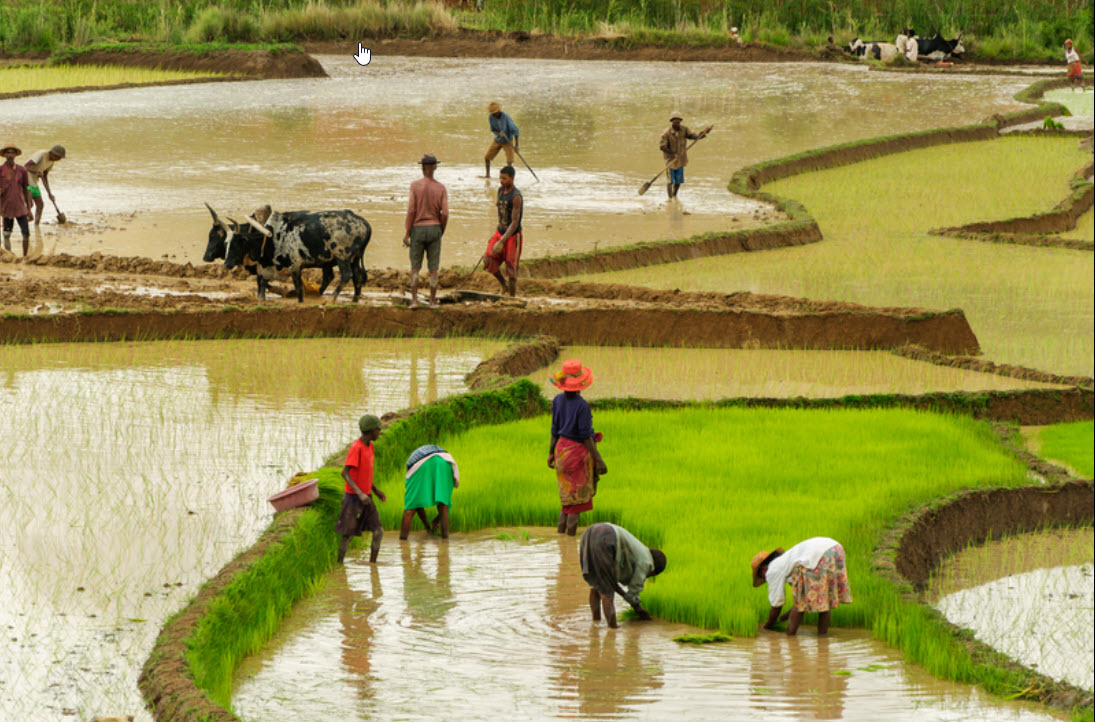
IMPACT (the International Model for Policy Analysis of Agricultural Commodities and Trade) is a system of linked economic, water, and crop models for analysis of climate change and other long-term drivers of the global food system. IMPACT focuses on the agriculture sector at subnational to global scales (including 60 commodities in 158 countries) over the medium-to-longer term (several decades).
Other modeling frameworks supported by IFPRI
DREAMpy (Dynamic Research EvaluAtion for Management, python version)
Open source, user-friendly software for evaluating the economic impacts of agricultural research and development projects.
MINK
A global-scale, systematically geographically gridded, process-based crop simulation modeling system.
SPAM (Spatial Production Allocation Model)
Open source, user-friendly software for evaluating the economic impacts of agricultural research and development projects.

Making a Difference Blog Series
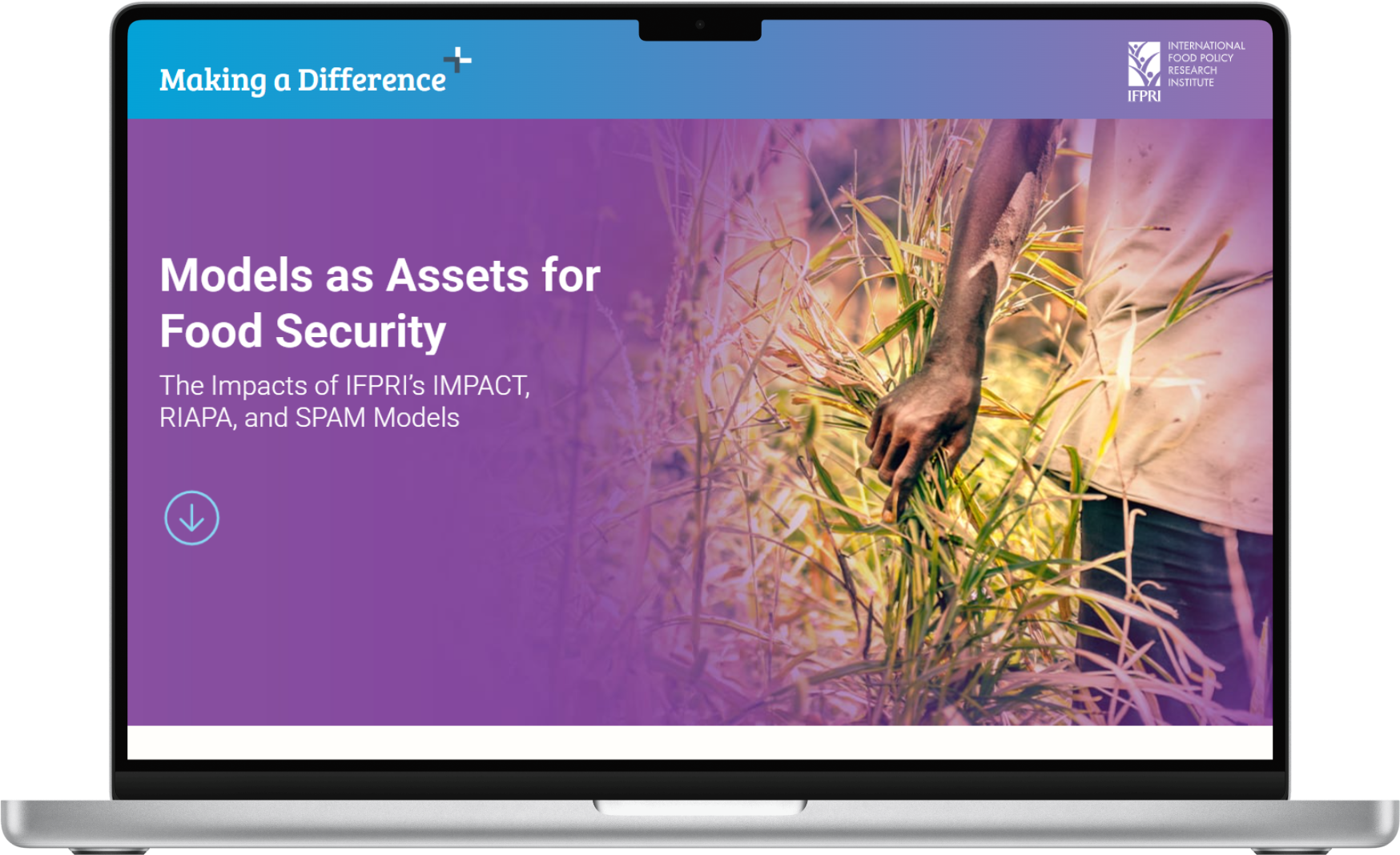
IFPRI’s modeling tools—IMPACT, RIAPA, and SPAM—provide global, national, and subnational insights to guide food policy decisions. They complement one another by answering the “what”, “how”, and “where” questions.
These models have influenced major investments and policies, offering evidence-based projections to enhance food security, nutrition, and resilience in evolving agrifood systems.
Models Webinar Series
In this webinar series, our researchers present insights from IFPRI’s key modeling systems and their outputs, developed with other CGIAR Centers and partners. This work is helping to answer the critical questions facing decision-makers and stakeholders in today’s agrifood systems: What does climate change mean for the future of agriculture? How do we prioritize different agrifood system policies and investments? What are the sources, impacts, and trade-offs of agricultural productivity growth? What policy steps should governments take when a crisis strikes and a rapid response is required?