





Irrigation is a potentially transformative technology for sub-Saharan Africa (SSA) that can address many of the region’s food system challenges, including growing food import dependence and stagnating rural employment—both linked to low agricultural productivity growth, poor market access, and weak financial systems—as well as climate change, characterized by unpredictable rainfall, prolonged dry spells, and floods.
Introduced at scale, irrigation could double or triple agricultural production on existing agricultural areas and reduce climate-related production risk. Thus, it could support more production of all crops—and in particular riskier, high-value crops such as vegetables and fruits essential to food system transformation and better nutrition. Evidence also suggests that irrigation could double agricultural incomes and dramatically reduce the region’s dependency on food imports.
Small-scale or farmer-led irrigation offers a highly promising path to irrigation expansion: farmers develop the irrigation source, typically a groundwater well, on their own and purchase the irrigation technology themselves. Small-scale irrigation is particularly profitable for farmers and has seen much faster expansion than large-scale systems that typically take many years to plan and finance. But it faces a significant problem: the rapid transition from hand pumps to diesel-operated pumps that can lift more water from greater depths, but contribute directly to greenhouse gas (GHG) emissions. Thus, this form of irrigation risks undermining the very climate resilience it aims to promote.
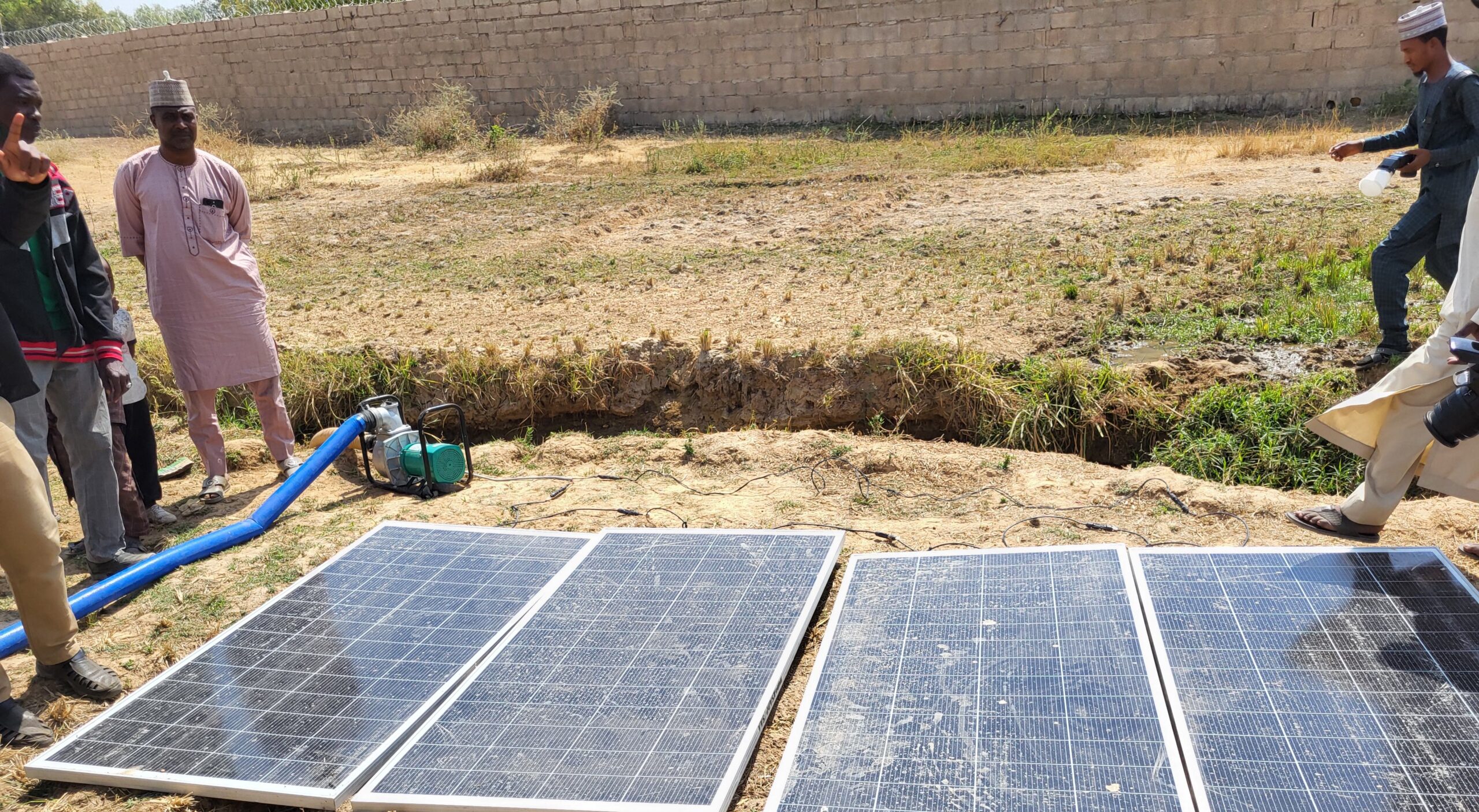
Solar-powered irrigation pumps, supported by the rapid decline in the cost of solar panels, offer an inexpensive and climate-friendly alternative. In SSA, this zero-emissions technology has an opportunity to leapfrog traditional manual and motorized technologies due to limited overall irrigation development. The technology has many advantages: investing in renewable energy for irrigation supports productivity and resilience, and helps countries pursue low-carbon development pathways.
Opportunities in sub-Saharan Africa
A recent analysis and accompanying dashboard by IFPRI provides quantitative estimates of the GHG emissions from deploying either diesel-powered or solar-powered irrigation systems—showing that a transition to solar is both economically feasible and would yield dramatic emissions reductions in many countries.
The analysis focused on groundwater-fed systems, which account for the majority of energy use in irrigated agriculture. The energy demand for irrigation water pumping was estimated according to climatic and hydrogeological conditions and crops across SSA. Using these estimates, the financial performance of appropriately sized solar- and diesel-powered irrigation systems was evaluated and compared to identify the geographic areas suitable for their application across different crop types.
A principal aim was to assess the potential of solar-powered irrigation to reduce GHG emissions in locations where this type of technology was also financially feasible. To do that, we compared emissions under two overarching scenarios. One looked at an irrigation expansion pathway that relied exclusively on financially feasible diesel-powered pumps; the other, a pathway in which solar-powered pumps replaced diesel-powered pumps in areas where the former is more cost-effective. (Residual emissions from diesel irrigation remain in locations where the replacement rate is less than 100%.)
The estimated potential reduction in GHG emissions varied across crops, but the findings consistently indicate that solar-powered irrigation can contribute significantly to GHG mitigation.
Figure 1a presents the geographical suitability of diesel- versus solar-powered irrigation pumps based on the financial performance of these two technologies for the sample crop of irrigated maize. Figure 1b, the calculated reductions in national average GHG emission levels for selected countries in SSA resulting from the adoption of solar-powered irrigation for maize in areas where solar irrigation is more cost-effective than diesel irrigation—compared to a scenario where only diesel-powered pumps are available. In many countries, substantial emissions reductions—sometimes approaching 100%—are observed, suggesting that solar-powered irrigation could largely replace diesel-powered irrigation without the need for subsidies.
Figure 1

Estimated national average GHG emission levels if only diesel-powered irrigation is available and following the potential to purchase solar-powered technologies, example of irrigated maize.
For example, in Ethiopia, the availability of solar-powered irrigation pumps would reduce GHG emissions annually by 300 kg CO2/ha or up to a total of 600,000 metric tons of CO₂ for irrigated maize. In Kenya, the reduction would be lower, by 200 kg CO2/ha or up to a total of 500,000 metric tons of CO₂ for the same crop. This is because the potential of replacing diesel-powered pumps with solar-powered technologies is more limited due to more variable solar irradiance. In Nigeria, finally, potential savings are ~500 kg CO2/ha or up to a total of 4,000,000 metric tons of CO₂ for irrigated maize. The potential is larger in Nigeria because of larger maize areas and better sunlight conditions.
The way forward
These findings confirm that solar irrigation can play a significant role in reducing the carbon footprint of farming—showing why it is essential to integrate solar irrigation into climate-smart agriculture initiatives.
A key question is how. Many policy and financing instruments are available to promote the adoption of low-carbon technologies—including subsidies, tax incentives, and carbon pricing or carbon credit mechanisms. For solar-powered irrigation development in sub-Saharan Africa, promoting these technologies requires building supportive regulatory frameworks, providing financial instruments that reduce upfront costs for farmers, and facilitating access to climate finance or carbon market schemes. These actions, paired with training and technical support, can support the accelerated use of solar-powered irrigation technologies for increased agricultural productivity, food security, and climate resilience.
Hua Xie is a Research Fellow with IFPRI’s Natural Resources and Resilience (NRR) Unit; Claudia Ringler is Director of NRR. This post references research that is not yet peer-reviewed. Opinions are the authors’.
This work was supported by the CGIAR Science Program on Climate Action.