Myanmar monthly food price report – June 2026
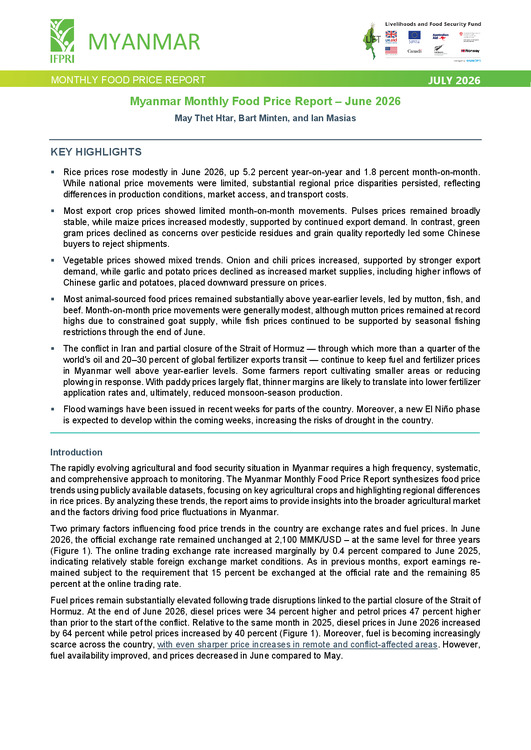
Rice prices rose modestly in June 2026, up 5.2 percent year-on-year and 1.8 percent month-on-month. While national price movements were limited, substantial regional price disparities persisted, reflecting differences in production conditions, market access, and transport costs.
Most export crop prices showed limited month-on-month movements. Pulses prices remained broadly stable, while maize prices increased modestly, supported by continued export demand. In contrast, green gram prices declined as concerns over pesticide residues and grain quality reportedly led some Chinese buyers to reject shipments.
Vegetable prices showed mixed trends. Onion and chili prices increased, supported by stronger export demand, while garlic and potato prices declined as increased market supplies, including higher inflows of Chinese garlic and potatoes, placed downward pressure on prices.
Most animal-sourced food prices remained substantially above year-earlier levels, led by mutton, fish, and beef. Month-on-month price movements were generally modest, although mutton prices remained at record highs due to constrained goat supply, while fish prices continued to be supported by seasonal fishing restrictions through the end of June.
The conflict in Iran and partial closure of the Strait of Hormuz — through which more than a quarter of the world’s oil and 20–30 percent of global fertilizer exports transit — continue to keep fuel and fertilizer prices in Myanmar well above year-earlier levels. Some farmers report cultivating smaller areas or reducing plowing in response. With paddy prices largely flat, thinner margins are likely to translate into lower fertilizer application rates and, ultimately, reduced monsoon-season production.
Flood warnings have been issued in recent weeks for parts of the country. Moreover, a new El Niño phase is expected to develop within the coming weeks, increasing the risks of drought in the country.
Authors
Htar, May Thet; Minten, Bart; Masias, Ian
Citation
Htar, May Thet; Minten, Bart; and Masias, Ian. 2026. Myanmar monthly food price report – June 2026. Myanmar Monthly Food Price Report June 2026. Washington, DC: International Food Policy Research Institute. https://hdl.handle.net/10568/183868
Keywords
Asia; South-eastern Asia; Food Prices; Food Security; Crops; Agricultural Marketing; Rice