





Efforts to promote the adoption of new and improved agricultural technologies often focus on increasing yields. This is for a good reason. There is a large and persistent gap in agricultural productivity between low-income countries, especially in Africa, and the rest of the world. For example, according to FAO Stat, maize yields in the United States reached 11.1 metric tons per hectare in 2019, while in countries within Africa, maize yields were only roughly 2.2 metric tons per hectare. Improving agricultural productivity helps reduce poverty and promote food security for local populations. But beyond such direct benefits, new and improved agricultural technologies can also generate benefits for nature and the local environment.
Two new studies demonstrate this “double dividend” enjoyed by nature from improving agricultural technologies and productivity—a key element of sustainable intensification. The studies evaluated the effects of an intervention in rice farming communities in Kwara State in western Nigeria, finding that the use of an improved form of urea fertilizer helped farmers eventually boost productivity and benefited the environment in two important ways.
The intervention: Urea super granules in Kwara State, Nigeria
One of Nigeria’s largest states in terms of land area, Kwara is the country’s least densely populated, with agricultural production occurring amid wooded savanna and forested ecosystems. The state’s northwest border includes part of Kainji National Park and follows the Niger River, which flows directly into Lake Jeba.
The intervention promoted the adoption of improved urea fertilizer. Urea provides nitrogen to plants, which is critical for growth but often leads to environmental damage if it is not properly applied when nitrogen runs off into surrounding water sources, is leached into groundwater, or is released into the atmosphere as a potent greenhouse gas.
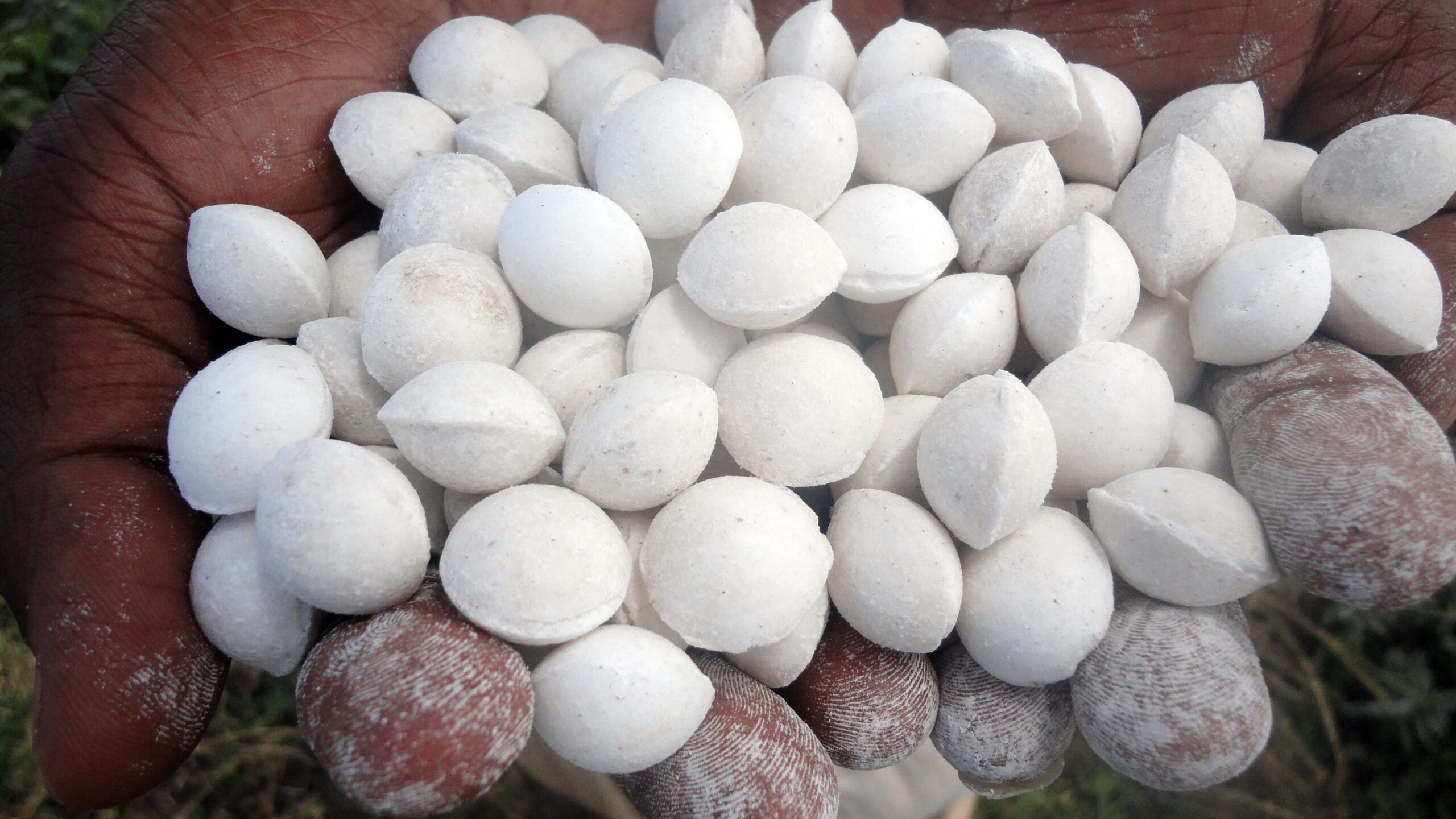
Shortly before the intervention, a private agricultural input supply company developed a technique for producing urea super granules (USG), which offers several advantages over conventional prilled urea fertilizer.
Prilled urea is broadcast over the soil surface. This way, only a fraction of applied nitrogen ultimately reaches crops, with the rest running off the plot. That runoff leads to two main impacts. First, leaching can occur in warm and moist environments when nitrogen dissolves in water, polluting nearby water sources and leading to the proliferation of harmful algae blooms. Second, nitrogen fertilizers on the soil surface can quickly dissipate into the atmosphere.
USG are larger than prilled urea, and collectively have less surface area, reducing volatilization. They are applied using the urea deep placement method, directly into the soil next to the root of the plant and beyond the roots of weeds. This increases nitrogen delivery to plants while reducing nitrogen runoff and associated environmental damage.
In partnership with the company, we randomly assigned 30 villages (of 45 villages included in the study) to receive a standard marketing package including an information campaign, demonstration plots, and a ready supply of USG available through local retailers. Additionally, we distributed vouchers for a 25% discount on the purchase of USG to a randomly selected set of households within treatment villages. On average, we included 30 households in our study sample within treatment villages. This intervention aimed to address both information and liquidity constraints on the adoption of this new and improved agricultural technology.
First study: Reduced nitrogen loss
A paper published in the Journal of Environmental Economics and Management—by Saweda Liverpool-Tasie of Michigan State University, Andrew Dillon of Northwestern University, Jeff Bloem of IFPRI, and Serge Adjognon of Amazon—shows that this intervention effectively promoted the adoption of USG fertilizer and the dis-adoption of prilled urea (the conventional type of urea fertilizer) and its associated environmental damages.
Rice farmers in treatment villages increased their use of USG by 28 percentage points and reduced their use of prilled urea by 19 percentage points.
This substitution, including adoption of the deep placement application method, yielded a significant environmental benefit. Based on the rates of adoption of USG and dis-adoption of prilled urea, we calculated that nitrogen losses were about 50% lower in treatment villages than in control villages (Figure 1).
Figure 1

It should be noted that the use of USG with the deep placement application method is relatively labor-intensive compared to broadcasting prilled urea. Recommended practices for the optimal benefit of USG include planting on leveled fields, the consistent availability of water, rigid application timing, and the correct depth of USG application in the soil. Of note, irrigation can be a high and prohibitive cost for rice farmers in Nigeria, and sub-optimal crop management practices (e.g., soil preparation, seed quality, timely weeding, etc.) can limit the yield gains associated with the use of USG.
Second study: Intensification and reduced deforestation
A follow-up paper published in the Journal of Development Economics—by IFPRI’s Jeff Bloem and Clark Lundberg of San Diego State University—studied the effect this same intervention had on rates of deforestation within areas around treatment villages relative to those around control villages.
The potential effects of adopting improved agricultural technologies on deforestation are theoretically ambiguous. On the one hand, using these technologies can increase the relative value of agricultural land, inducing farmers to expand cultivation into forested areas. On the other hand, it could lead to intensification of production on existing farmland, easing land conversion pressures on nearby forests.
Figure 2

We found evidence of an intensification response by the rice farmers. Specifically, in land areas with relatively sparse pre-intervention tree cover (below 20%), exposure to the intervention increased tree canopy loss, while in areas with denser pre-intervention forest cover, the intervention reduced tree canopy loss, i.e., deforestation (Figure 2). These results suggest that farmers exposed to the experimental intervention promoting the use of USG intensified their agricultural production on existing cropland. By contrast, farmers not exposed to this intervention were more likely to expand their cultivation into adjacent forested areas.
We also used our method of linking earth observation data with intervention survey data to estimate effects on agricultural productivity, while incorporating possible diffusion of the technology across both geography and crops. Consistent with the intensification response, we found evidence of increased agricultural productivity in areas with relatively sparse pre-intervention tree cover.
These productivity results demonstrate that the benefits enjoyed by nature due to the promotion of USG do not require smallholder farmers to accept reductions in agricultural productivity. Instead, adoption of this technology generates both public and private benefits.
Conclusion
These two new studies highlight the potential “double dividend” for nature due to the promotion of new and improved agricultural technology and improved agricultural productivity. Clearly, adopting new agricultural technologies has important direct benefits to farmers. But researchers and policymakers must not forget that such interventions can also have substantial public benefits. That implies that we cannot solely rely on private actors to supply (and to use) these new and improved technologies. Rather, public support of agricultural research and development is essential in technology rollouts to systematically identify and realize benefits such as protecting the environment.
Jeffrey R. Bloem is a Research Fellow with IFPRI’s Markets, Trade, and Institutions Unit. Opinions are the author’s.
This work was supported by the Gates Foundation (study 1) and the CGIAR Initiative on Rethinking Food Markets (study 2).
References:
Liverpool-Tasie, Lenis Saweda O.; Dillon, Andrew; Bloem, Jeffrey R.; and Adjognon, Guigonan Serge. 2025. Private sector promotion of agricultural technologies: Experimental evidence from Nigeria. Journal of Environmental Economics and Management 133 (September 2025): 103201. https://doi.org/10.1016/j.jeem.2025.103201
Bloem, Jeffrey R.; and Lundberg, Clark. 2026. Agricultural technology adoption and deforestation: Evidence from a randomized control trial. Journal of Development Economics 178 (January 2026): 103600. https://doi.org/10.1016/j.jdeveco.2025.103600