






Natural language processing (NLP), a subfield of artificial intelligence that uses computational techniques to interpret, analyze, and generate human language, encompasses a range of tasks and techniques. These include the large language models (LLMs) that power chatbots and other types of systems, as well as specific approaches (some employed by LLMs), including information extraction and text mining.
NLP offers powerful opportunities to support the UN Sustainable Development Goals (SDGs)—including SDG2 (Zero Hunger). In the wake of the COVID-19 pandemic, the Russia-Ukraine war, mounting climate change impacts, and other crises in the 2020s, global food security has suffered and progress towards meeting SDG2 has lagged. Urgent action, backed by evidence-based policymaking, is needed to reverse this trend.
NLP applications in the policy cycle can help to address food insecurity and meet SDG2. In recent decades, there has been a significant increase in the volume of unstructured data generated from diverse sources, including social media, research publications, and news articles. Due to its complexity and volume, traditional methods of data analysis are often insufficient to extract actionable insights for evidence-based policymaking; NLP tools can greatly expand the capacity to gain insights from such data, thereby contributing to the policy process.
Yet, while many NLP applications have been documented across several SDG domains, its potential contribution to SDG 2 has not yet been systematically assessed. Our recent scoping review, “The Role of Language Technology and Artificial Intelligence in Food Security Policymaking,” addresses this knowledge gap, finding an array of promising approaches, most still in the early stages of research and development.
Six ways NLP can strengthen food policy
We reviewed a mix of academic and grey literature studies (60 in total) that apply an NLP approach for a potential policy application in the food security domain. We identify six key application areas where NLP can strengthen food policy:
- Early warning systems: NLP can enhance existing models that predict food insecurity or food price inflation by incorporating unstructured data from timely sources such as news articles and social media. It can also provide contextual grounding to better interpret predictions of food security status.
- Understanding public discourses: By analyzing online discussions, NLP helps policymakers gauge how citizens in diverse locations and contexts perceive policies and behavioral interventions, from dietary guidelines to sustainable food practices (like plant-based diets or local food networks). These insights can inform more responsive and inclusive policy design and communication.
- Knowledge generation and management: NLP can be used to synthesize and analyze policy and program documents (e.g., reports, evaluations, and national strategies), supporting evidence-based policymaking and program evaluation.
- Understanding dietary habits: Mining user-generated content such as social media posts can reveal trends in dietary behavior. These insights can guide nutrition programming, obesity-prevention strategies, and other public health initiatives.
- Food item classification: Food composition databases are essential for informing nutritional and dietary guidelines and for developing public health policies and strategies. However, these datasets can be messy and incomplete. NLP can help improve their consistency and reliability, for example, by categorizing food items and enriching records with information on nutritional value or processing level.
- Addressing data gaps: NLP can extract and structure information from unconventional sources, like text documents or social media, which is especially helpful in data-scarce contexts. This can, for instance, complement official statistics and provide timely insights during crises or disaster situations.
From research to reality: The role of authentic partnerships
Despite their potential, most of the NLP projects reviewed, and AI for social good projects in general, remain in early research and development stages, with limited real-world deployment: only 12% of studies examined had been deployed. Indeed, these efforts face several serious obstacles, including technical challenges such as poor data quality, data preprocessing and management issues, information and communications technology (ICT) infrastructure requirements, and the manual labor involved in data and model validation. There are non-technical challenges as well, including expectation management, trust, transparency, and explainability.
Limited stakeholder involvement is also a major barrier to deploying NLP tools and integrating them into the policy process. Most projects examined (73%) were conducted within academia, without explicit mentions of collaboration with societal partners. We argue that establishing authentic partnerships from the outset is essential to ensure stakeholder ownership and to align the work with their needs and values. Such collaboration enhances the relevance of research and facilitates the transition toward successful and sustainable implementation.
Figure 1
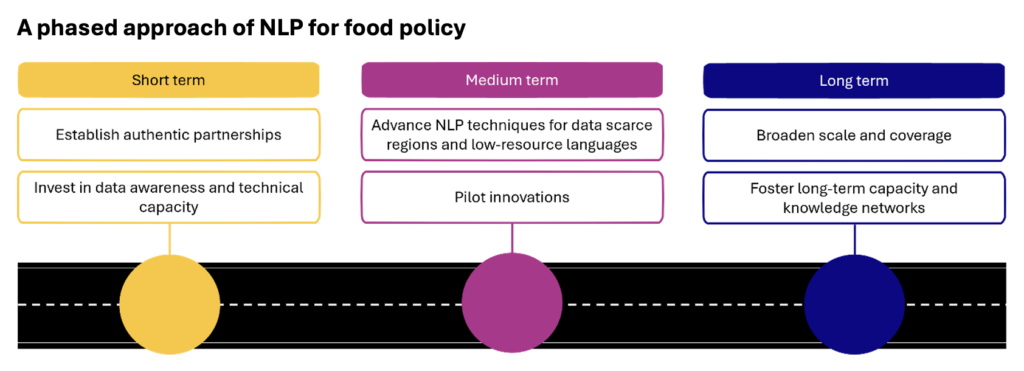
Our review proposes a phased approach to advance NLP for food policy from concept to practical application. The first phase focuses on laying strong foundations by building authentic partnerships between AI researchers, policymakers, and local experts from the outset. Guidelines for establishing successful collaborations on AI for social good projects include, for instance, aligning organizational incentives towards the common goal and establishing and maintaining trust. In parallel, investment in data awareness and technical capacity within policymaking institutions is essential to enhance data utilization and strengthen data-driven decision-making.
The second phase centers on leveling the playing field and piloting innovations. This involves research on addressing data scarcity and supporting low-resource languages. This is especially critical in the context of food insecurity, which often involves populations that are underrepresented in the global NLP market. Thus, existing NLP applications may not be available for certain languages, or performance may be variable. Simultaneously, innovative pilot projects can help uncover methodological, operational, and ethical challenges before scaling up.
The final phase emphasizes responsible scaling and long-term sustainability. This includes expanding successful projects across regions and contexts, and fostering communities of practice, training programs, and knowledge networks. Throughout all phases, ethical and responsible AI principles must guide development and implementation to ensure NLP applications in food policy are fair, inclusive, and accessible.
That said, we should remain mindful that AI, including NLP, is not a silver bullet. While it can help to transform previously untapped data into actionable insights for decision-making, deeper and more structural efforts on the political, economic, and social fronts are essential to truly advance progress toward ending hunger and achieving food security and improved nutrition for all.
Marieke Meeskeis a PhD Candidate at the Zero Hunger Lab of Tilburg University, Netherlands, which aims to contribute to global food and nutrition security through data science. This post is based on peer-reviewed research in collaboration with Frans Cruijssen (Tilburg University, Zero Hunger Lab), Chris van der Lee (Tilburg University, Department of Communication & Cognition) and Emiel Krahmer (Tilburg University, Department of Communication & Cognition). Opinions are the authors’.
Reference:
Meeske, M., Cruijssen, F., van der Lee, C. et al. The role of language technology and artificial intelligence in food security policymaking. Discov Sustain 7, 34 (2026). https://doi.org/10.1007/s43621-025-02209-2