





Generative artificial intelligence (gen AI) applications—which produce text, images, code, and other content based on surfacing patterns in vast datasets—promise many benefits for agrifood systems (e.g., reaching more people at less cost, availability around the clock, real-time data).
One promising area for gen AI is agricultural extension services. Gen AI tools such as chatbots accessed via tablets, computers, and smartphones can help services to reach more people with information tailored to their specific circumstances, drawing on real-time data. This form of automated “last mile” delivery offers a way to advise farmers spread out across rural areas at a fraction of the cost of deploying field staff, if these farmers can access and use digital tools.
Decades of research in both traditional and digital extension services show that effective advisory support depends on local knowledge networks—including lead farmers, participatory groups, and field schools—to build trust and embed knowledge in place. Yet many recent advisories using gen AI in extension services appear disconnected from this important insight, offering generic advice.
Trust, in particular, remains a key barrier to adoption of gen AI in extension. This raises important questions: Can AI take on the role of a virtual extension agent? If AI tools are to reliably offer personalized, context-specific farming advice and answer a wide range of questions, they should incorporate what we know about what person-to-person extension gets right.
Currently, extension-related gen AI is being used at a limited scale in certain projects, geographical areas, and organizations. For instance, Digital Green uses an AI-powered assistant called FarmerChat to deliver free, real-time, climate-smart, and locally relevant advice in farmers’ own languages through text, video, and voice. Deployed in Brazil, India, Kenya, and Nigeria, FarmerChat engaged over 165,000 farmers and answered over 200 million queries, 70% in local languages, between April 2024 and March 2025.
As part of the Agricultural Large Language Model (AgriLLM) project, a collaboration of leading global organizations to harness AI’s potential to drive meaningful change in agriculture at scale, IFPRI researchers are investigating the best ways to train virtual conversational AI extension agents for use in low- and middle-income countries.
In March 2025, we carried out focus group discussions with about 30 field extension officers from seven countries representing Africa’s key agricultural extension systems, gathered for an international conference in Malawi, to support this project. The discussions explored how participants do their jobs and interact with farmers, and highlighted the problems extension agents face—helping to identify measures to improve AI-supported extension tools.
What traditional extension gets wrong
Human resources are the costliest component in extension budgets. While the recommended ratio of extension staff to farmers is about 1:500, in many countries it is more like 1:5,000. With budgets going mainly to staff salaries, little funding remains for operational activities like field visits or training. Thus, it is not surprising that in many countries, extension services face serious, longstanding limitations, including low pay and limited materials, in addition to lack of staff. This results in limited coverage of remote and hard-to-reach areas, few visits, limited time per farmer or per visit, and more generic advice not tailored to a farmer’s specific needs.
Moreover, while extension staff are trained in technical areas before starting their jobs, they receive limited or no continuing education and insufficient training in “soft” skills such as gender sensitivity or group dynamics.
In addition, the presence of many different extension providers—radio shows, agrochemical companies, nongovernmental organizations, public agencies, and village agents—can lead to uncoordinated outreach and conflicting messaging. Less visible are the power asymmetries within extension and the dynamics between the so-called experts and laypersons that can also affect how and what information is delivered. Extension clients—that is, farmers—are rarely involved in evaluating extension programs. Farmers may also face the risk of exploitation (e.g., when advice is tied to sales or input promotion) or services are linked to voting. Finally, as a field traditionally dominated by men, agricultural extension can systemically exclude women, youth, and other socially marginalized groups.
What traditional extension gets right
Effective extension engages with farmers on their specific needs that are shaped by household, agricultural production system, and external factors, such as input and output prices and distance to markets. Extension thrives on human strengths, including:
- Building trust through face-to-face relationships
- Responding to context, nuance, and emotion
- Adapting advice based on lived experience
- Listening and learning from farmers, not just instructing (and using that advice to inform practice)
- Offering accountability—farmers can ask follow-up questions or raise concerns
In practice, farmers already exchange a lot of extension advice and information in digital spaces such as Facebook or WhatsApp groups, where knowledge circulating through back-and-forth conversation is socially validated (although farmers remain anonymous on some of these digital platforms). Still, these spaces function not just as channels for information but as sites of collective reasoning and shared accountability. In contrast, many current gen AI tools are designed around one-way expert advice, often lacking the dialogic, adaptive, and situated nature of peer exchange. Without the ability to support conversational learning or reflect the full set of farmers’ diverse realities, using AI risks bypassing the very systems where meaningful knowledge-sharing already happens.
Bringing together traditional and AI-supported extension
To avoid losing the benefits of traditional extension while integrating the advantages of AI tools, we suggest a hybrid approach for farmers with the resources to acquire digital tools and access to a power source.
Researchers explored the potential of this approach during the focus group discussions, examining how participating extension officers diagnose farmer needs in situations where they have limited contextual knowledge and the need for trust is high. The goal of the discussions was to understand their conversational strategies, reasoning processes, and real-time adjustments in probing questions to find out additional contextual information.
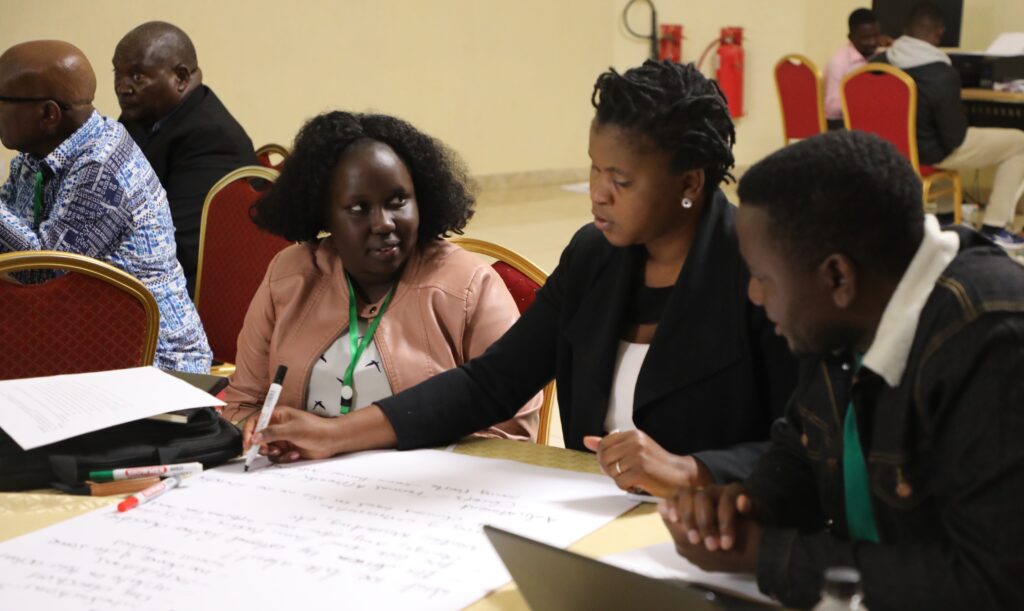
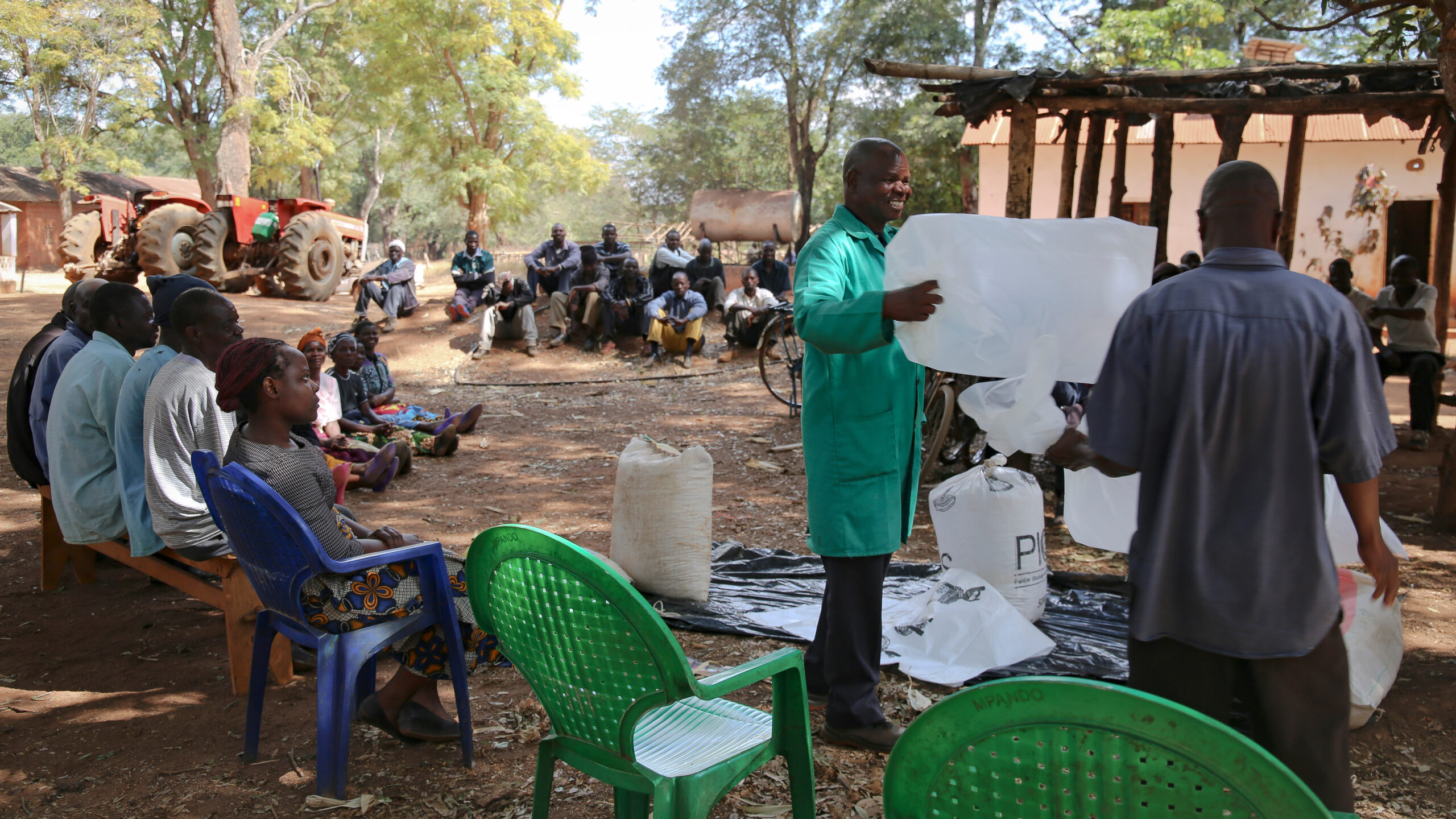
African extension officers participate in a focus group discussion intended to help develop AI tools.
Going forward, these insights will help us to assess the feasibility of AI extension conversations, offering insights on how a virtual agent might best respond to questions from a farmer about the broad range of issues they face, without displaying bias against, or systematically excluding, particular groups—a common problem in gen AI applications. These discussions provided several insights:
- Building trust. Trust is at the heart of extension-farmer interaction and comes in part from building rapport (see next bullet). Trust is also built through a good understanding of the farmer’s situation and background.
- Personal and social connection. Extension typically includes “small talk,” greetings, and discussion of social issues. Extension officers may drink a cup of tea, offer a prayer, or dance with farmers during meetings.
- Fostering a natural conversational structure. Extension officers use practices of questioning, listening, and adaptive reasoning to help get to the bottom of farmers’ queries. This helps them deal with ambiguity, make decisions based on limited information, and surface values and challenges beyond what is verbally communicated.
- Adapting levels of formality. Officers adjust their conversational content and formality—even dress—depending on who they are interacting with. They may use more formal language with older people or leaders and less formal approaches with younger farmers. And women farmers are often approached when with their spouses or by women extension agents.
- Bias recognition and mitigation. An AI system must be trained to actively avoid expressing biases that may be historically present in extension practices—a risk given models would be trained on existing extension texts and related data—and offer equitable and inclusive advice that does not reinforce existing inequalities among marginalized groups.
By incorporating these insights, AI systems can be trained to have more authentic, effective conversations with farmers and to obtain better information on their needs, plans, and long-term aspirations.
However, as our focus group data suggests, there is much to extension work that an AI app cannot do. Notably, it cannot have full emotional intelligence (EI). It may be able to detect emotional cues in a user’s language and to mimic an emotional response in its answers. But AI models are computer systems that generate appropriate responses to prompts. They have no emotions or subjective experience. Thus, they cannot “assimilate emotion in thought, understand and reason with emotion, and regulate emotion in the self and others,” which are essential components of EI.
This is one reason that while AI can be useful in extension services, it cannot fully replace humans. If used right, AI apps can support the extension-farmer relationship, with the potential to vastly increase timely and tailored information and reach. But extension is not just about providing information; it is about exchanging information, fostering empowerment, offering hands-on advice, providing in-person support services, and brokering linkages between farmers and other food system actors.
Conclusion
Grounding AI in real-world extension practices is essential to ensure that farmers will benefit from its dissemination. The large language models that underlie gen AI apps must be better trained in human interaction, recognizing and mitigating biases inherited from traditional extension services. Program developers and users must also take proactive measures to ensure inclusive, equitable interactions tailored to different socioeconomic conditions of farmers, and not just different biophysical conditions of the farm.
Kristin Davis is a Senior Research Fellow with IFPRI’s Natural Resources and Resilience (NRR) Unit; Eliot Jones-Garcia is an NRR Senior Research Analyst; Niyati Singaraju is a Postdoctoral Fellow in Gender Research, International Rice Research Institute/Gender and Inclusion Focal Point, CGIAR Gender + AI Accelerator & Digital Transformation Initiative. Opinions are the authors’.