




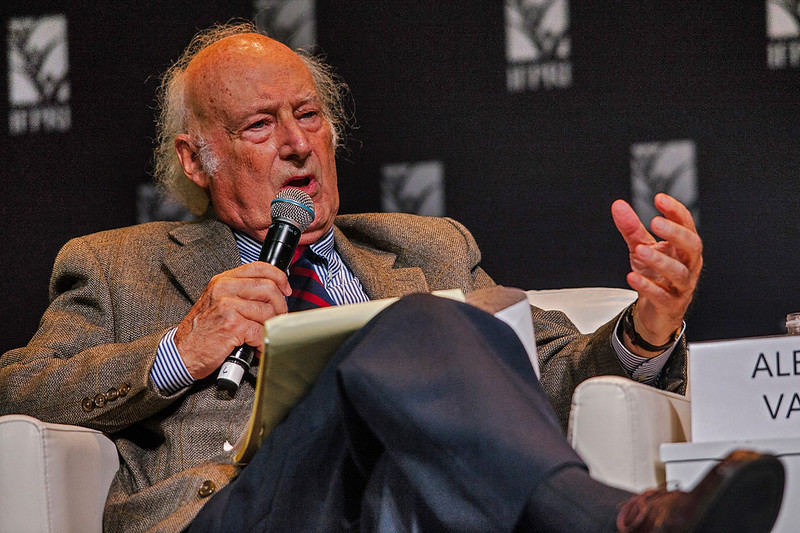
It is with deep sadness that we share the news of the passing of Alberto Valdés, an accomplished agricultural economist and a long-standing colleague and friend to many of us at IFPRI. Alberto joined IFPRI in 1976, just one year after the institute was founded, and served as a Program Director of the Food Trade and Food Security Program until 1989.
Dr. Valdés, who earned an agricultural engineering degree from the Pontifical Catholic University of Chile (UC), a master’s degree in economics from the University of Chicago, and a Ph.D. in Economics from The London School of Economics and Political Science (LSE), devoted his career to advancing research and educating future generations. He founded and directed UC’s Department of Agricultural Economics and created its first-ever Master of Science program in Agricultural Economics. He played a hugely important role in building one of Latin America’s leading centers for agricultural economics.
While at IFPRI, Alberto teamed with Anne Krueger and Maurice Schiff of the World Bank for work on linkages between industrial trade policy, real exchange rates, and price incentives for agriculture. This highly influential study of eighteen developing countries was later published in a five-volume set on “The Political Economy of Agricultural Pricing Policy” in 1991 and 1992. Under his leadership, IFPRI also published a series of research reports on the effects of trade and exchange rate policies on agriculture in various countries including Colombia, Pakistan, the Philippines, Nigeria, and Democratic Republic of the Congo (then known as Zaire).
After completing his term at IFPRI and returning to Chile as a Research Associate and later Professor Emeritus at UC, Alberto continued collaboration with IFPRI and CGIAR researchers in many honorary roles over the years. This included serving on the Advisory Panel of the IFPRI-led CGIAR Research Program on Policies, Institutions, and Markets and contributing to major IFPRI initiatives. In 2007, together with William Foster, he authored “Economic Reform to Stimulate Growth and Reduce Poverty: The Latin American Experience,” which was published as a 2020 Focus Brief on the World’s Poor and Hungry People under the 2020 Vision Initiative. In IFPRI’s 40th anniversary series, he wrote a retrospective on the institute’s research on agricultural policy distortions, reflecting on work he had led during his years there.
Alberto’s contributions to IFPRI’s mission and research are immense and range from trade, economic, and agricultural policy analysis to a strong commitment to supporting smallholders and reducing poverty. His expertise had a truly global reach, with important country analyses carried out across numerous low- and middle-income countries.
We offer our deepest condolences to his family, colleagues, and friends around the world.