





Reducing greenhouse gas emissions and climate change impacts is a core element of global agrifood system transformation. Yet, while it represents an important opportunity for capital markets and investors, climate finance focused on agrifood systems has thus far been limited. In 2022, $95 billion of global climate finance funding was dedicated to agrifood industries and practices, with 22% coming from private sources. This represents only 7% of total climate finance and merely 8% of the estimated amount needed by agrifood systems to support transformation and meet annual global climate goals until 2030.
The underinvestment can be explained by two characteristics of the agrifood sector: scale and fragmentation. To achieve broad, systemic change, hundreds of millions of varied production units must be financed—among them the smallholder farmers in low- and middle-income countries. This is a monumental task requiring much greater capital flows.
An additional challenge is the complexity of measurement. The multiplicity and context-specificity of climate transition levers make it difficult to assess the genuine impact of investments.
These obstacles can be overcome. A key tool in those efforts is consistent standards that align diverse local financing needs with the requirements of lenders and international climate goals. Widespread adoption of clearer, standardized guidance is essential to give the financial sector confidence in defining and tracking a credible transition path.
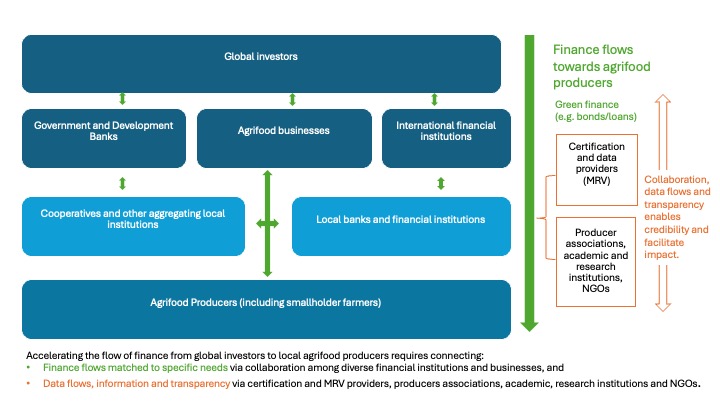
The guidance provided by the Climate Bonds Initiative (Climate Bonds) helps to place those local needs in a harmonized sustainable finance framework that is legible and credible to international investors (Figure 1). Climate Bonds provides science-based, credible guidance on measures that mitigate climate emissions, enhance resilience, and protect economic returns. In this post, we outline the challenges and opportunities of climate finance in agrifood systems and the role of standardized approaches.
Figure 1
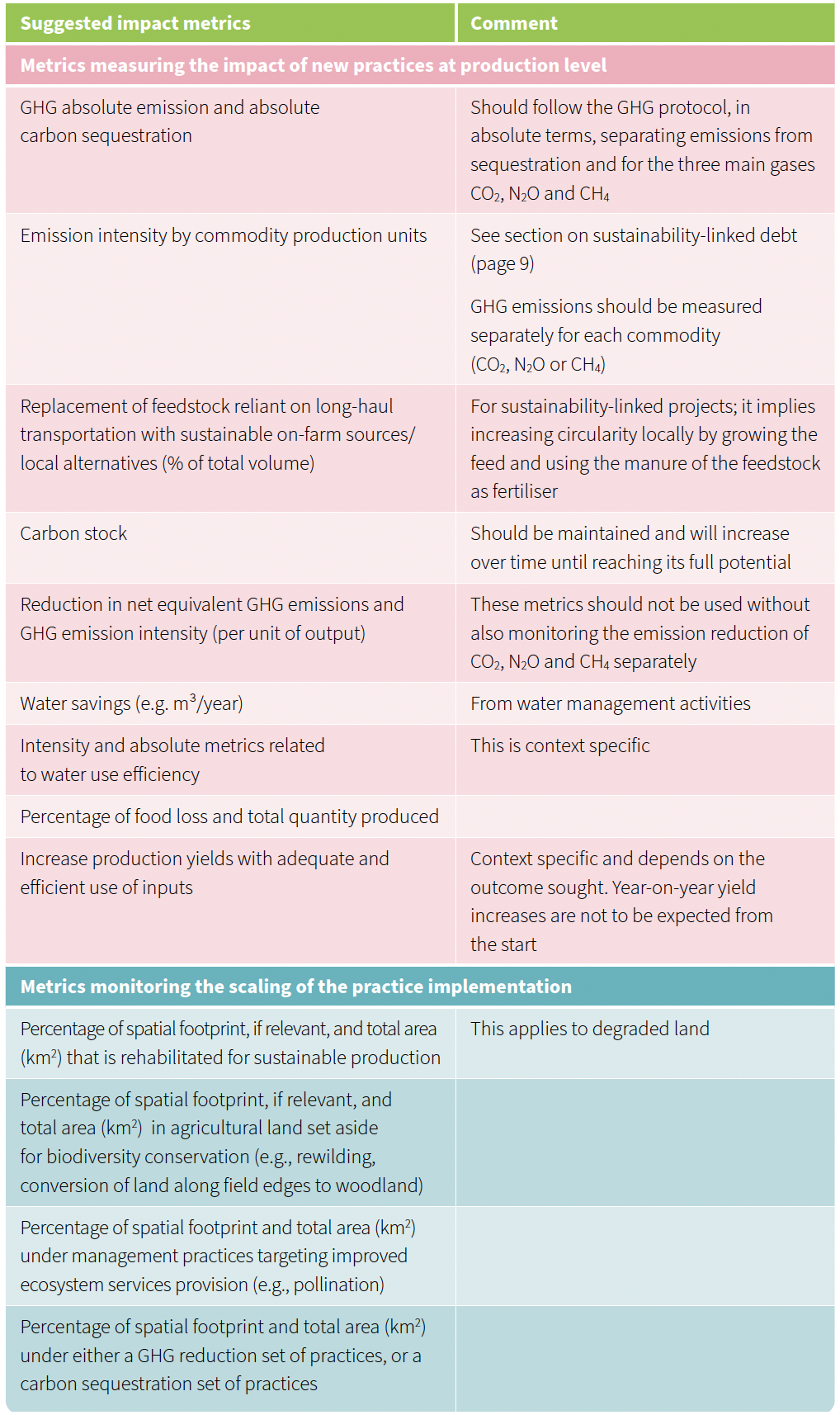
Metrics and KPIs that can be used to track impact of climate measures in agriculture production
Tailoring finance to context: from commercial farms to smallholders
Green, social, sustainability, and sustainability-linked (GSS+) bonds offer an effective route to fund large-scale sustainability initiatives across the food value chain. These instruments have consistently demonstrated the ability to deliver competitive pricing and heightened investor interest compared to conventional (vanilla) bonds. Evidence suggests that green bonds are priced tighter (lower interest rates) and oversubscribed (higher demand) compared to traditional debt. Crucially, the financial system champions sustainable debt because it provides a tangible, foundational mechanism upon which banks and institutions can structure their own corporate commitment to net-zero transitions.
Traditional green capital flows have favored sectors like renewable energy and electric vehicles; the agrifood system has lagged. For example, in 2022, agrifood systems received three and five times less finance than transport and energy systems, respectively. The increasing appearance of agrifood investments in green finance frameworks and taxonomies is encouraging and supports the growing community of dedicated green and sustainability investors to construct well-diversified portfolios.
A central issue in agrifood climate finance is the gulf between the needs in high- vs. low- and middle-income countries. For example, a large-scale mechanized dairy farm in Ireland, likely part of an investment portfolio, might require capital to modernize operations and reduce methane emissions and nitrogen runoff, to align with national and/or European Union regulations and secure a price premium for low-emissions milk. Meanwhile, a smallholder rice farmer in India might face low productivity, high energy costs for irrigation, and narrow margins that barely cover production costs.
While a typical climate finance approach such as a green bond focused on methane mitigation might be suitable to fund the large-scale operation, it seems inappropriate for an individual smallholder. Yet, finance on favorable terms can be structured in innovative ways to reach the smallholder, supporting increased productivity and profitability while simultaneously advancing climate mitigation and adaptation.
For instance, alternate wetting and drying (AWD) in rice cultivation is a technical measure that reduces methane emissions. It is also a direct pathway to increased productivity and resilience, benefiting farmers’ livelihoods and promoting rural development. Its implementation on a small rice farm can be financed by a green loan from a local cooperative bank with a methane-abatement credit line. To make such loans available to local farmers, the bank itself can borrow via an intermediary green financial instrument issued by an international development bank. This could be in the form of a green bond earmarked for specific climate measures or a sustainability-linked debt instrument (a bond or a loan) with beneficial terms linked to the farm’s transition plan. These instruments can specifically target methane emissions and other climate mitigation and adaptation measures.
This structure allows the small-scale farmer, traditionally disconnected from global capital markets, to access sustainable debt finance via the aggregation and collaboration of local institutions, banks, NGOs, and farmer representatives, effectively building the crucial bridge between international stakeholders and small-scale producers.
Figure 2
Simplified multi-stakeholder sustainable finance model for green capital flows
Defining credible finance: the role of standards and taxonomies
Key to these local finance efforts are national and regional sustainable finance taxonomies: government regulatory frameworks designed to steer sustainable financial decisions towards opportunities that transform economies while delivering co-benefits for climate, resilience, biodiversity, and farmer livelihoods. Governments are increasingly incorporating agrifood taxonomies into their sustainable finance regulations, most recently Brazil, Australia, New Zealand, Thailand, and Rwanda.
Climate Bonds is designed to operate within these taxonomies. The Climate Bonds Agrifood Transition Framework and Agrifood Criteria guidance (including standards for agriculture production, the food value chain, alternative proteins, and deforestation- and conversion-free sourcing) are specifically designed to navigate financial institutions, investors, and agrifood businesses through the complexities of financing a credible, just, and science-aligned transition.
The central goal is to ensure capital is directed toward initiatives that address climate mitigation and adaptation, protect nature, and support social equity. The Criteria establish a robust, yet practical, categorization of green activities aligned with IPCC recommendations, including key performance indicators (KPIs) and metrics (beyond standard GHG emissions), suitable for labeled use of proceeds debt and sustainability-linked instruments.1
For instance, Climate Bonds organizes eligible agrifood activities into categories so investors and verifiers can map investments into climate outcomes. Some of the principal categories includemeasures that reduce direct GHG emissions from farms (for example, improved nitrogen management, enteric methane mitigation, and on-farm energy efficiency); measures that sequester carbon in agricultural lands (like biochar and agroforestry); measures to adapt agriculture to climate impacts and build resilience, among others.
Examples of KPIs for agricultural production are included in Figure 2 (there are KPIs for the other groups of activities in each Criteria guidance – see references).
Pioneering examples of green finance vehicles
These cases illustrate how standards can enable real-world financial instruments:
Landshypotek Bank AB green bond
In October 2025, the Swedish Landshypotek Bank issued a SEK 6 billion ($500 million) bond under its newly enhanced green bond framework, which now explicitly includes sustainable agriculture alongside forestry. The proceeds are earmarked for a diverse range of climate-resilient activities, including precision farming (to optimize fertilizer use and reduce emissions), organic cultivation, alternative proteins, and biodiversity protection. Crucially, these eligible activities directly map to the Climate Bonds Criteria for Agriculture Production, helping to ensure that capital is directed towards credible, measurable climate solutions across the value chain.
PandanGreen green bond
To mobilize private climate finance at scale for vulnerable rural communities in Asia and the Pacific Islands, PandanGreen (Pandan) is a finance facility issuing a $150 million green bond, investment-grade rated and listed on the Luxembourg Green Exchange (LGX). This innovative structure provides inclusive financial institutions (IFIs) with long-term green loans. Utilizing their local networks, IFIs will then disburse green and sustainable financing directly to smallholder farmers and micro-businesses, with women the majority of the borrowers. By engaging with local governments and communities, Pandan ensures capital flows toward crucial climate solutions, enhancing resilience. The framework is aligned with Climate Bonds Agriculture Production Criteria and the issuer intends to seek certification under these criteria.
Lagos State green bond
In Nigeria, the Lagos State Government’s pioneering NGN 14.82 billion ($10.2 million) green bond, issued in December 2025, is the first sub-national bond from Africa to be certified by the Climate Bonds Initiative. The certification confirms that the bond’s rigorous project selection process and its proceeds, earmarked for solar energy, flood management infrastructure, and agriculture projects, fully meet international green bond standards.
Accelerating an inclusive agrifood transition
The transition to climate-resilient and low-carbon agrifood systems is underway. The strategic imperative now is to accelerate this momentum and ensure capital flows efficiently, transparently, and crucially, inclusively across the entire value chain. The initial groundwork is established, involving a dynamic ecosystem of stakeholders, from innovative start-ups and fintech platforms to global development banks and local financial institutions. But more work needs to be done to expand climate finance for agrifood systems.
Standards and transparency underpin growth
To scale this transition, the financial sector requires clarity and scientific rigor. Standardized frameworks, including the Climate Bonds Criteria for Agrifood, are essential in this area. However, greater transparency is also needed in the loan market. While downstream actors, like traders, manufacturers, and retailers, increasingly utilize climate transition finance via bilateral bank loans, most of this market remains untracked. To move capital at the speed and scale required, greater visibility and consistent disclosure are essential to build trust and allow the entire financial system to benchmark progress toward net-zero targets.
The imperative of farm-level inclusion
For the transition to be effective, finance must reach the hundreds of millions of smallholder farmers who are the ultimate implementers of climate solutions. Sustainable finance instruments must be structured to have resilient socioeconomic and environmental impacts, lifting farmers out of poverty rather than driving them deeper into debt. This requires a shift toward financial support that rewards farmers for the nature-based solutions they implement, such as soil recovery and biodiversity protection.
Achieving this requires building a bridge between international capital and local producers. Local institutions, like banks, NGOs, public services, and farmer cooperatives, are the linchpin of this inclusion model. They possess the local expertise needed to understand farmers’ socioeconomic needs and identify the precise financing required. A report discussing options for bridging capital towards smallholder farmers will be published in early 2026 by FAO and Climate Bonds.
The path to systemic collaboration and innovation
Scaling up impactful transition at the production level demands a multi-stakeholder approach. This requires collaboration across the entire value chain to avoid carbon leakage, share risk, and reduce costs. Sustainability-linked or green co-financing must span the value chain to incentivize collective action. For example, the NGO Root Capital, acting as technical assistant and lender, uses a tripartite agreement with farmer cooperatives and global buyers, advancing working capital to the cooperatives, secured by purchase contracts with buyers. Under this model, repayment flows directly from the buyer to banks or social investors upon harvest, minimizing risk for all parties.
Furthermore, the integrity of these financial instruments hinges on material KPIs. Current GHG emissions reporting for value chains has limitations; it should be expanded to capture the complexity of the agrifood sector, including the urgent challenge of methane reduction in the near term. The transition is about supporting strong collaboration among all stakeholders, both small and large, and across jurisdictions to ensure a system-wide shift.
The successful climate transition of the global agrifood system depends on adopting harmonized standards, scaling finance through local intermediaries to ensure inclusion, and fostering innovative, multi-stakeholder collaboration. By aligning global capital markets with local implementation realities, the financial sector can play its essential role in delivering a sustainable, resilient, and poverty-alleviating future.
Reyes Tirado is an Agri-Food Senior Manager with the Climate Bonds Initiative, leading the development of Agri-Food Standards. Opinions are the author’s.
1. Climate Bonds Agrifood Criteria:
•Agriculture Production: https://www.climatebonds.net/our-expertise/climate-bonds-standard-and-certification-scheme/sector-criteria/agriculture-production
•Food Value Chain: https://www.climatebonds.net/our-expertise/climate-bonds-standard-and-certification-scheme/sector-criteria/food-value-chain
•Alternative Proteins: https://www.climatebonds.net/our-expertise/climate-bonds-standard-and-certification-scheme/sector-criteria/alternative-proteins
•Agrifood Deforestation and Conversion-Free Sourcing: https://www.climatebonds.net/our-expertise/climate-bonds-standard-and-certification-scheme/sector-criteria/deforestation-conversion-free-sourcing
•Agrifood Transition Plan Assessment Framework: https://www.climatebonds.net/data-insights/publications/agrifood-transition-plan-assessment-framework