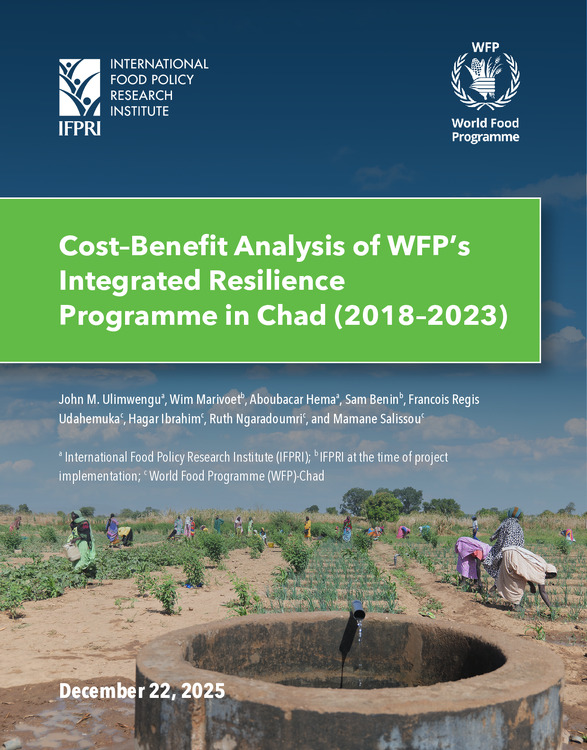
Cost–benefit analysis of WFP’s integrated resilience programme in Chad (2018–2023)
1. Integrated resilience programming (IRP) works. The IRP significantly improved household food security, with participating households recording an average 6.6 point increase in Food Consumption Scores (FCS) and reduced reliance on negative coping strategies, and increased resilience capacities, compared with nonparticipants, underscoring the value of multisectoral, layered interventions.
2. High economic returns are achievable in fragile contexts. Overall, the IRP delivered a benefitcost ratio (BCR) of 3.98, meaning every US$1 invested generated nearly US$4 in measurable benefits.
3. Nutrition interventions (treatment of acute malnutrition and blanket supplementary feeding) yield the strongest returns. Treatment of acute malnutrition and preventive nutrition support for women and children produced BCRs ranging from 6:1 to 9:1, validating global evidence on the cost-effectiveness of nutrition investments.
4. Knowledge-based and community-led interventions are transformative. Training and sensitization activities achieved the highest BCR (20:1) for resilience outcomes, highlighting the long-term payoffs of behavior change, empowerment, and knowledge transfer activities.
5. Cereal banks, particularly when combined with Food Assistance for Assets (FFA) through cash transfers, contributed to improved food security and resilience outcomes. The Cereal Bank + FFA Cash Transfers combination achieved balanced gains across key indicators (FCS +9.2, rCSI –3.4, RCS +10.4), highlighting its role in stabilizing seasonal food availability and access. However, despite these outcome improvements, the cost-effectiveness was modest, with BCRs ranging from 0.4 to 0.6—suggesting that while the intervention supports resilience, its financial return per dollar invested may be limited under current implementation models.
6. Bundled interventions outperform stand-alone ones. Layered approaches—particularly FFA Cash Transfers combined with School Feeding—produced the largest FCS gains (+5.7 points; BCR = 2.85), reinforcing WFP’s integrated “three-pronged approach” to resilience-building.
7. Short-term transfers remain essential but less cost-efficient. Lean season food and cash distributions provided vital relief but yielded lower long-term returns (BCR < 1), emphasizing the need to balance immediate humanitarian needs with investments in sustainability.
8. Strategic scaling of high-return interventions is crucial. Scaling nutrition, training, and cereal bank programs, while optimizing the design and sequencing of combined packages, could maximize impact per dollar spent and strengthen resilience dividends.
9. Resilience is a smart investment. The findings demonstrate that resilience programming is not only a humanitarian necessity but also a financially sound strategy—reducing long-term aid dependency, improving livelihoods, and fostering local self-reliance across fragile environments in Chad.
10. Short-term coping behavior responds more slowly than food security and resilience capacity outcomes, highlighting the need for sustained and sequenced support. While IRP interventions generated significant improvements in food consumption and resilience capacity, reductions in severe coping strategies were not observed in the short term. This underscores that behavioral change lags behind stabilization and capacity-building gains, and that resilience impacts should be assessed over longer horizons rather than through immediate reductions in negative coping alone.
Authors
Ulimwengu, John M.; Marivoet, Wim; Hema, Aboubacar; Benin, Samuel; Udahemuka, Francois Regis; Ibrahim, Hagar; Ngaradoumri, Ruth; Salissou, Mamane
Citation
Ulimwengu, John M.; Marivoet, Wim; Hema, Aboubacar; Benin, Samuel; Udahemuka, Francois Regis; et al. 2026. Cost–benefit analysis of WFP’s integrated resilience programme in Chad (2018–2023). Washington, DC: International Food Policy Research Institute. https://hdl.handle.net/10568/183180
Keywords
Africa; Middle Africa; Cost Benefit Analysis; Resilience; Livelihoods; Policies; Food Security