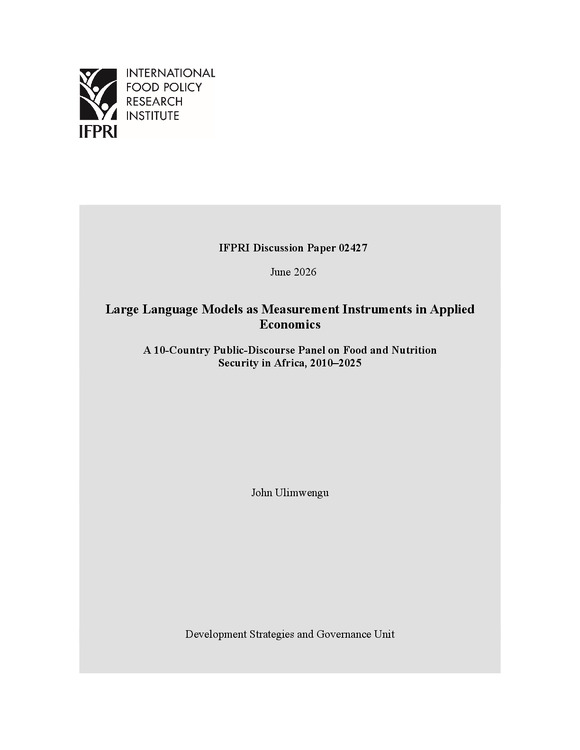
Large language models as measurement instruments in applied economics: A 10-country public-discourse panel on food and nutrition security in Africa, 2010–2025
Large language models (LLM) are increasingly used in applied economics to convert unstructured text into structured empirical measures. This paper examines their use as measurement instruments through a 10-country public-discourse panel on food and nutrition security in Africa from 2010 to 2025. The panel covers Somalia, South Sudan, Sudan, Democratic Republic of the Congo, Nigeria, Ethiopia, Kenya, Niger, Mali, and Burkina Faso, and contains 206 document-level records drawn from public early-warning, humanitarian, government, and technical sources. Each record is organized by country, date, source type, geography, benchmark type, benchmark phase where available, leakage risk, and a set of generated coding variables describing food-security dimension, text severity, narrative frame, tone, attribution, and evidence type. The paper treats LLM-coded outputs not as ground truth, but as generated variables subject to measurement error, source-selection bias, benchmark leakage, and uncertainty arising from incomplete or uneven source text. A conservative validation sample is limited to records with completed source-grounded excerpts, while an exploratory validation sample uses the broader metadata-supported corpus to examine phase coverage across benchmark categories. The results illustrate both the promise and the limits of LLM-assisted public-discourse measurement. Public documents can be transformed into transparent, auditable indicators of food-security stress, but their validity depends on document sampling, excerpt quality, benchmark independence, source diversity, and careful distinction between technical classifications and independent discourse. The paper contributes to the emerging literature on LLMs in economics by shifting attention from general productivity uses toward the practical conditions under which LLM-assisted text measurement can support applied research and policy analysis.
A reproducibility package accompanies the study and includes the coded data, validation samples, codebook, data dictionary, AI-use disclosure, leakage documentation, and scripts for reproducing the descriptive results.
Authors
Ulimwengu, John M.
Citation
Ulimwengu, John. 2026. Large language models as measurement instruments in applied economics: A 10-country public-discourse panel on food and nutrition security in Africa, 2010–2025. IFPRI Discussion Paper 2427. Washington, DC: International Food Policy Research Institute. https://hdl.handle.net/10568/183571
Country/Region
Somalia; Sudan; Nigeria; Ethiopia; Kenya; Niger; Mali; Burkina Faso
Keywords
South Sudan; Congo, Democratic Republic of; Africa; Sub-saharan Africa; Large Language Models; Food Security; Economics; Measurement
Access/Licence
Open Access