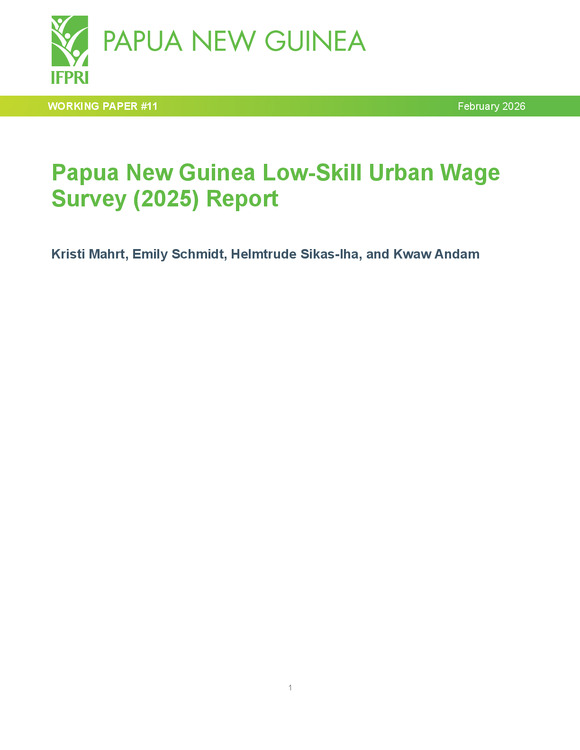
Papua New Guinea low-skill urban wage survey (2025) report
The Papua New Guinea Low-Skill Urban Wage Survey (PLUWS 2025) was designed to fill an information gap on low-skill wage employment and dietary purchasing power in select urban areas across Papua New Guinea. Telephone interviews were conducted from June 2nd through November 10th of 2025, that purposefully interviewed urban wage earners in low- or low-medium1 skill occupations in cities where the Fresh Produce Development Agency (FPDA) is also collecting monthly fresh food prices. In doing so, the survey collected information from individuals based in Port Moresby, Kokopo, Lae, Mount Hagen, Banz, Goroka, and Daru, with a focus of achieving a total survey sample that supported gender disaggregated analysis of wage rates, payment preferences, purchasing power, and household and individual characteristics of low- and medium-low skill wage earners. The International Food Policy Research Institute (IFPRI) partnered with a large PNG mobile phone company, Digicel, who randomly selected mobile phone clients from comprehensive lists of users geographically mapped to each of the urban cities identified for survey implementation. Two sampling strategies were implemented (described in more detail below) which resulted in a lower-bound (e.g., greater share of informal employment, less training or education, and lower wage rates) and upper-bound sample of low-wage earners. The final survey sample consists of 590 low- and medium-low skilled wage workers. Of which, approximately 2/3 of survey respondents are men (69% men and 31% women). The survey asked questions about individual characteristics (gender, age, marital status, education, etc.) of the respondent and the respondent’s household (assets, household composition, decision-making regarding earned incomes, etc.); characteristics of respondents’ employment; preferences for wage payment in money or in-kind; and the respondents’ diet quality. This report provides results tables and a discussion of the descriptive statistics by gender and sample approach (lower-bound and upper-bound) of low-skill wage workers.
Authors
Mahrt, Kristi; Schmidt, Emily; Sikas-Iha, Helmtrude; Andam, Kwaw S.
Citation
Mahrt, Kristi; Schmidt, Emily; and Sikas-Iha, Helmtrude; and Andam, Kwaw S. 2026. Papua New Guinea low-skill urban wage survey (2025) report. Papua New Guinea Food Policy Strengthening Working Paper 11. Washington, DC: International Food Policy Research Institute. https://hdl.handle.net/10568/181719
Country/Region
Papua New Guinea
Keywords
Melanesia; Oceania; Surveys; Labour; Households