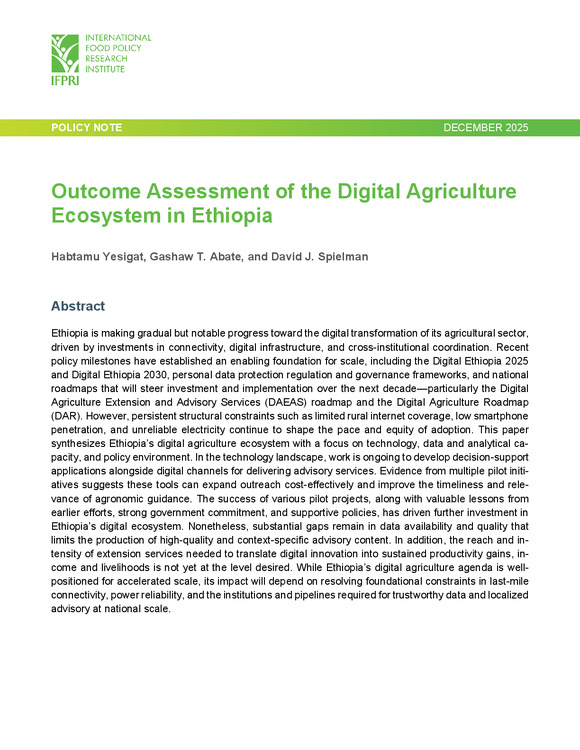
Outcome assessment of the digital agriculture ecosystem in Ethiopia
Ethiopia is making gradual but notable progress toward the digital transformation of its agricultural sector, driven by investments in connectivity, digital infrastructure, and cross-institutional coordination. Recent policy milestones have established an enabling foundation for scale, including the Digital Ethiopia 2025 and Digital Ethiopia 2030, personal data protection regulation and governance frameworks, and national roadmaps that will steer investment and implementation over the next decade—particularly the Digital Agriculture Extension and Advisory Services (DAEAS) roadmap and the Digital Agriculture Roadmap (DAR). However, persistent structural constraints such as limited rural internet coverage, low smartphone penetration, and unreliable electricity continue to shape the pace and equity of adoption. This paper synthesizes Ethiopia’s digital agriculture ecosystem with a focus on technology, data and analytical capacity, and policy environment. In the technology landscape, work is ongoing to develop decision-support applications alongside digital channels for delivering advisory services. Evidence from multiple pilot initiatives suggests these tools can expand outreach cost-effectively and improve the timeliness and relevance of agronomic guidance. The success of various pilot projects, along with valuable lessons from earlier efforts, strong government commitment, and supportive policies, has driven further investment in Ethiopia’s digital ecosystem. Nonetheless, substantial gaps remain in data availability and quality that limits the production of high-quality and context-specific advisory content. In addition, the reach and intensity of extension services needed to translate digital innovation into sustained productivity gains, income and livelihoods is not yet at the level desired. While Ethiopia’s digital agriculture agenda is well-positioned for accelerated scale, its impact will depend on resolving foundational constraints in last-mile connectivity, power reliability, and the institutions and pipelines required for trustworthy data and localized advisory at national scale.
Authors
Yesigat, Habtamu; Abate, Gashaw T.; Spielman, David J.
Citation
Yesigat, Habtamu; Abate, Gashaw T.; and Spielman, David J. 2026. Outcome assessment of the digital agriculture ecosystem in Ethiopia. IFPRI Policy Note. Washington, DC: International Food Policy Research Institute. https://hdl.handle.net/10568/180318
Keywords
Africa; Sub-saharan Africa; Eastern Africa; Assessment; Digital Agriculture; Data