Myanmar monthly food price report – July 2026
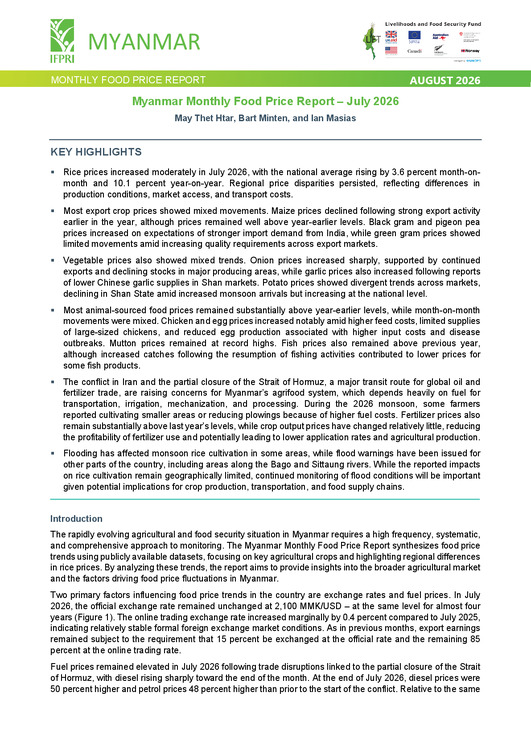
Rice prices increased moderately in July 2026, with the national average rising by 3.6 percent month-on-month and 10.1 percent year-on-year. Regional price disparities persisted, reflecting differences in production conditions, market access, and transport costs.
Most export crop prices showed mixed movements. Maize prices declined following strong export activity earlier in the year, although prices remained well above year-earlier levels. Black gram and pigeon pea prices increased on expectations of stronger import demand from India, while green gram prices showed limited movements amid increasing quality requirements across export markets.
Most export crop prices showed mixed movements. Maize prices declined following strong export activity earlier in the year, although prices remained well above year-earlier levels. Black gram and pigeon pea prices increased on expectations of stronger import demand from India, while green gram prices showed limited movements amid increasing quality requirements across export markets.
Most animal-sourced food prices remained substantially above year-earlier levels, while month-on-month movements were mixed. Chicken and egg prices increased notably amid higher feed costs, limited supplies of large-sized chickens, and reduced egg production associated with higher input costs and disease outbreaks. Mutton prices remained at record highs. Fish prices also remained above previous year, although increased catches following the resumption of fishing activities contributed to lower prices for some fish products.
The conflict in Iran and the partial closure of the Strait of Hormuz, a major transit route for global oil and fertilizer trade, are raising concerns for Myanmar’s agrifood system, which depends heavily on fuel for transportation, irrigation, mechanization, and processing. During the 2026 monsoon, some farmers reported cultivating smaller areas or reducing plowings because of higher fuel costs. Fertilizer prices also remain substantially above last year’s levels, while crop output prices have changed relatively little, reducing the profitability of fertilizer use and potentially leading to lower application rates and agricultural production.
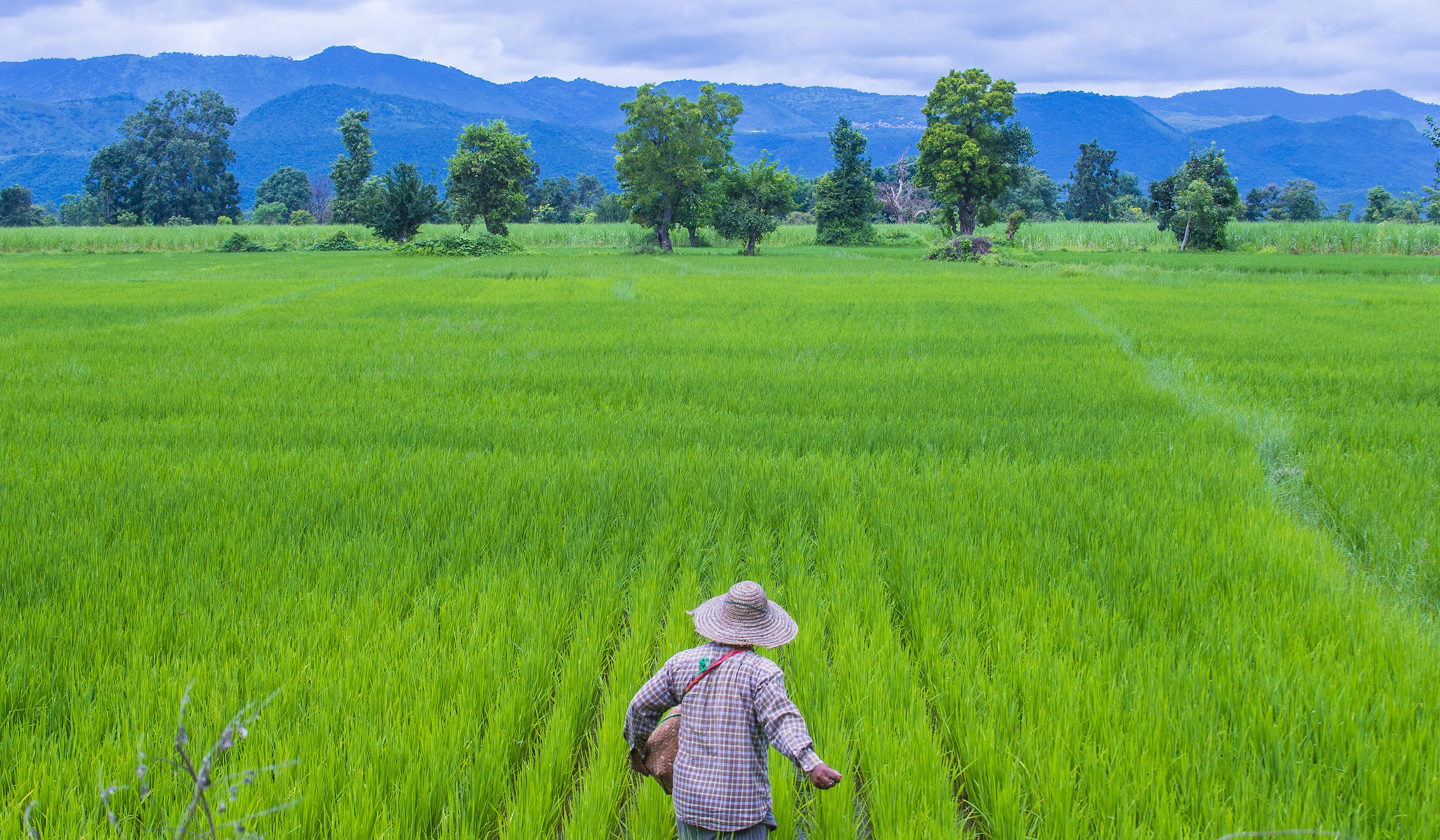
Flooding has affected monsoon rice cultivation in some areas, while flood warnings have been issued for other parts of the country, including areas along the Bago and Sittaung rivers. While the reported impacts on rice cultivation remain geographically limited, continued monitoring of flood conditions will be important given potential implications for crop production, transportation, and food supply chains.
Authors
Htar, May Thet; Minten, Bart; Masias, Ian
Citation
Htar, May Thet; Minten, Bart; and Masias, Ian. 2026. Myanmar monthly food price report – July 2026. Myanmar Monthly Food Price Report July 2026. Washington, DC: International Food Policy Research Institute. https://hdl.handle.net/10568/185166
Keywords
Asia; South-eastern Asia; Food Prices; Food Security; Crops; Animal Source Foods