

Linking Malawian smallholders to larger-scale agribusiness enterprises for inclusive development: A conceptual critique of the anchor enterprise model
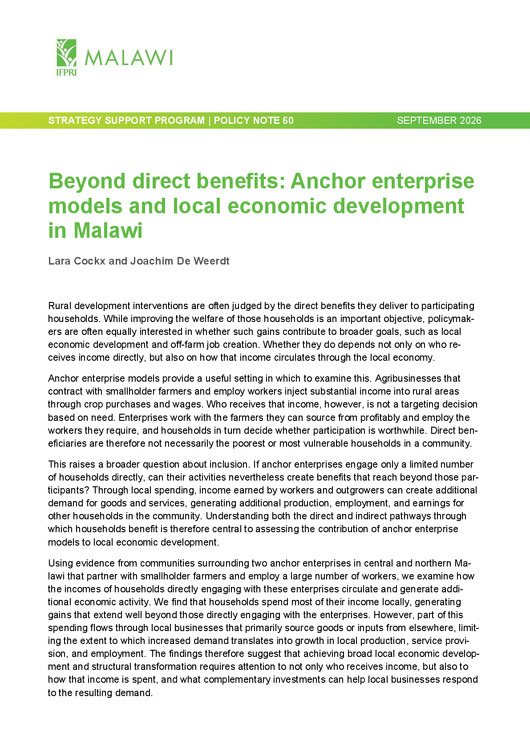
While smallholder farming has been and remains at the center of agricultural transformation efforts in Malawi, the limited success of smallholder-centered agricultural development strategies has led policymakers to explore alternative approaches. One emerging approach involves larger farms or agribusiness firms partnering with smallholder farming households, in what we will refer to as an anchor enterprise model. Under this model, smallholder farming households contribute land and labor to produce crops or livestock products that serve as inputs for, or are marketed jointly with, the anchor enterprise. In return, the anchor enterprise provides support such as technical assistance, inputs, transport, or storage. This partnership is intended to be commercial and mutually beneficial. While support for such partnerships is growing and the anchor enterprise model is increasingly being used in development programming in Malawi, there is still little clarity on what they involve, what they aim to achieve, and the conditions they need for success. This study seeks to address these questions and assess whether such linkages between larger farms or agrifood processors and smallholder farming households can contribute to sustainable, resilient, and inclusive wealth creation in Malawi. The findings from this study are also summarized in a policy note (Benson, Cockx, and De Weerdt, 2025).
Anchor enterprise partnerships can be valuable development models in specific contexts. In particular, they can help both larger enterprises and smallholders overcome constraints imposed by weaknesses in Malawi’s factor, input, and output markets, enabling both land and labor to be used more productively. However, the viability of the model depends heavily on the nature of the product at its center. Anchor enterprise models are generally not suitable for grain or other generic staple crops. For such products, partnerships are costly and carry high risk since farmers can easily find and sell to other buyers than their anchor enterprise partner if market prices rise above the agreed price for the partnership (side-selling). Similarly, if market prices drop below the agreed price, enterprises may buy elsewhere (side-buying). Rather, these partnerships are most likely to be economically justified for higher value, less widely grown, more specialized, more complex to produce or process, or highly perishable agricultural products. For these products, the risk of default is lower as the reduction in transaction costs provides both parties with strong incentives for maintaining a longer-term commercial relationship.
These incentives are especially important as the legal framework governing commercial partnerships in Malawi’s agrifood sector remains underdeveloped. Formal contracts were found to be important but not central to successful anchor enterprise operations. Partnerships that endure are built on a strong economic rationale, clear financial incentives for all parties, and a degree of bilateral dependency.
Anchor enterprise models cannot be profitably and sustainably employed for many types of commercial agricultural production in Malawi. Consequently, only a small portion of farming households can directly participate, and the poorest and most vulnerable are generally less likely to be included. Nonetheless, where such models work well, they can deliver indirect benefits to the broader rural community, including its poorer and more vulnerable members, by stimulating local demand for labor, goods, and services. Complementary interventions aimed at strengthening the capacity of the poorest households to capture these indirect benefits may, however, be necessary for the model to contribute meaningfully to inclusive development.
A model centered around commercial farms or agro-processors requires an enabling environment for such enterprises to operate effectively. This includes macroeconomic stability, an investment climate that facilitates private investment in agribusiness, and trade and exchange rate policies that support formal exports. To be sustainable, anchor enterprise models must be grounded in a strong economic rationale for partnering. Government and development partners can, however, support such partnerships without eroding their commercial foundations by, for example, investing in new institutions for conflict prevention and resolution, providing enterprises with assistance in managing relationships with smallholder partners, organizing financial and business training for farmers to reduce information asymmetries, or supporting organizations that can act as effective third-party intermediaries.
Authors
Benson, Todd; Cockx, Lara; De Weerdt, Joachim
Citation
Benson, Todd; Cockx, Lara; and De Weerdt, Joachim. 2026. Linking Malawian smallholders to larger-scale agribusiness enterprises for inclusive development: A conceptual critique of the anchor enterprise model. MaSSP Working Paper 46. Washington, DC: International Food Policy Research Institute.
Keywords
Africa; Sub-saharan Africa; Southern Africa; Smallholders; Agro-industrial Sector; Enterprises; Agro-industrial Complexes; Economic Development