


Despite broad acknowledgement by the research community that large-scale food fortification (LSFF) is a cost-effective intervention to address micronutrient deficiencies, the uptake and implementation of LSFF regulations and supporting policies is highly variable across countries and across food different food vehicles. This project therefore examines the political economy dynamics—inclusive of political incentives and implementation capacity—that can undermine uptake, scaling, and institutionalization over time.
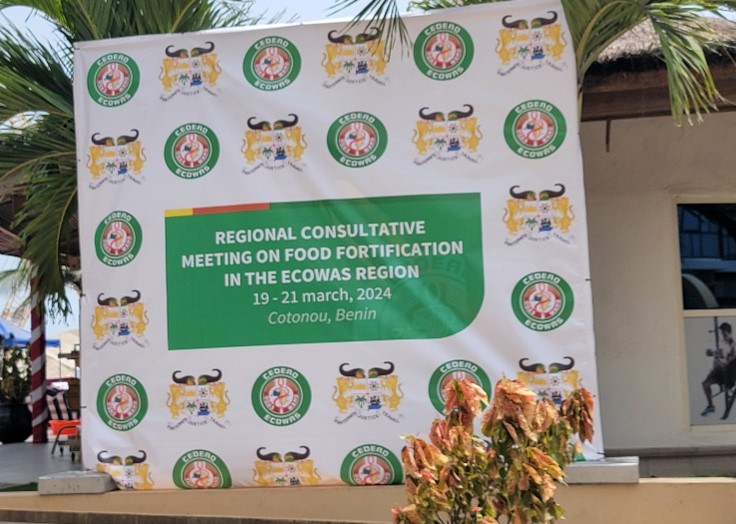
Specifically, the project has three key objectives: 1) To develop the Political Economy Diagnostic for LSFF (PEDAL) framework and apply it across diverse contexts and food vehicles that can help government partners, the private sector, and donors determine how to prioritize LSFF investments, 2) To identify binding political economy constraints to LSFF implementation within the public, private, and civil society sectors in a set of African and Asian countries as well as via regional harmonization bodies, such as the Economic Community of West African States (ECOWAS) and the East African Community (EAC), and 3) To propose viable solutions to address those binding constraints, drawing on lessons learned elsewhere.
The project has generated a series of knowledge products, including Discussion Papers, briefs, and country snapshots. These resources are available below.
Discussion Papers
- Senegal at a crossroads: Prioritizing large-scale food fortification under financial uncertainty
- The political economy of large-scale food fortification in West Africa: Pathways toward harmonization
- The enabling environment for large-scale food fortification in Madagascar
PEDAL Briefs
- Methodology
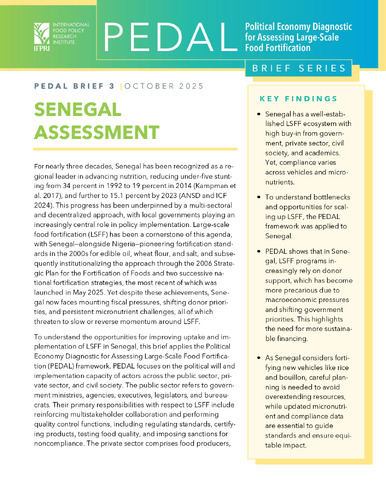
- Senegal | [English] and [French]
- Madagascar
PEDAL Snapshots