





IFPRI Strategy
2026-2030
FOOD POLICY RESEARCH for a CHANGING WORLD

IFPRI’s Strategy for 2026–2030 reaffirms the Institute’s commitment to providing research-based policy solutions. IFPRI works with partners to use the power of policy to improve food security, nutrition, and livelihoods, contribute to empowerment, and promote sustainability and climate resilience, particularly in low- and middle-income countries. This new strategy responds to the many challenges and opportunities emerging today, from climate change to growing inequities to digital technologies and more.
We see research not just as a tool for solutions, but as a catalyst for just, resilient, and prosperous societies.
Our strategy framework: 4 approaches, 5 research themes
Our strategy applies a systems view that encompasses all sectors and actors that participate in food systems. It combines a proven four-pronged research and engagement approach with five research themes that reflect a systems understanding of food policies—from farm to consumer.
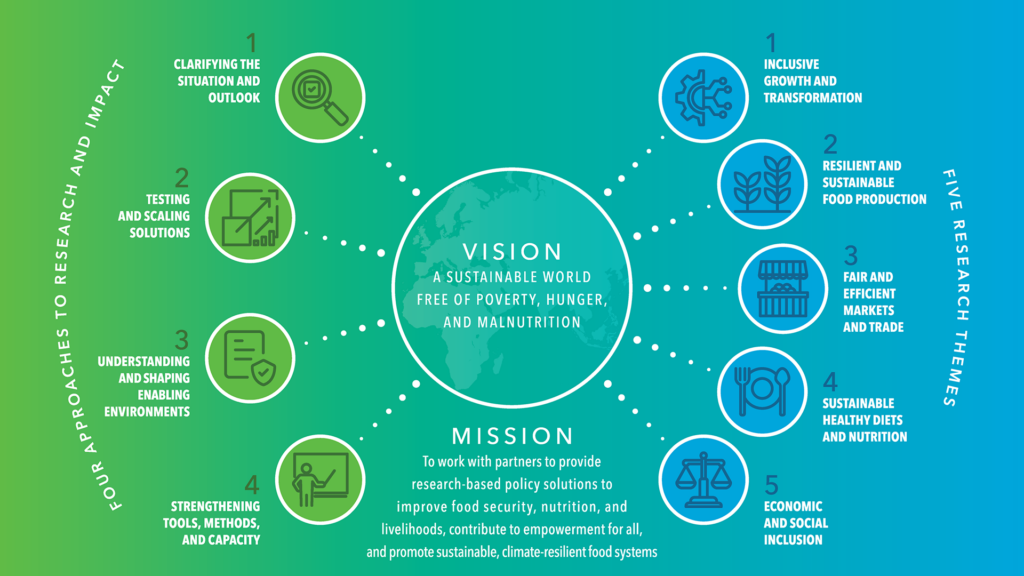
Our four-pronged approach generates knowledge that is actionable across the policy cycle through: (1) clarifying the situation and modeling outlooks, (2) deploying, testing, and scaling best-bet policy solutions, (3) understanding and shaping enabling environments, and (4) improving quality and uptake of tools and methods and contributing to sustainability of knowledge and capacity around the world.
IFPRI’s research themes are connected by an emphasis on inclusive economic growth and targeted approaches to ensure all people have access to safe, sufficient, and sustainably produced food. Three interconnected themes reflect the food system — from food production to diets, nutrition, and health, with market systems providing the vital connection (Themes 2, 3, and 4). The first and fifth themes address the economic and societal context that shapes food systems outcomes. The first examines governance and investment policies that can unlock the potential of food systems to drive pro-poor and planet-friendly economic transformation (Theme 1). The fifth centers on delivering scalable policy solutions, including targeted programs and growth, to strengthen economic and social inclusion for the poor, women, youth, and other marginalized populations (Theme 5). Critical goals cut across all these themes: equity and inclusion, empowerment, sustainability, resilience, and building national and local strengths.
Explore IFPRI Strategy 2026-2030 below or download a PDF here. For a quick overview, see this two-pager.
You can also view the recording of our special event,“Shaping Food Policy in a Changing World: Research Priorities for Greater Impact” (December 16, 2025), where the Strategy was presented.