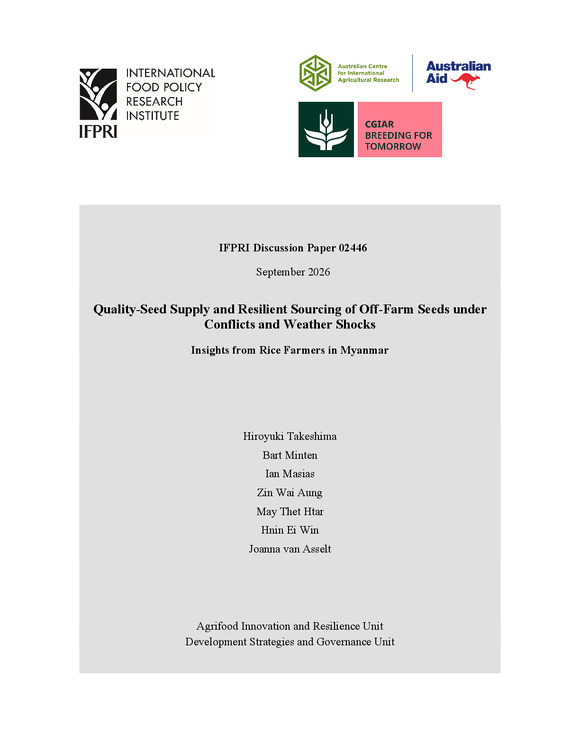
Quality-seed supply and resilient sourcing of off-farm seeds under conflicts and weather shocks: Insights from rice farmers in Myanmar
The acquisition of rice seeds from off-farm sources (off-farm seeds) can be beneficial for maintaining and raising productivity in Myanmar, where the use of off-farm rice seeds is relatively common. Identifying factors that can raise farmers’ resilience in acquiring off-farm seeds is potentially important in Myanmar and similar country contexts, where persistent and recurring shocks such as conflicts and weather events can disrupt such acquisition. This study addresses an important knowledge gap by examining the potential role of Myanmar’s rice seed sector in maintaining resilient access to off-farm seeds. We use unique three-year panel data on monsoon-sea-son rice producers in Myanmar, combined with detailed spatial data on violent events, various measures of weather shocks, information on spatial variation in local and regional seed production capacity compiled from secondary sources, and an innovative methodology based on instrumental variables and machine-learning approaches. Our findings suggest that using off-farm seeds generally leads to higher rice yields in the monsoon season, particularly if farmers used re-cycled seeds during the previous monsoon season. This result holds at the national level, as well as within the major rice-producing agroecological zones (AEZs), namely, the Delta and Dry Zone. During the study period (2021–2023), the use of off-farm seeds declined overall and was negatively associated with rainfall and temperature shocks during the previous monsoon season, floods during the late dry season, and fatal violent events during the dry season. However, these negative effects were largely mitigated in townships hosting seed farms or research farms that specialize in early-generation seeds (EGS) of rice, and in states with higher state-level production of certified rice seeds, relative to estimated in-state seed use. While the dominant types of shocks varied across AEZs and years, the mitigating effects of government seed or research farms and state-level production of certified seeds remained robust throughout. Overall, the results indicate that continued efforts to expand local and regional EGS production, alongside stronger certified seed systems, can strengthen smallholders’ resilience in off-farm seed use during conflicts and weather shocks.
Authors
Takeshima, Hiroyuki; Minten, Bart; Masias, Ian; Aung, Zin Wai; Htar, May Thet; Ei Win, Hnin; van Asselt, Joanna
Citation
Takeshima, Hiroyuki; Minten, Bart; Masias, Ian; Aung, Zin Wai; Htar, May Thet; et al. 2026. Quality-seed supply and resilient sourcing of off-farm seeds under conflicts and weather shocks: Insights from rice farmers in Myanmar. IFPRI Discussion Paper 2446. Washington, DC: International Food Policy Research Institute.
Keywords
Asia; South-eastern Asia; Seed Collection; Seed Quality; Certified Seed; Rice; Conflicts; Weather Hazards; Economic Shock; Machine Learning; Climate Change Adaptation; Climate Change Mitigation; Climate Change
Access/Licence
Open Access