GCAN Partner Workshop: Report on lessons and priorities for strengthening policy engagement, institutional capacity, and sustainability
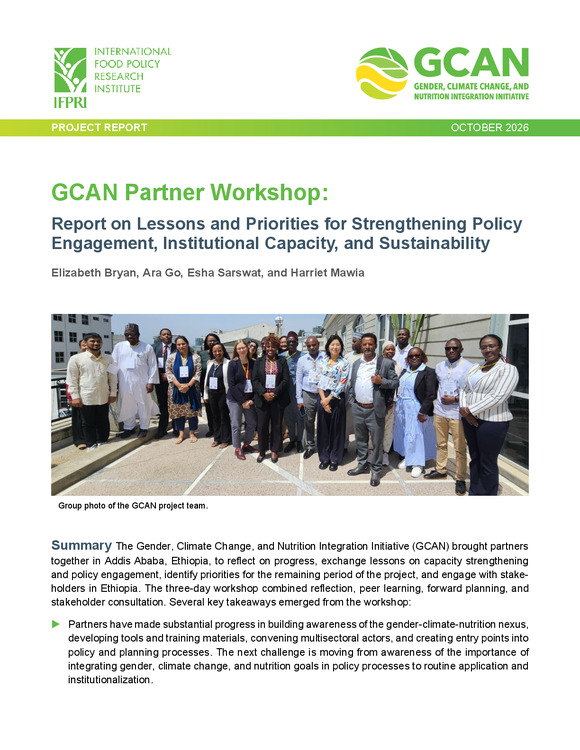
The Gender, Climate Change, and Nutrition Integration Initiative (GCAN) brought partners together in Addis Ababa, Ethiopia, to reflect on progress, exchange lessons on capacity strengthening and policy engagement, identify priorities for the remaining period of the project, and engage with stakeholders in Ethiopia. The three-day workshop combined reflection, peer learning, forward planning, and stakeholder consultation. Several key takeaways emerged from the workshop: Partners have made substantial progress in building awareness of the gender-climate-nutrition nexus, developing tools and training materials, convening multisectoral actors, and creating entry points into policy and planning processes. The next challenge is moving from awareness of the importance of integrating gender, climate change, and nutrition goals in policy processes to routine application and institutionalization. Capacity strengthening on integrating gender, climate change, and nutrition needs to extend beyond training individuals. Participants emphasized leadership buy-in, institutional mandates, coordination mechanisms, practical tools, sustained financing, follow-up, and opportunities to apply learning in real policy and planning processes. Country approaches differ, but partners gained insights from cross-country experiences and valued the opportunity for cross-country learning. Existing manuals, frameworks, metrics, policy briefs, and facilitation approaches could be consolidated and adapted rather than creating entirely new products in each setting. Policy engagement is most effective when it is sustained, demand-driven, linked to active policy windows, and grounded in relationships with both technical staff and decisionmakers. Partners also highlighted the importance of co-creating evidence and translating it into practical guidance to facilitate GCAN integration. Looking ahead, partners want to strengthen monitoring of capacity and institutional change, deepen peer learning, embed GCAN approaches in existing institutions and platforms, and mobilize resources and partnerships that can sustain the work beyond the current project period.
Authors
Bryan, Elizabeth; Go, Ara; Sarswat, Esha; Mawia, Harriet
Citation
Bryan, Elizabeth; Go, Ara; Sarswat, Esha; Mawia, Harriet. 2026. GCAN Partner Workshop: Report on lessons and priorities for strengthening policy engagement, institutional capacity, and sustainability. Project Report October 2026. Washington, DC: International Food Policy Research Institute. https://hdl.handle.net/10568/186223
Keywords
Climate Resilience; Capacity Building; Gender; Climate Change; Policy Innovation