




What Do We Know About the Future of Food Systems?
IFPRI Book published in July 2025

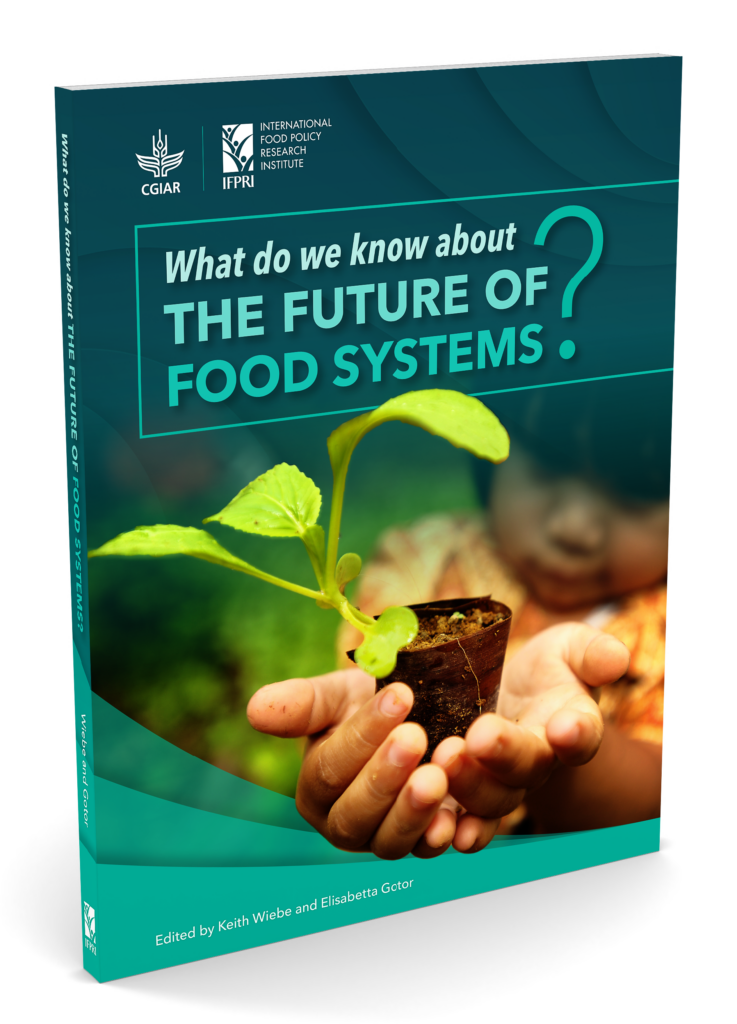
Food systems have achieved remarkable progress in recent decades, but moving forward, they will face significant challenges in delivering the many outputs and services—such as poverty alleviation, nutrition and health, livelihoods, and environmental sustainability—we expect and need. By combining sophisticated analysis and close engagement with stakeholders, we can identify and explore the likely impacts of different future scenarios based on alternative development pathways and external factors. These results can help inform the decisions we make about food systems today.
This book, What Do We Know About the Future of Food Systems?, is a collection of short chapters that synthesize current knowledge about different aspects of the future of food systems. Written by more than 100 scientists from around the world with expertise in a wide range of related disciplines and regions, these chapters provide accessible overviews of the latest foresight research on each topic, guide readers toward more detailed information, and offer insights into how our knowledge of future trends can be improved.
Table of contents
Introduction / Overview
Chapter 1. What are food systems and what can we know about their future?
By Keith Wiebe (IFPRI) and Elisabetta Gotor (Bioversity International)
Permanent link – https://hdl.handle.net/10568/175020 (Chapter) / https://hdl.handle.net/10568/175019 (Full Book)
Part One: What do we know about the future of food systems drivers and impacts?
Chapter 2. Poverty
By Karl Pauw (IFPRI), Paul Dorosh (IFPRI), Wenqian Xu (IFPRI) and Jean Balié (CGIAR)
Permanent link – https://hdl.handle.net/10568/175110 (Chapter) / https://hdl.handle.net/10568/175019 (Full Book)
Chapter 3. Diets and nutrition
By Timothy B. Sulser (IFPRI), Marie Ruel (IFPRI), and Shakuntala Thilsted (CGIAR)
Permanent link – https://hdl.handle.net/10568/175111 (Chapter) / https://hdl.handle.net/10568/175019 (Full Book)
Chapter 4. Gender
By Elizabeth Bryan (IFPRI), Marilia Magalhaes (IFPRI), Ranjitha Puskur (IRRI), Nicoline de Haan (CGIAR), Els Lecoutere (CGIAR), and Hazel Malapit (IFPRI)
Permanent link – https://hdl.handle.net/10568/175112 (Chapter) / https://hdl.handle.net/10568/175019 (Full Book)
Chapter 5. Environment
By Elisabetta Gotor (Bioversity International) and Cargele Masso (CGIAR)
Permanent link – https://hdl.handle.net/10568/175227 (Chapter) / https://hdl.handle.net/10568/175019 (Full Book)
Chapter 6. Climate
By Timothy Thomas (IFPRI) and Aditi Mukherji (CGIAR)
Permanent link – https://hdl.handle.net/10568/175228 (Chapter) / https://hdl.handle.net/10568/175019 (Full Book)
Chapter 7. Agrobiodiversity
By Nicola Cenacchi (IFPRI), Elisabetta Gotor (Bioversity International), Athanasios Petsakos (Bioversity International), and Benjamin Schiek (CIAT)
Permanent link – https://hdl.handle.net/10568/175229 (Chapter) / https://hdl.handle.net/10568/175019 (Full Book)
Chapter 8. Crop pests and diseases
By Athanasios Petsakos (Bioversity International), Carlo Montes (Bioversity International), Diego Pequeno (CIMMYT), Benjamin Schiek (CIAT), and Kai Sonder (CIMMYT)
Permanent link – https://hdl.handle.net/10568/175230 (Chapter) / https://hdl.handle.net/10568/175019 (Full Book)
Chapter 9. Land
By Ricky Robertson (IFPRI), Nicola Cenacchi (IFPRI), and Abhijeet Mishra (IFPRI)
Permanent link – https://hdl.handle.net/10568/175231 (Chapter) / https://hdl.handle.net/10568/175019 (Full Book)
Chapter 10. Water
By Claudia Ringler (IFPRI), Matthew McCartney (IWMI), and Mohsin Hafeez (IWMI)
Permanent link – https://hdl.handle.net/10568/175232 (Chapter) / https://hdl.handle.net/10568/175019 (Full Book)
Chapter 11. Energy
By Channing Arndt (Purdue University)
Permanent link – https://hdl.handle.net/10568/175233 (Chapter) / https://hdl.handle.net/10568/175019 (Full Book)
Chapter 12. Innovation
By Daniel Mason-D’Croz (Cornell University), Mario Herrero (Cornell University), Cody Kugler (Independent), Rosaline Remans (Bioversity International), Philip Thornton (ILRI, Cornell University, Clim-Eat, and University of Edinburgh), and Heather Zornetzer (Bioversity International)
Permanent link – https://hdl.handle.net/10568/175234 (Chapter) / https://hdl.handle.net/10568/175019 (Full Book)
Chapter 13. Trade
By Joseph Glauber (IFPRI) and Sherwin Gabriel (IFPRI)
Permanent link – https://hdl.handle.net/10568/175406 (Chapter) / https://hdl.handle.net/10568/175019 (Full Book)
Chapter 14. Urbanization
By Paul Dorosh (IFPRI) and James Thurlow (IFPRI)
Permanent link – https://hdl.handle.net/10568/175407 (Chapter) / https://hdl.handle.net/10568/175019 (Full Book)
Chapter 15. El Niño
By Jawoo Koo (IFPRI) and Weston Anderson (University of Maryland and NASA)
Permanent link – https://hdl.handle.net/10568/175408 (Chapter) / https://hdl.handle.net/10568/175019 (Full Book)
Chapter 16. Food assistance
By Steven Were Omamo (IFPRI)
Permanent link – https://hdl.handle.net/10568/175409 (Chapter) / https://hdl.handle.net/10568/175019 (Full Book)
Part Two: What do we know about the future of food systems in selected regions?
Chapter 17. West and Central Africa
By Dolapo Enahoro (ILRI), Charles Mensah (University of Ghana), and Sika Gbegbelegbe (IITA)
Permanent link – https://hdl.handle.net/10568/175454 (Chapter) / https://hdl.handle.net/10568/175019 (Full Book)
Chapter 18. East and Southern Africa
By Kindie Tesfaye Fantaye (AGRA), Faaiqa Hartley (IFPRI), Timothy S. Thomas (IFPRI), Sika Gbegbelegbe (IITA), and Sherwin Gabriel (IFPRI)
Permanent link – https://hdl.handle.net/10568/175455 (Chapter) / https://hdl.handle.net/10568/175019 (Full Book)
Chapter 19. Central and West Asia and North Africa
By Aymen Frija (ICARDA)
Permanent link – https://hdl.handle.net/10568/175456 (Chapter) / https://hdl.handle.net/10568/175019 (Full Book)
Chapter 20. South Asia
By Swamikannu Nedumaran (ICRISAT), Judy Thomas (ICRISAT), Ravi Nandi (CIMMYT), Jyosthnaa Padmanabhan (ICRISAT), and Victor Afari-Sefa (ICRISAT)
Permanent link – https://hdl.handle.net/10568/175457 (Chapter) / https://hdl.handle.net/10568/175019 (Full Book)
Chapter 21. Southeast Asia
By Nhuong Tran (HSB-VNU and ANU), Harold Glenn Valera (BSP), Chin Yee Chan (WorldFish), Valerien Olivier Pede (IRRI), Yee Mon Aung (Yezin Agricultural University), and Ronald Jeremy Antonio (BSP)
Permanent link – https://hdl.handle.net/10568/175507 (Chapter) / https://hdl.handle.net/10568/175019 (Full Book)
Chapter 22. Latin America and the Caribbean
By Valeria Piñeiro (IFPRI), Guy Hareau (CIP), and Robert Andrade (CIAT)
Permanent link – https://hdl.handle.net/10568/175508 (Chapter) / https://hdl.handle.net/10568/175019 (Full Book)
Part Three: What do we know about the future of food systems in selected countries?
Chapter 23. Argentina, Brazil, Paraguay and Uruguay
By Nicolas Jorge (Bolsa de Cereales), Silvia Kanadani Campos (Embrapa), Juan Pablo Gianatiempo (IFPRI), Vanessa da Fonseca Pereira (MAPA and Embrapa), and Valeria Piñeiro (IFPRI)
Permanent link – https://hdl.handle.net/10568/175509 (Chapter) / https://hdl.handle.net/10568/175019 (Full Book)
Chapter 24. China
By Xinru Han (IAED, CAAS), Xiangdong Hu (IAED, CAAS), and Kevin Chen (IFPRI and Zhejiang University)
Permanent link – https://hdl.handle.net/10568/175511 (Chapter) / https://hdl.handle.net/10568/175019 (Full Book)
Chapter 25. India
By Sedithippa Janarthanan Balaji (ICAR-NIAP), Pratap S. Birthal (ICAR-NIAP), and Barun Deb Pal (IFPRI)
Permanent link – https://hdl.handle.net/10568/175512 (Chapter) / https://hdl.handle.net/10568/175019 (Full Book)
Chapter 26. Indonesia
By Erizal Jamal (BRIN), Sahara Sahara (IPB University), Syahid Izzulhaq (ANU), Syarifah Amaliah (IPB University), Fahmi Salam Ahmad (IPB University), Komalawati Komalawati (BRIN), Pihri Buhaerah (BRIN), Ifan Martino (Bappenas), Wulan Metafurry (Bappenas), Dadang Jainal Mutaqin (Bappenas), Irfan Thofiq Firdaus (Bappenas), Dewi Setyawati (IPB University), Angga Pradesha (IFPRI), Vivi Yulaswati (Bappenas), Irfan Syauqi Beik (IPB University), Irwanda Wisnu Wardhana (BRIN), Jarot Indarto (Bappenas), Agus Eko Nugroho (BRIN), Bustanul Arifin (University of Lampung), and Tahlim Sudaryanto (BRIN and APPERTANI)
Permanent link – https://hdl.handle.net/10568/175513 (Chapter) / https://hdl.handle.net/10568/175019 (Full Book)
Chapter 27. South Africa
By Ferdi Meyer (BFAP and University of Stellenbosch), Louw Pienaar (BFAP and University of Stellenbosch), Tracy Davids (BFAP and University of Stellenbosch), and Mmatlou Kalaba (BFAP and University of Stellenbosch)
Permanent link – https://hdl.handle.net/10568/175514 (Chapter) / https://hdl.handle.net/10568/175019 (Full Book)
Part Four: What do we know about the future of selected food commodities?
Chapter 28. Animal-source foods
By Dolapo Enahoro (ILRI), Daniel Mason-D’Croz (Cornell University), Mario Herrero (Cornell University), Charles Mensah (University of Ghana), and Isabelle Baltenweck (ILRI)
Permanent link – https://hdl.handle.net/10568/175515 (Chapter) / https://hdl.handle.net/10568/175019 (Full Book)
Chapter 29. Aquatic foods
By Chin Yee Chan (WorldFish), Nhuong Tran (HSB-VNU and ANU), Yan Hoong (S&P Global), Timothy B. Sulser (IFPRI), and Yee Mon Aung (Yezin Agricultural University)
Permanent link – https://hdl.handle.net/10568/175523 (Chapter) / https://hdl.handle.net/10568/175019 (Full Book)
Chapter 30. Maize
By Kindie Tesfaye Fantaye (AGRA), Kai Sonder (CIMMYT), Diego Pequeno (CIMMYT), Faaiqa Hartley (IFPRI), and Sika Gbegbelegbe (IITA)
Permanent link – https://hdl.handle.net/10568/175524 (Chapter) / https://hdl.handle.net/10568/175019 (Full Book)
Chapter 31. Pulses
By Sika Gbegbelegbe (IITA), Wupe Msukwa (IITA), Swamikannu Nedumaran (ICRISAT), and Arega Alene (IITA)
Permanent link – https://hdl.handle.net/10568/175526 (Chapter) / https://hdl.handle.net/10568/175019 (Full Book)
Chapter 32. Rice
By Harold Glenn Valera (BSP), Valerien Olivier Pede (IRRI), and Ronald Jeremy Antonio (BSP)
Permanent link – https://hdl.handle.net/10568/175530 (Chapter) / https://hdl.handle.net/10568/175019 (Full Book)
Chapter 33. Roots, tubers, and bananas
By Evelyne Kihiu (CIP), Guy Hareau (CIP), Sika Gbegbelegbe (IITA), Robert Andrade (CIAT), Athanasios Petsakos (Bioversity International), and Arega Alene (IITA)
Permanent link – https://hdl.handle.net/10568/175531 (Chapter) / https://hdl.handle.net/10568/175019 (Full Book)
Chapter 34. Wheat
By Gideon Kruseman (Kruseman Consultancy), Kai Sonder (CIMMYT), Diego Pequeno (CIMMYT), Matthew Reynolds (CIMMYT), and Aymen Frija (ICARDA)
Permanent link – https://hdl.handle.net/10568/175532 (Chapter) / https://hdl.handle.net/10568/175019 (Full Book)
Part Five: What do we know about the future of foresight data and analytical tools?
Chapter 35. Measuring food systems
By Jessica Fanzo (Columbia University), Bianca Carducci (Columbia University), and Michael Puma (Columbia University and NASA)
Permanent link – https://hdl.handle.net/10568/175533 (Chapter) / https://hdl.handle.net/10568/175019 (Full Book)
Chapter 36. Projections from the IMPACT model
By Nicola Cenacchi (IFPRI), Timothy B. Sulser (IFPRI), and Abhijeet Mishra (IFPRI)
Permanent link – https://hdl.handle.net/10568/175534 (Chapter) / https://hdl.handle.net/10568/175019 (Full Book)
Chapter 37. Foresight modeling
By Keith Wiebe (IFPRI), Aline Mosnier (FABLE and SDSN), Daniel Mason-D’Croz (Cornell University), Athanasios Petsakos (Bioversity International), Johannes Svensson (BC3 and IDDRI), and Monika Zurek (University of Oxford)
Permanent link – https://hdl.handle.net/10568/175535 (Chapter) / https://hdl.handle.net/10568/175019 (Full Book)
Note: You can also order a printed copy of the book from Amazon here.
Blogs
-
What do we know about the future of food systems?
Challenges and opportunities for transformation.
Events
-
 July 23, 2025, 9:30 – 11:00 am
What Do We Know About the Future of Food Systems?
Food systems have achieved remarkable progress in recent decades, but moving forward, they will face significant challenges in delivering the many outputs and services—such as poverty alleviation, nutrition and health, livelihoods, and environmental sustainability—we expect and need. By combining sophisticated analysis and close engagement with stakeholders, we can identify and explore the likely impacts of…