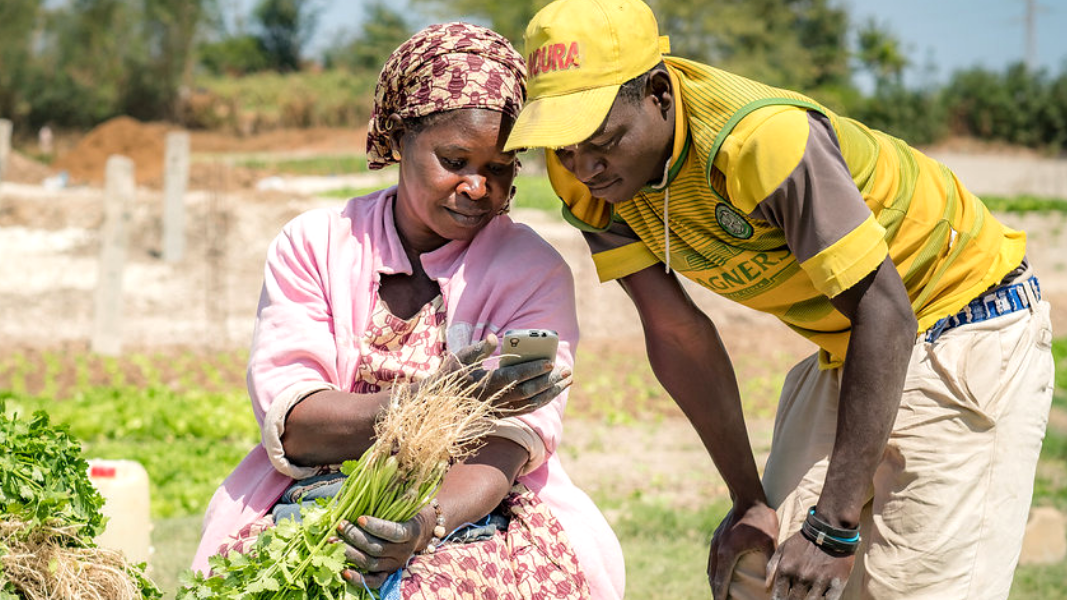







Income growth and urbanization are driving changes in agrifood value chains in many low- and middle-income countries (LMICs), expanding business opportunities for individuals and firms involved in moving food from rural to urban areas. This value chain midstream is a promising entry point for efforts to expand digital finance, offering benefits not just to firms adopting new applications but across food systems.
Digital finance—including online payments, banking, loan processing, and other services accessible by mobile phone or computer—can improve the efficiency, transparency, and resiliency of intermediary agrifood firms. These innovations also help both producers and consumers. Smallholder farmers benefit from reduced transaction costs, receiving higher prices; at the same time, more efficient, transparent, and resilient links up and down the value chain can result in lower prices for consumers.
Yet efforts to expand digital finance in this area face significant obstacles, including limited network coverage and a widespread preference among firm owners and managers for using cash in business transactions—despite the common use of mobile money for personal needs.
What, then, are the most effective ways to address these obstacles and encourage midstream firms to embrace digital finance? In this blog post, we describe the barriers and opportunities affecting the adoption of a specific technology—digital payments—among intermediary actors working in LMIC agrifood value chains, complementing ongoing work by IFPRI researchers focusing on smallholder farmers and digital finance. We summarize findings from IFPRI scoping reports conducted in Ethiopia, Kenya, Nigeria, and Tanzania, and a case study on existing efforts to digitalize payments within agrifood value chains.
Barriers
Across the five reports, the two barriers to adoption of digital payments for business stand out:
Limited or sporadic digital network coverage in rural areas. A consistent finding across each report is the problem of poor digital infrastructure and mobile network coverage in rural areas in Africa. When the physical infrastructure that enables and facilitates the digital network leaves coverage gaps or is otherwise unreliable and at times inaccessible, then even the most well-designed digital financial service technology will not function.
Weak agent networks are another factor. The use of mobile money and associated mobile wallet platforms and technologies requires a reliable and accessible network of agents to facilitate their adoption and use. Our case studies cite numerous examples of agrifood value chain actors listing both poor mobile connectivity and costly access to mobile money agents as primary factors that discourage their adoption and/or increased use of digital financial services.
Strong preferences for cash payments. Several reports also document this predilection among potential users. In Ethiopia, for example, mobile money account ownership is only 18% among adults who report being aware of the technology and having access to a mobile phone. Evidence from ongoing work in Bangladesh suggests that this strong preference for cash may be independent of limited access to physical and digital networks.
The persistence of cash in business transactions may stem from multiple sources. The prevalence of online fraud can undermine trust in digital technologies. For example, in Nigeria, potential users of digital technologies cited fears of scams (i.e., SIM swaps and phishing attacks) and overcharging by agents who often lack sufficient oversight. A 2023 survey in Nigeria estimated that 2.3 million users had experienced fraud by mobile money agents.
Another source of this problem is limited digital and financial literacy in rural areas. Many potential users of digital financial services are unaware of the benefits of shifting to digital payments. Successful efforts to promote digital payments within agrifood value chains often include account-opening campaigns that include tailored gender-sensitive financial literacy trainings.
Opportunities
While these barriers are formidable, evidence also shows there are opportunities for innovation in the provision of digital financial services that can expand their reach.
Public sector support. While the provision and use of digital financial services rely primarily on private sector actors, the public sector—regulatory frameworks, government policies, and public investment—plays an important role in their pricing and adoption within agrifood value chains.
For example, the Rwandan government’s cashless economy initiative, Vision 2050, accelerated digital adoption in the tea sector. A coordinated effort across tea processing facilities, cooperative organizations, mobile operators, and financial institutions encouraged tea factories to use mobile money to pay farmers. These efforts led to reductions in payment timelines, reduced costs, and increased farmer productivity.
Similarly, Kenya’s regulatory flexibility, characterized by a “test-and-learn” approach, played an important role in the adoption and innovation surrounding mobile money services, enabling products such as M-PESA and initiatives such as Connected Farmer to quickly adapt and scale. According to the most recent World Bank Global Findex, Kenya leads Africa South of the Sahara in digital payments for agriculture.
Ethiopia has recently revised policies to attempt to catalyze increased financial inclusion in the agricultural sector. Recent policy documents and initiatives—such as the Digital Ethiopia 2025 policy and the Digital Agricultural Roadmap (2024-2032)—make digital financial services a key priority in improving agricultural productivity, financial inclusion, and transparency across value chains. To build an enabling environment for the growth of digital financial services, Ethiopia’s government has begun a series of projects to strengthen the digital infrastructure, develop systems for improved online interactions, and to enhance digital payments and e-commerce through the private sector. It will take some time to observe and assess the effects of these policy actions.
Private sector incentives. Private agro-processing firms play a key role in implementing digitalization throughout their supply chains, including access to finance, as it improves traceability and generates other benefits for their operations. An apex actor (such as large buyer aggregators) can help in this context. Apex actors can pay the fixed costs of digitalizing their own value chain transactions, since the benefits of doing so can outweigh those costs. They can then influence their client firms to digitalize transactions to continue to do business with them. Those intermediary value chain firms can then benefit from higher payments due to lower transaction costs, or by developing a stream of digital payments that can be used as an alternative form of collateral.
For example, the Kenya Nut company piloted a digital payment system that significantly reduced operational costs by generating faster and safer payments. The increased velocity of payments rippled through the value chain to firms even further upstream than Kenya nut’s direct suppliers, and ultimately drove adoption of digital payments in Kenya’s groundnut sector.
Conclusion
As income growth and urbanization in LMICs transform agrifood value chains, it is clear that digitalization among intermediary firms can improve efficiency, transparency, and resilience, benefiting both producers and consumers. It can also help improve access to finance both directly through digital financial products and indirectly through the traceability of digital payments.
Our next step in this work is to conduct and analyze focused value chain surveys, using a network-driven sampling approach, to better understand how barriers to the adoption and use of digital financial services may vary by type of actors within the agrifood midstream. This work will build a better understanding of barriers to the use of digital services, to help inform product innovation by digital financial service providers that can stimulate adoption.
Kate Ambler and Alan de Brauw are Senior Research Fellows with IFPRI’s Markets, Trade, and Institutions (MTI) Unit; Jeffrey R.. Bloem is an MTI Research Fellow. Opinions are the authors’.
This work was supported by the Gates Foundation and the CGIAR Science Programs on Better Diets and Nutrition and Policy Innovations.