





Demand system estimation—gauging how consumer choices respond to changing prices and incomes—is a crucial facet of food policy research, yet remains a highly specialized and underdeveloped area in development economics. Globally, many researchers lack the necessary skills to accurately apply this approach to estimate elasticities of consumer demand.
India is a case in point. As consumption patterns shift rapidly across the country, shaped by rising incomes, nutrition transitions, demographic shifts, and evolving lifestyles, the need for robust, evidence-based food demand analysis is fundamental to designing effective agriculture and food policies.
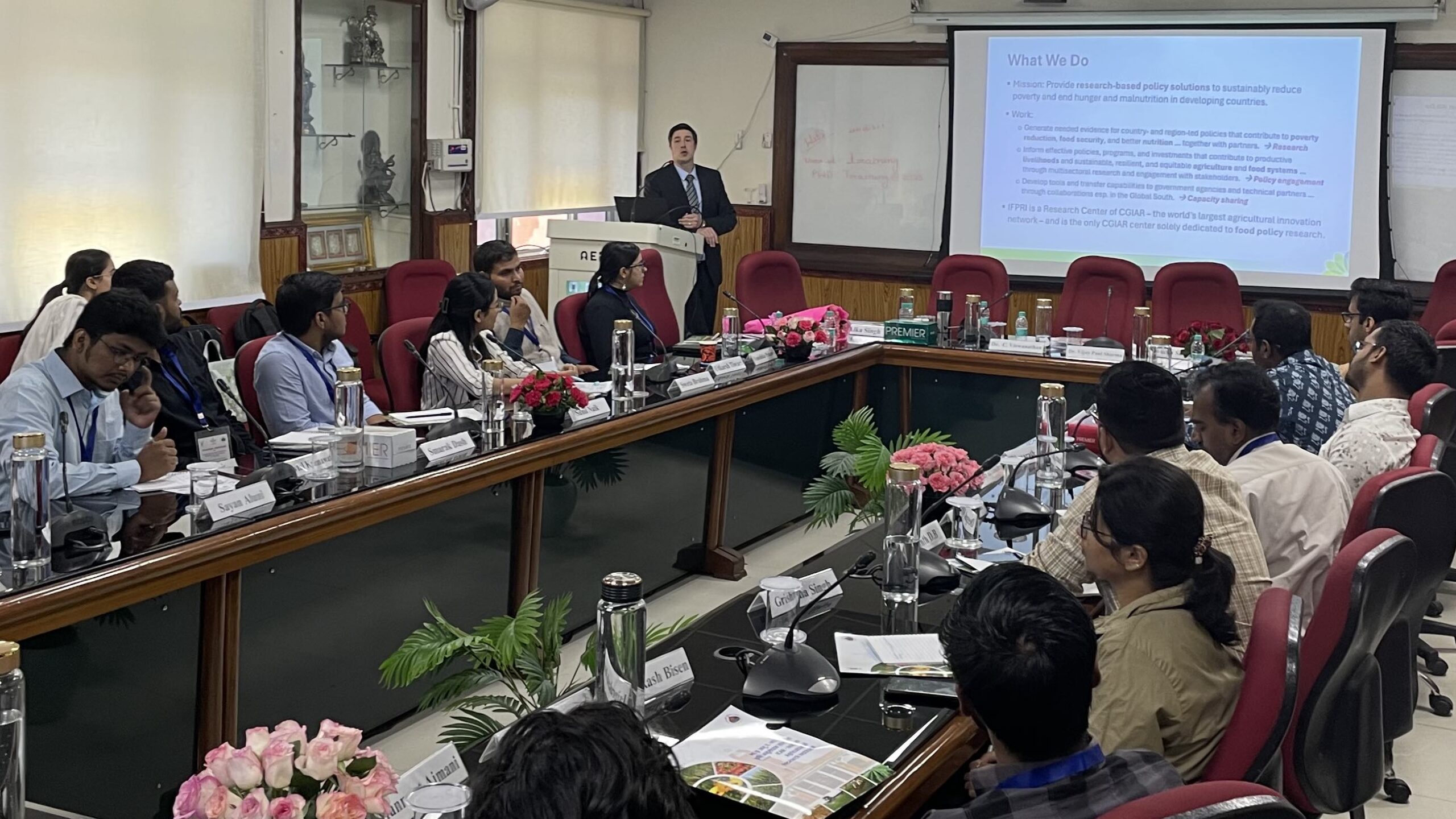
Recognizing that many policies fail due to inaccurate or unverified data and/or a lack of capacity to develop and understand data, the CGIAR Policy Innovation Science Program has placed a special focus on this issue. As a part of that effort, IFPRI, Alliance Biodiversity International-CIAT, and the division of agricultural economics at the Indian Agricultural Research Institute (ICAR-IARI) jointly organized a four-day capacity building training on “Food Demand Systems and Elasticity Estimation for Policy Analysis” November 4-7 at ICAR-IARI in New Delhi.
This training was attended by 27 participants, including nine women, from ICAR-IARI, the National Institute of Agricultural Economics and Policy Research (ICAR-NIAP), IFPRI, and allied institutions.
Led by IFPRI’s Olivier Ecker and Andrew Comstock, the training provided a theoretical background on consumer theory and demand system estimation that can be used effectively in policy decision-making. Participants engaged in intensive hands-on exercises to estimate food demand models using officially published household survey data.
The state of demand modeling in India
In the opening session, experts from CGIAR centers, ICAR institutes, and government officials involved in shaping agricultural policy addressed the current state of modeling consumer demand in India. Alka Singh, Professor and Head, Division of Agricultural Economics, ICAR-IARI, emphasized the need for strengthening modeling and analytical capacity in India to better support data-driven policymaking. Many of her students, while having an interest in demand modeling, she said, lacked the necessary skills for achieving their goals. Raka Saxena, Senior Adviser (Agriculture Policy), NITI Aayog, the Indian government public policy institute, noted the country’s rapidly changing consumption patterns and rising demand for high-value foods and stressed the need for accurate elasticity estimates for planning and policy decisions.
Vishwanathan Chinnusamy, Joint Director (Research) at ICAR-IARI, emphasized the critical need for sophisticated demand modeling tools – like those taught in this training – to effectively plan and prioritize research, allocate resources, and develop successful export strategies. Demand is now more volatile and diversified than supply, noted Vijay Paul Sharma, Chairman, Commission for Agricultural Costs and Prices (CACP), Ministry of Agriculture, the chief guest of the session. That, he said, requires robust, granular, and context-specific projections to guide Minimum Support Prices (MSP), trade, resource allocation, and agricultural diversification.
IFPRI and the CGIAR can help meet the urgent need for researchers to strengthen their ability to collect, interpret, and analyze data effectively, said Jai Rana, CIAT Senior Scientist and Country Representative for India.
A hands-on learning experience: Building skills for modern food policy analysis
By providing both strong theoretical grounding and ample space for hands-on, instructor-guided, practical exercises, the training allowed participants to internalize concepts through application.
The training devoted extensive time to understanding the fundamentals of consumer demand theory and their implications for data analysis and estimation. Participants were also given grounding in processing household survey data, dealing with common data pitfalls, and crafting the type of high-quality data inputs needed for strong policy analysis.
A key feature of the training was the proprietary Stata module for estimating a censored quadratic almost ideal demand system (QUAIDS), a flexible tool for estimating consumer demand. Through guided exercises, participants learned to handle censoring in consumption data, implement the QUAIDS model, conduct post-estimation analysis, and interpret demand elasticities for policy purposes. Participants also shared their research work with the instructors to receive feedback. Future communication channels were established for participants to continue their work with guidance from IFPRI staff.
Towards a stronger evidence-based policy ecosystem
By equipping participants with advanced quantitative tools and improving conceptual understanding, the training has helped them take an important step toward building a stronger ecosystem for evidence-based agricultural policy in India. As consumption patterns continue to evolve, and as national priorities shift toward sustainability, nutrition, and global competitiveness, the ability to accurately estimate food demand elasticities will play a crucial role.
IFPRI, together with ICAR-IARI and Alliance Bioversity International-CIAT, remains committed to supporting India’s efforts to foster analytical excellence and generate high-quality data-driven insights for policymaking. This training program marked an important milestone in that ongoing journey.
Manmeet Singh Ajmani is a Senior Research Analyst with IFPRI’s Foresight and Policy Modeling (FPM) Unit based in New Delhi; Andrew Comstock is an FPM Senior Research Analyst based in Washington, DC; Olivier Ecker is an FPM Senior Research Fellow based in Washington; Barun Deb Pal is an FPM Research Coordinator based in New Delhi. Opinions are the authors’.