



Key takeaways
- Agricultural carbon markets can boost farm incomes in Nepal. Carbon credits could create a new revenue stream for smallholder farmers while supporting climate-smart agriculture.
- Methane reduction offers major potential. Improved rice and livestock practices could cut emissions and generate significant carbon credit revenues.
- Success depends on strong institutions. Better monitoring, fair benefit-sharing, and cooperative-based farmer participation are essential for scaling agricultural carbon trading.
Climate finance has evolved from a peripheral concern of development policy into a central component of the global financial architecture. Carbon markets allow businesses and other organizations to monetize emissions reductions through credits sold on international exchanges.
Agriculture currently represents only a tiny slice of this activity. The agricultural carbon credit market was valued at just $36.1 million in 2024 out of more than $100 billion globally.
This current landscape—a large compliance market (where governments require regulated entities to pay for emissions, valued at $107 billion in 2025), a small voluntary segment (where companies purchase credits to meet self-determined commitments, valued at just $1.7 billion as of 2024), and within the latter, a near-nonexistent agricultural niche—represents a significant opportunity for agricultural finance. Even a modest reallocation of voluntary credits toward agriculture would represent a large proportional gain for a sector starting from near zero. That, in turn, can provide an important funding stream to drive food system transformation.
Nepal offers a case study for the potential of carbon credits as a means of climate-friendly agricultural finance. The challenges are significant. Key among them will be integrating smallholder farmers into carbon markets. In Nepal, as in other countries, smallholder farmers are almost entirely absent from carbon markets historically dominated by energy corporations and reforestation programs.
Yet expanding smallholder participation (amid a broader market expansion of agriculture) would yield many advantages. Agricultural mitigation, particularly of methane, a potent greenhouse gas (GHG), offers credit buyers measurable, near-term climate benefits; for farming households, carbon markets represent an untapped revenue stream that complements existing activities. They monetize climate-smart farming practices, providing farmers with recurring income that supplements, rather than replaces, existing agricultural earnings. This effort faces some serious obstacles, including integrating smallholders into the carbon market system and distributing benefits equitably.
Nepal’s current carbon market: status, scale, and participants
Nepal contributes only 0.1% of global GHG emissions, yet its community-managed forests, hydropower sector, and agricultural potential make it a credible candidate for carbon market participation.
The Carbon Trading Regulation, 2082, enacted in December 2025 under the Environment Protection Act 2076, established Nepal’s first legal framework for creating, registering, and trading carbon credits, covering forestry, agriculture, hydropower, clean cooking, transport, and waste management.
Until now, Nepal’s carbon market activity has predominantly been restricted to the REDD+ forestry program. Under REDD+, in 2025-2026, it secured a $9.4 million results-based carbon payment from the World Bank and a $55 million purchase agreement with the LEAF Coalition, a public-private initiative that finances the protection of forests. It is the first Asian country to join LEAF. But, as elsewhere, agriculture remains virtually absent from Nepal’s carbon market.
Why agriculture, and why now
Nepali agriculture is often described in terms of decline: falling productivity, shrinking labor availability, and rising import dependency. Agricultural carbon trading offers a pathway to improve those conditions while addressing climate change.
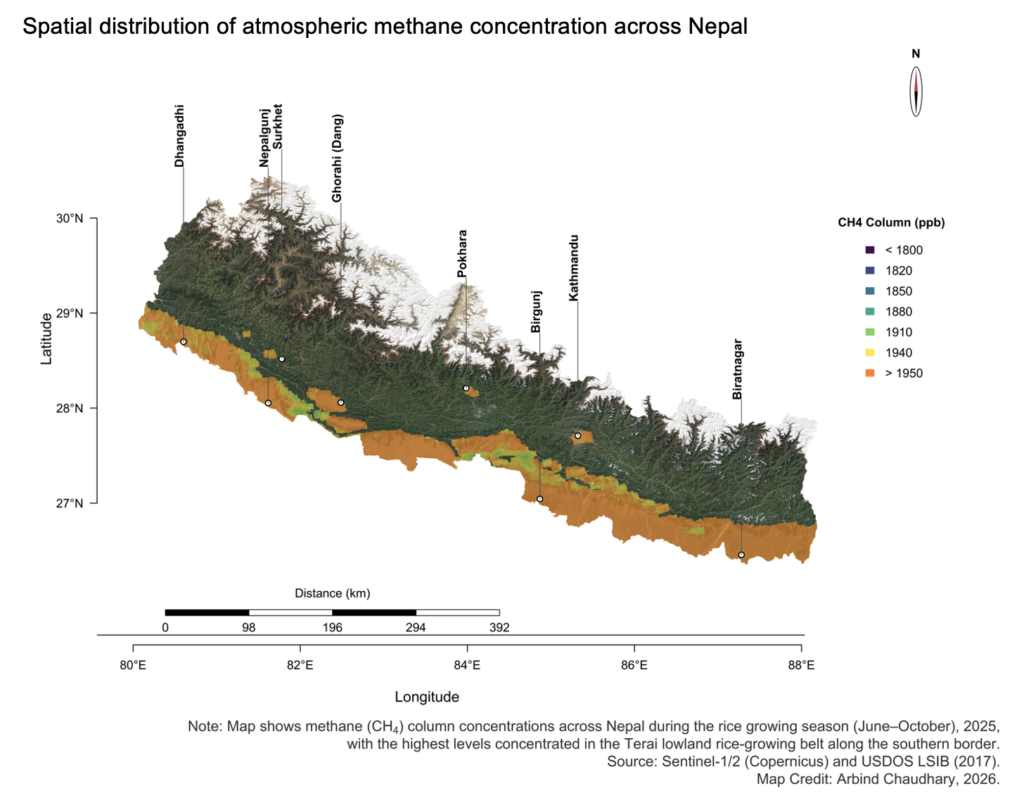
Expanding carbon market access to agriculture matters for two reasons: reducing emissions and generating income. Methane accounts for nearly 50% (28.1 MtCO₂e) of the national GHG profile (59 MtCO₂e), with livestock and crops contributing 18 MtCO₂e and 4.4 MtCO₂e, respectively. These emissions respond to on-farm practice rather than capital-intensive infrastructure and thus do not require large fiscal commitments; alternate wetting and drying (AWD), improved feed formulation, and efficient fertilizer use are established pathways that lower both costs and emissions.
Figure 1
Rice, methane, and alternate wetting and drying
Conventional flooded paddy cultivation is a significant source of methane. AWD involving periodic drainage rather than continuous flooding offers a well-established alternative. A recent meta-analysis found AWD reduces methane emissions by 51.6% compared with continuous flooding; another study in Nepal showed that AWD lowered the volume of water required for irrigation by approximately 57%, often with maintained or increased yields.
AWD requires no major capital investment and is scalable across Nepal’s 1.43 million hectares of rice cultivation, of which about 770,000 hectares (54.5%) are irrigated and potentially amenable to the practice. Available evidence indicates a mitigation potential of roughly 1.2 tCO₂e per hectare annually under AWD. At full scale across 770,000 irrigated hectares, this could generate around 924,000 tCO₂e in annual verified reductions, translating to $12 million-$25 million per year in credit revenue.
AWD should be understood as illustrative rather than a standalone business case. Its value lies in direct agronomic benefits that may matter more to farmers than the carbon payment itself and in demonstrating the type of practice change agricultural carbon finance could reward at scale.
Livestock, methane, and the larger opportunity
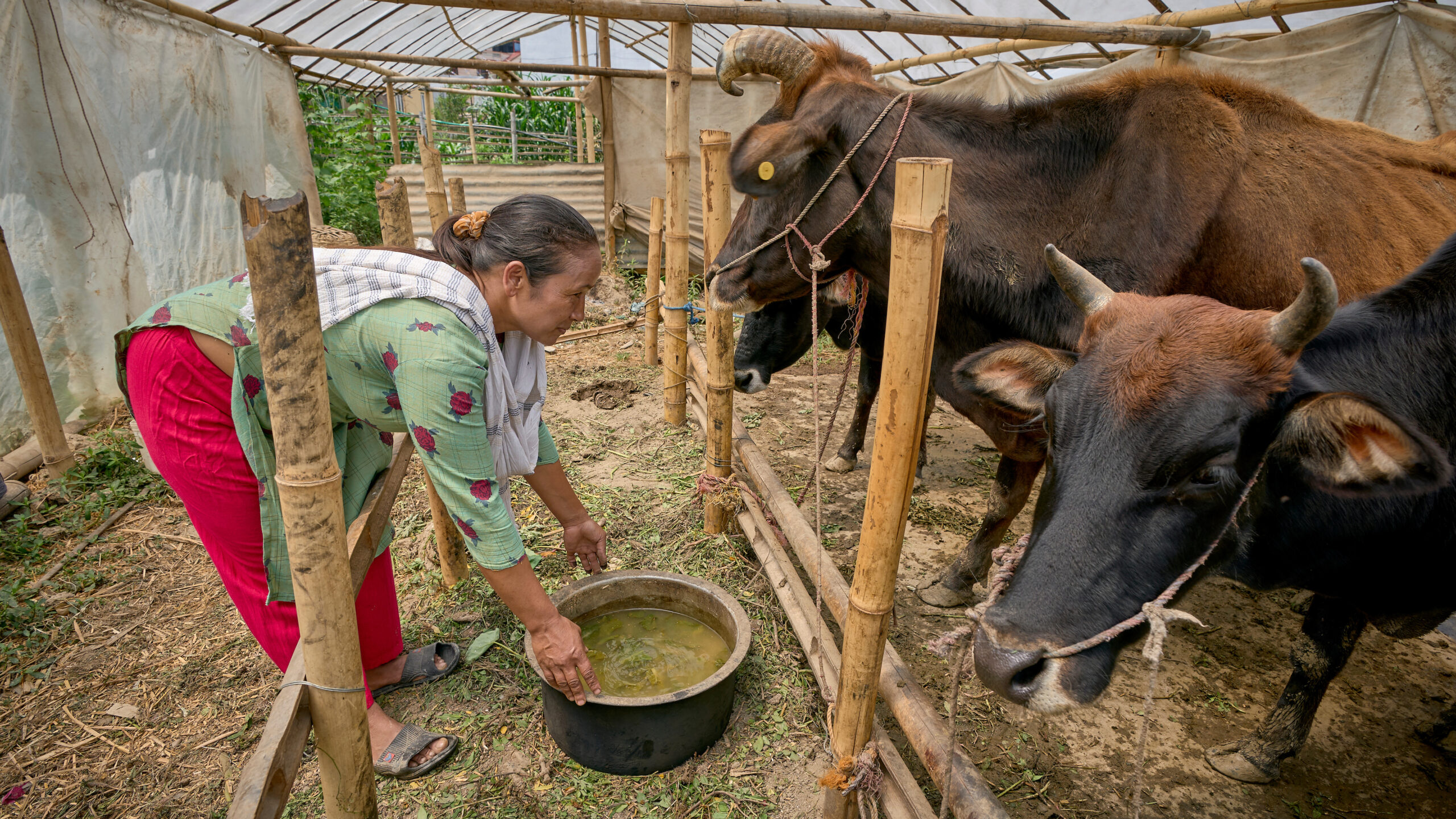
Livestock is Nepal’s leading source of agricultural methane, yet its carbon potential receives little attention compared to that of rice. But it warrants treatment on par with rice in any serious assessment of the country’s agricultural carbon opportunity.
Nepal has 5.2 million cattle, 3.3 million buffaloes, and 15.3 million goats, a herd whose scale suggests an opportunity for climate finance that may nationally exceed what rice cultivation can offer. Most livestock emissions arise from enteric fermentation, with manure management contributing a smaller share. Mitigation practices include improved feed formulation and additives such as nitrate or tannin supplements.
Using IPCC Tier 1 emission factors of 1.0 to 1.3 tCO₂e per animal annually, a 10%-15% reduction across half of the national herd could generate $15 million-$30 million per year at current market prices—comparable to, and potentially exceeding, AWD’s estimated returns. Methane’s short atmospheric lifetime makes near-term reductions attractive to buyers, and livestock mitigation maps well onto Nepal’s dairy cooperative infrastructure, allowing faster scaling than AWD.
A broader portfolio: improved livestock, agroforestry and on-farm energy
A durable carbon market strategy for Nepali agriculture should incorporate a portfolio of practices aligned with three revenue streams: production revenue, environmental service payments compensating farmers for stewardship of land and carbon stock, and renewable energy income.
Improved livestock feed and manure management can generate additional credits. Agroforestry and soil carbon practices, such as reduced tillage and biochar application, can sequester carbon while improving soil fertility. On-farm solar for irrigation offers cost savings that complement carbon payments.
For the purposes of carbon markets, each technology carries its own measurement, reporting, and verification (MRV) requirements and should not be oversold as an immediate solution. A diversified portfolio, anchored by AWD’s demonstrated feasibility and scaled through cooperative aggregation, offers a more credible path to revenue commensurate with institutional costs.
Building an agricultural carbon trading system
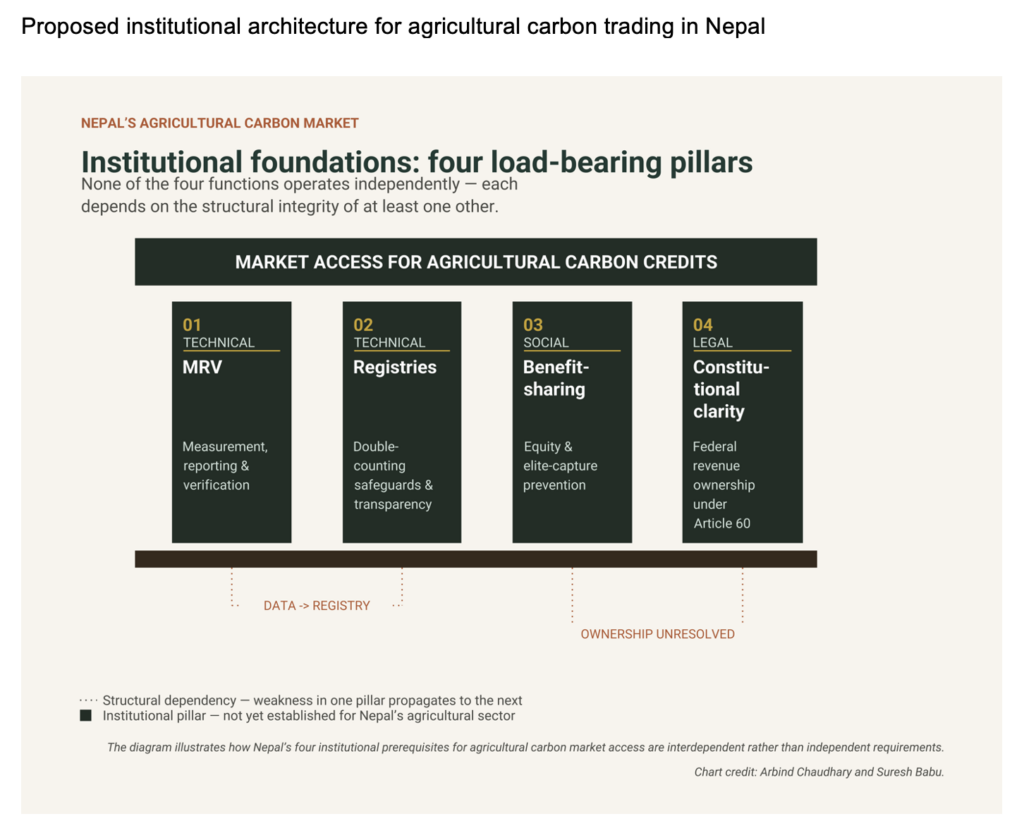
Creating robust agricultural carbon trading will require assembling the necessary institutional architecture.
Figure 2
Measurement, reporting, and verification (MRV)
MRV systems present perhaps the most immediate challenge. Nepal currently lacks agricultural MRV infrastructure capable of large-scale verification. Buyers require assurance that emissions reductions are real, measurable, additional, and permanent, but variability in land size and cropping conditions complicates measurement and imposes costs smallholders cannot bear.
Registries and safeguards against double counting
Transparent accounting systems are essential to prevent double counting, i.e., whether a reduction is sold multiple times or counted toward both national commitments and private offset claims. International scrutiny has intensified, and weak registries risk undermining Nepal’s credibility.
Constitutional and fiscal clarity
A more fundamental issue concerns constitutional authority. The 2025 regulation raises unresolved questions about the allocation of fiscal and natural resource powers under Nepal’s federal constitution, particularly Articles 60 and 116, which govern revenue-sharing across government levels.
This ambiguity is more than a technical concern, since investors and carbon buyers prioritize policy certainty, and unresolved jurisdictional disputes can discourage participation. Legislative amendments clarifying ownership rights and intergovernmental roles would enhance predictability.
Benefit sharing and equity
An equally important question is whether the benefits of carbon credits will reach smallholders who make the effort to participate. In many cases, local producers have received disproportionately small shares of revenue relative to intermediaries.
A prime example is the Kariba REDD+ forest conservation project in Zimbabwe. Launched in 2011, the project was designed to prevent deforestation across 758,000 hectares of land and directly financially support the local communities. The project generated over $100 million in carbon credit sales, but local communities and regional councils doing the ground-level conservation work received a mere $16 million.
Nepal’s program design should adopt a defined benefit-sharing model rather than relying on ad hoc negotiation between farmers and credit buyers. This approach guarantees a fixed farmer share, cooperative dividends channel payment through existing networks, and upfront payment reduces farmers’ cash-flow risk by disbursing revenue before verification.
Figure 3
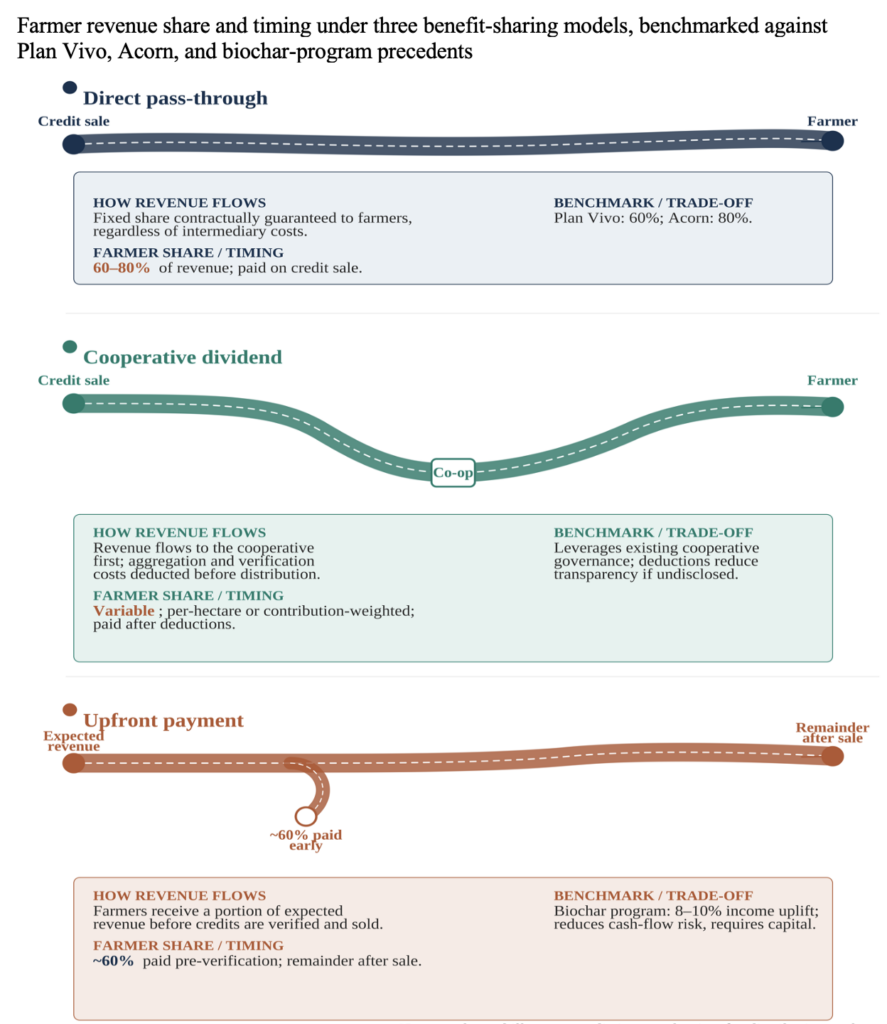
Source: Authors. Preferred by Nature (Plan Vivo, a community-focused voluntary carbon standard established in 1994, and Acorn, a Rabobank-Microsoft agroforestry program certified by Plan Vivo that returns roughly 70– of revenue to smallholder farmers); Climate Policy Initiative: a cluster-based biochar carbon removal model (Circkular AgroFintech) that pays 60% of revenue upfront to smallholders, with an early-reported 8–10 % income uplift.
Cooperatives as carbon aggregators: a Nepal-specific model
Nepal’s agricultural system is overwhelmingly dominated by smallholders, whose fragmented landholdings make individualized participation prohibitively costly. A scalable aggregation mechanism is therefore indispensable.
Nepal already possesses an underutilized asset for this role: its network of more than 34,000 registered agricultural cooperatives, many deeply embedded in rural communities, positioning them to intermediate between farmers and carbon markets.
Under a cooperative-as-aggregator model, cooperatives would coordinate farmer enrollment, training, data collection, and revenue distribution, bundling emissions reductions across many households into tradable assets and lowering transaction costs.
Cooperatives’ local trust makes farmers more likely to adopt unfamiliar practices such as AWD, and their governance provides a foundation for accountable benefit-sharing.
Building such a system will take time. Not all cooperatives possess the managerial capacity or transparency required, and governance weaknesses remain documented concerns. A successful model would require accreditation, technical support, and independent oversight.
Conclusion: Reframing Nepal’s agricultural future
Carbon markets will not independently transform Nepal’s economy, eliminate its dependency on food imports, or reverse labor migration out of agriculture. Yet agricultural carbon trading can function as a catalytic instrument within a broader agenda of rural revitalization, fiscal resilience, and food system transformation.
Carbon finance also differs structurally from the grants, loans, and remittances on which Nepal has long relied for rural development, reflecting surplus labor and low returns that have driven much of the rural workforce abroad. Because carbon payments are performance-based, they could help retain labor in agriculture.
If the MRV, registry, and benefit-sharing institutions described above are built, the cooperative network is mobilized for aggregation, and farmers employ a diversified portfolio of practices, Nepal’s carbon dividend could extend well beyond emissions reductions. The challenge now is to build institutions capable of capitalizing on this opportunity rather than to merely demonstrate its existence.
Arbind Chaudhary is a Climate Economist and Chairperson at the Policy Research Foundation, Nepal; Suresh Babu is a Research Fellow Emeritus with IFPRI’s Director General’s Office and teaches at the Department of Food, Agricultural, and Resource Economics (FARE), School of Environmental and Biological Sciences (SEBS), Rutgers University, New Jersey. Opinions are the authors’.