




Global Agrifood Systems Outlook to 2050
IFPRI Report | September 2026

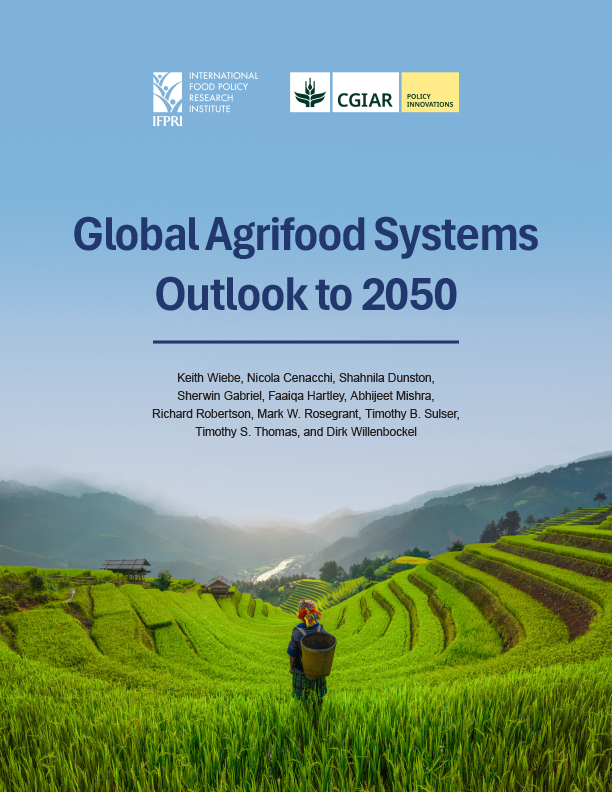
Recommended citation: Wiebe, Keith; Cenacchi, Nicola; Dunston, Shahnila; Gabriel, Sherwin; Hartley, Faaiqa; Mishra, Abhijeet; Robertson, Richard; Rosegrant, Mark W.; Sulser, Timothy B.; Thomas, Timothy S.; and Willenbockel, Dirk. 2026. Global Agrifood Systems Outlook to 2050. Report September 2026. Washington, DC: International Food Policy Research Institute. https://hdl.handle.net/10568/185223
Agrifood systems include all of the people, resources, and processes used to produce, transform, transport, and consume food. These systems have evolved in remarkable ways, driven by changes in population, income, technology, and climate.
How will these systems continue to evolve over the next 25 years? To answer this question, we need to learn from the past and carefully consider how the future may differ. Near-term forecasts on agricultural commodities and markets are widely available, but longer-term outlooks remain limited, especially for issues affecting low- and middle-income producers, consumers, and countries.
IFPRI’s Global Agrifood Systems Outlook to 2050 fills this gap by using advanced modeling tools to help project likely changes across major agrifood systems drivers and indicators over the next 25 years, at global and regional levels.
The report’s findings are critical for decision-makers, because these possible futures depend on the choices we make today, from daily decisions about what we eat to the policy and investment decisions that shape how nations use resources, innovate, and trade.
In this peer-reviewed publication, leading experts examine how population, income, technology, and climate interact to drive changes in food demand, production, prices, trade, resource use, food security and nutrition, and employment and income, covering seven regions and seven commodity groups.
Key findings provide details on how:
- Hunger, malnutrition, environmental sustainability, and climate resilience continue to be major challenges
- Projected outcomes differ significantly across regions, commodities, and populations
- Strategic policy and investment planning is critical to address emerging food, nutrition, and sustainability challenges
Explore the full report for more on the data, regional findings, and implications for policy and investment.
Press Release
News Release
-
New IFPRI/CGIAR report explores the future of global agrifood systems through 2050
Comprehensive long-term analysis highlights opportunities for progress and the need for strategic policy and investment planning to address emerging food, nutrition, and sustainability challenges.
Events
-
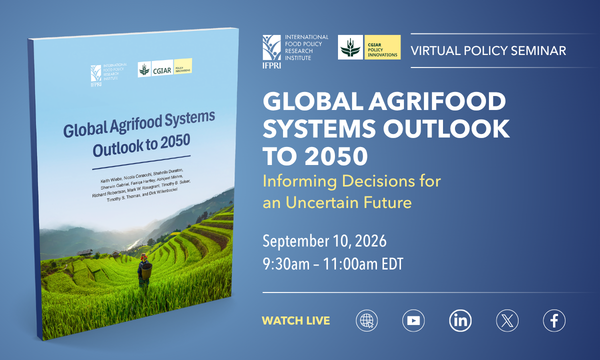 September 10, 2026, 9:30 – 11:00 am
Global Agrifood Systems Outlook to 2050: Informing Decisions for an Uncertain Future
Around the world, agrifood systems are changing rapidly as populations grow, incomes rise, technological innovations emerge, and the climate shifts. But how will these systems continue to evolve over the next 25 years? Anticipating and preparing for change requires us to learn from the past and anticipate future dynamics. While near-term forecasts and medium-term outlooks…
Related Materials
Working Paper
The International Model for Policy Analysis of Agricultural Commodities and Trade (IMPACT): Model documentation for version 4
Global Agrifood Systems Outlook to 2050: Key Indicators Dashboard
Explore the data in more detail—Coming soon!