Labor market and gender impacts of agricultural mechanization: Evidence from Bangladesh’s combine harvester subsidy program
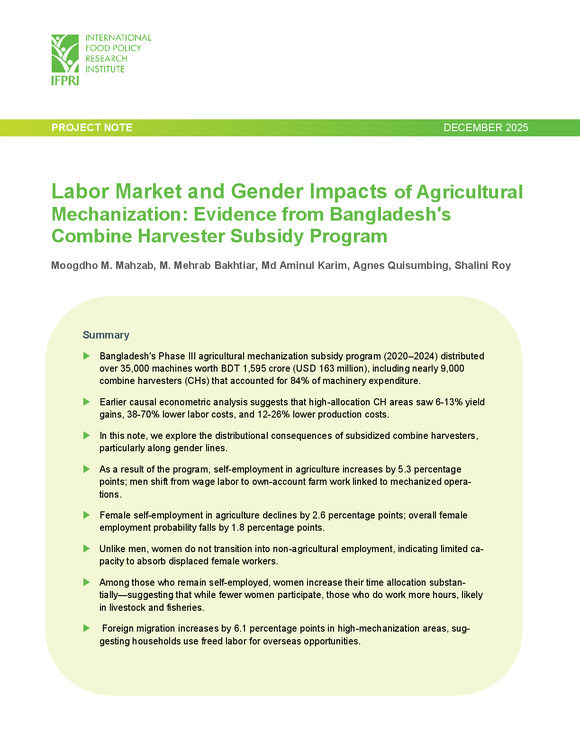
Bangladesh’s Phase III agricultural mechanization subsidy program (2020–2024) distributed over 35,000 machines worth BDT 1,595 crore (USD 163 million), including nearly 9,000 combine harvesters (CHs) that accounted for 84% of machinery expenditure. Earlier causal econometric analysis suggests that high-allocation CH areas saw 6-13% yield gains, 38-70% lower labor costs, and 12-26% lower production costs. In this note, we explore the distributional consequences of subsidized combine harvesters, particularly along gender lines. As a result of the program, self-employment in agriculture increases by 5.3 percentage points; men shift from wage labor to own-account farm work linked to mechanized operations. Female self-employment in agriculture declines by 2.6 percentage points; overall female employment probability falls by 1.8 percentage points. Unlike men, women do not transition into non-agricultural employment, indicating limited capacity to absorb displaced female workers. Among those who remain self-employed, women increase their time allocation substantially—suggesting that while fewer women participate, those who do work more hours, likely in livestock and fisheries. Foreign migration increases by 6.1 percentage points in high-mechanization areas, suggesting households use freed labor for overseas opportunities.
Authors
Mahzab, Moogdho; Bakhtiar, M. Mehrab; Karim, Md. Aminul; Quisumbing, Agnes R.; Roy, Shalini
Citation
Mahzab, Moogdho; Bakhtiar, M. Mehrab; Karim, Md. Aminul; Quisumbing, Agnes R.; and Roy, Shalini. 2025. Labor market and gender impacts of agricultural mechanization: Evidence from Bangladesh’s combine harvester subsidy program. IFPRI Project Note. Washington, DC: International Food Policy Research Institute. https://hdl.handle.net/10568/178946
Country/Region
Bangladesh
Keywords
Asia; Southern Asia; Labour Market; Gender; Impact; Agricultural Mechanization; Subsidies; Combine Harvesters
Access/Licence
Open Access