





Shared natural resources such as cultivated land, water, wetlands, fisheries, and forests play a vital role in supporting human well-being but are often contested: Both between individuals and groups or between groups of competing resource users. These conflicts can be hard to manage; and government regulations and markets often fall short. Cooperation and self-regulation among local actors can be a powerful alternative or complement to formal mechanisms. However, supporting their development becomes particularly challenging when local governance structures are weak or entirely absent.
Experiential learning games that simulate resource conflicts and cooperation are increasingly used as tools for this purpose. Playing such games can vividly illustrate social-ecological system dynamics, raising awareness of tradeoffs and offering ways to discuss and finding solutions to address them cooperatively.
By providing a safe, low-risk space for exploration, simulating long-term decisions, and building trust through communication, games can foster social and experiential learning, sparking individual or collective behavioral change, and ultimately improve resource management. Unlike conventional teaching, games help participants actively discover their own locally appropriate rules for resource management. These are often better suited to the game players’ unique context and needs than rules imposed from the outside, and participants are more motivated to implement them.
Such games were the focus of a session at the 20th Biennial Conference of the International Association for the Study of the Commons, which took place in Amherst, Massachusetts in June 2025. Panelists presented four studies showcasing the use of games—and complementary approaches such as visioning exercises and debriefing discussions—for understanding and promoting collective action and behavior change in sustainable resource governance.
The cases, presented by Thomas Falk and Wei Zhang from IFPRI as well as Juan Felipe Ortiz-Riomalo of the University of Osnabrück, Germany, and Franziska Auch of the University of Stuttgart, Germany, spanned three continents, covering Colombia, India, Kenya, and Namibia.
What behavioral change did each game seek to influence?
In Colombia, the intervention took place in Lake Tota, the country’s largest lake, where intensive use of water and fertilizers for the cultivation of onions, potatoes, and berries led to deteriorating soil and water quality and threatens biodiversity. Game participants were asked to imagine and discuss their desired future for the local ecosystem, focusing on the impacts that alternative practices such as reduced water use might have on the ecosystem and on people’s livelihoods.
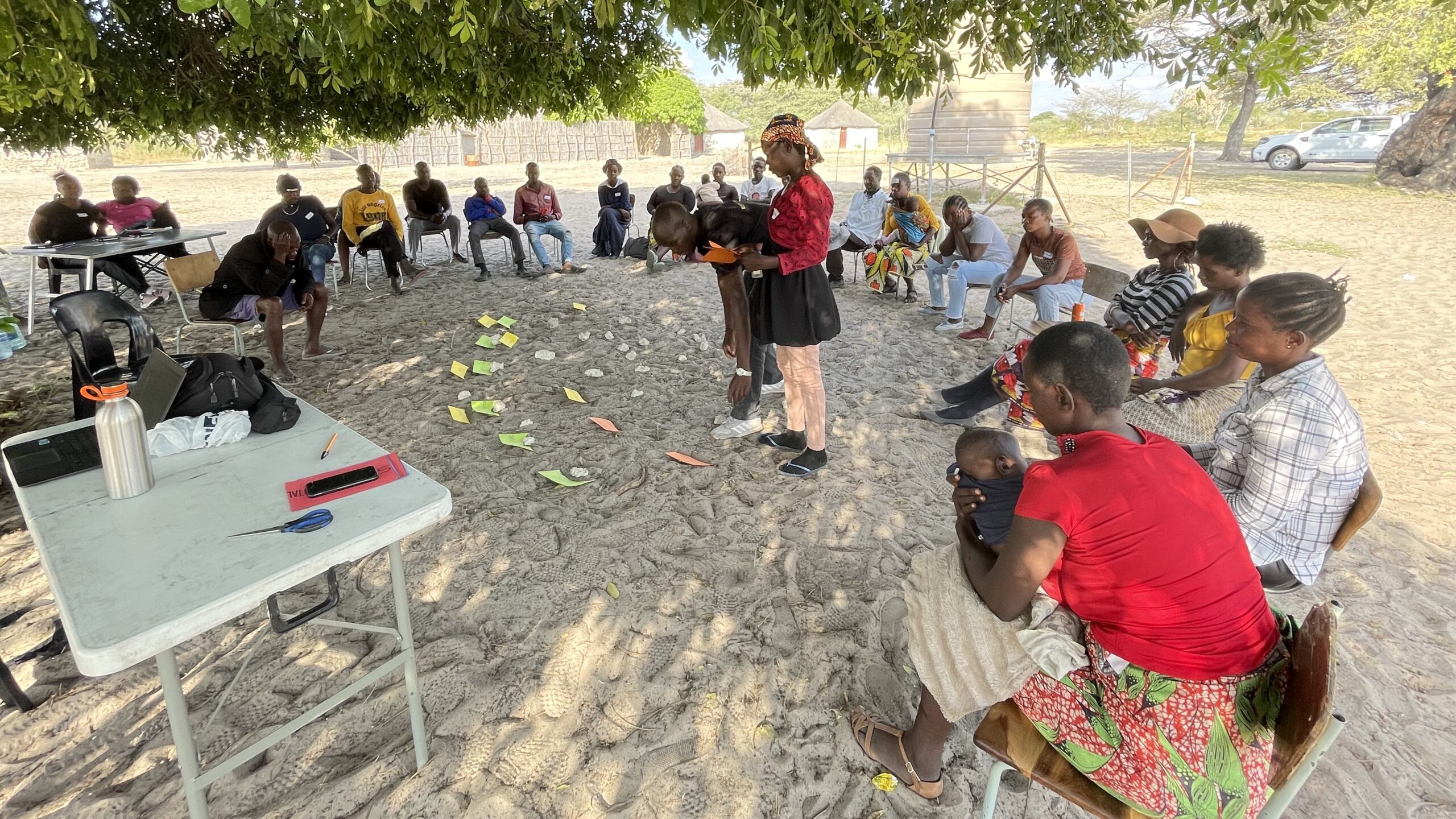
In Namibia’s Zambezi region, where communities face increasing droughts and floods, the intervention focused on fostering community-based climate adaptation strategies. The game simulated an intergenerational dilemma, highlighting how present-day actions—such as preparing for droughts and floods —impact the well-being of future generations. It aimed to build empathy for future generations, boost self-efficacy (the extent to which people believe they are capable of acting), and encourage information-seeking around climate change as preparatory steps for taking climate action.
Kenya’s intervention complemented efforts of local communities supported by the CGIAR Research Initiative on Nature-Positive Solutions (now part of the Multifunctional Landscapes Science Program) to pilot farming schemes in Kisumu and Vihiga counties, where farmers jointly manage land. Such aggregated sustainable farming aims to support biodiversity conservation at a landscape scale while achieving economies of scale in farm management. Joint farming requires trust, coordination, and collective action among many diverse smallholders. The intervention used the SharedCropping game, which aims to foster cooperation and institutional development capacities, enabling farmers to align their practices across ecological and social boundaries, and experiment with group rules for improved economic and sustainability outcomes.
In India, the focus was on rapidly depleting groundwater resources in the states of Andhra Pradesh, Karnataka, and Rajasthan. With little effective state regulation, collective action among farmers is urgently needed. The game aimed to nudge participants to shift to water-saving practices such as growing water-efficient crops, investments in the maintenance of village dams and other community-managed water infrastructure, and creating local rules to coordinate efforts and prevent groundwater depletion.
The game mechanisms to support behavioral change, and evidence on achieved behavioral change
Across all cases, the games and other exercises encouraged reflection and engaged both emotional and cognitive drivers of cooperation and long-term planning.
In Colombia, a participatory vision-building exercise was combined with a game emphasizing trade-offs between the immediate income of farmers and long-term sustainability of the lake and the well-being of people living around it. While the visioning exercises appeared to trigger more cooperation in the game, the effect was not statistically significant. However, exploratory analyses do suggest that the visioning nurtured inspiration and preferences for unilateral pro-social action in the lake area. Participant reflections and debriefing workshops indicate that the exercise helped participants recognize their interdependence and the importance of collective action.
In Namibia, a game, debriefing and visioning exercises were combined. The game assigned players to represent either present or future generations, and they had to choose between immediate gains or investments creating benefits for the future generation. Its focus was on influencing perceptions of threats, behavior controls (especially self-efficacy), and social norms to create motivation to act in the interest of future generations. The presented study confirmed that the intervention increased participants’ self-efficacy in coping with climate change and the demand for climate information. Players broadened their focus on resource management, becoming more likely to consider both short- and long-term impacts. Six out of 26 treated communities independently developed and shared concepts of local climate action projects.
In India and Kenya, changing real-life behaviors towards more positive socioecological outcomes was assumed to happen through changing mental models and drawing attention to pro-social norms. In Kenya, the game was played on tablets in single- and mixed-gender groups, with all-female and mixed-gender groups performing particularly well. The game modeled land use, farming intensity, community conservation practices, among other farming decisions. Those choices had both economic and environmental implications, for example, adopting low- or high-intensity farming practices or deciding whether to cut down or conserve nitrogen-fixing trees. Post-game discussions focused on governance, fairness, and environmental trade-offs, reinforcing trust and cooperation. Evidence shows that participants started paying attention to the benefits of investing time in farming for the benefit of the community after playing the game. There was evidence of technical learning about soil health and land use diversification, and greater appreciation for group coordination challenges. These lessons persisted in a follow-up visit.
In India, five players in the groundwater game chose between high-profit, high-water-use crops and less profitable, water-saving crops. The game simulated groundwater depletion and recharge. Rounds were played with and without communication, demonstrating how coordination could support sustainability. An impact assessment indicates significant improvements in local governance, infrastructure maintenance, water-saving practices, and women’s participation in decision-making.
How can the benefits of games be scaled up?
Given their promise, especially at the pilot level, there is a growing interest in scaling games to reach many more communities—while maintaining their relevance in local contexts and their financial viability.
Thus, developing scaling strategies is a key issue, panelists agreed. Scaling strategies could include partnering with extension agencies or NGOs to incorporate games into their activities, and using games to complement other participatory approaches aimed at facilitating learning processes, collective action institutions (rules and norms), and changing behaviors. In India, for example, partnering with large government programs enabled new partners to independently apply the games in almost 5,000 communities. Ongoing research on the long-term effects of these interventions, as well as dissemination of results and other complementary approaches to sustain engagement, will be crucial for civil society, government, and even private sector partners to integrate the approach into their intervention strategies.
Overall, the session demonstrated the potential of experiential learning games as powerful tools for catalyzing collective action in natural resource governance. By immersing participants in realistic scenarios and supporting structured group deliberations these games make abstract dilemmas tangible, spark reflection, and foster new institutional arrangements and decision-making processes. As these interventions spread and evolve, they offer a hopeful path toward more resilient and collaborative communities.
Hagar ElDidi is a Senior Research Analyst with IFPRI’s Natural Resources and Resilience (NRR) Unit;, Thomas Falk is an NRR Research Fellow; Juan Felipe Ortiz-Riomalo, postdoctoral researcher at the Department of Environmental Economics (School of Business Administration and Economics), and member of the IUSF Research Centre, Laboratory of Economics Research (LaER) and ECORISK at Osnabrück University; Germany; Franziska Auch is a PhD student at the University of Stuttgart, Germany (Institute of Economics and Law) and Political Economy of Global Development Lab; Wei Zhang is an NRR Senior Research Fellow; Upeksha Hettiarachchi is an NRR Research Analyst. Opinions are the authors’.
The session was a contribution to work on Nexus Policies under the CGIAR Policy Innovations Science Program.
Juan Felipe Ortiz-Riomalo’s work (Colombia) is co-authored by Stefanie Engel (Osnabrück University) and Ann-Kathrin Koessler (Leibniz University Hannover) Working paper: https://papers.ssrn.com/sol3/papers.cfm?abstract_id=4911063
Franziska Auch’s work (Namibia) is co-authored by Thomas Falk (IFPRI), Ivo Steimanis (University of Marburg), Björn Vollan (University of Marburg), and Meed Mbidzo (Namibian University of Science and Technology).
Wei Zhang’s work (Kenya) is co-authored by Andrew Bell (Cornell University), Balentine Oingo and Ivy Blackmore (independent consultants), Upeksha Hettiarachchi, Dickson Kinuthia, and Kristin Davis (IFPRI).
Thomas Falk’s work (India) is co-authored by Richu Sanil and Pratiti Priyadarshini (FES), Mequanint Melesse and Vishwambhar Duche (ICRISAT), Ruth Meinzen-Dick, Katrina Kosec, Hagar ElDidi, Lucia Carrillo, and Wei Zhang (IFPRI).
ChatGPT and Perplexity were used iteratively during the drafting of this blog post. The authors provided the content and the text was carefully reviewed and edited for publication.