





Key takeaways
•A new systematic risk profiling (SRP) tool analyzes the varied triggers of economic shocks in developing countries using economy-wide models, historical data, and machine learning.
•SRP was used to simulate thousands of shock scenarios in 11 countries, showing that household‑level welfare is often shaped more by global price and capital‑flow shocks than by domestic agricultural crises.
•By identifying country‑specific risk profiles, SRP enables targeted policymaking, helping governments tailor responses to build resilience to shocks with local or global origins.
When we think about economic crises in developing countries, we tend to picture droughts, floods, or pest outbreaks devastating local agriculture and driving up poverty and undernourishment. While that scenario is accurate for some countries, it tells only part of the story.
In today’s interconnected world, economic shocks rarely occur in isolation. Weather-related shocks may collide with spikes in global energy and fertilizer prices or sudden interruptions in foreign capital flows. Understanding how these forces interact at the country level is the first step to designing policies that respond to shocks and build long-term resilience. Yet, most traditional analytical tools are only equipped to look at shocks one at a time.
To bridge this gap, IFPRI recently applied a new analytical framework—systematic risk profiling (SRP)—across 11 developing economies in Africa and Asia. By combining economy-wide models, historical data, and machine learning, we simulated 10,000 correlated shock scenarios per country. Results show that the shocks countries face are driven by a range of local and global factors and that the relative importance of these factors varies across countries. Our findings reveal which risks are most important for a country and can help policymakers manage economic uncertainty and protect vulnerable populations.
The disconnect between GDP and household welfare
When evaluating national vulnerability, analysts often look at aggregate GDP. Our study confirmed that in most of the analyzed developing countries, overall GDP volatility is predominantly driven by domestic agricultural shocks. When agriculture experiences problems, the whole economy is affected.
However, when we zoom in on household-level welfare—specifically private consumption, poverty, and undernourishment—a somewhat different risk profile emerges. Even in highly agrarian economies, the welfare of the poorest and most vulnerable populations is frequently dictated by external, global shocks. World market prices for exported commodities and the volatility of foreign capital flows often govern a country’s exchange rate. When these external factors fluctuate, they dictate the affordability of imported food, fuel, and fertilizers, often hitting poor households harder than a localized crop failure.
Two typologies of risk
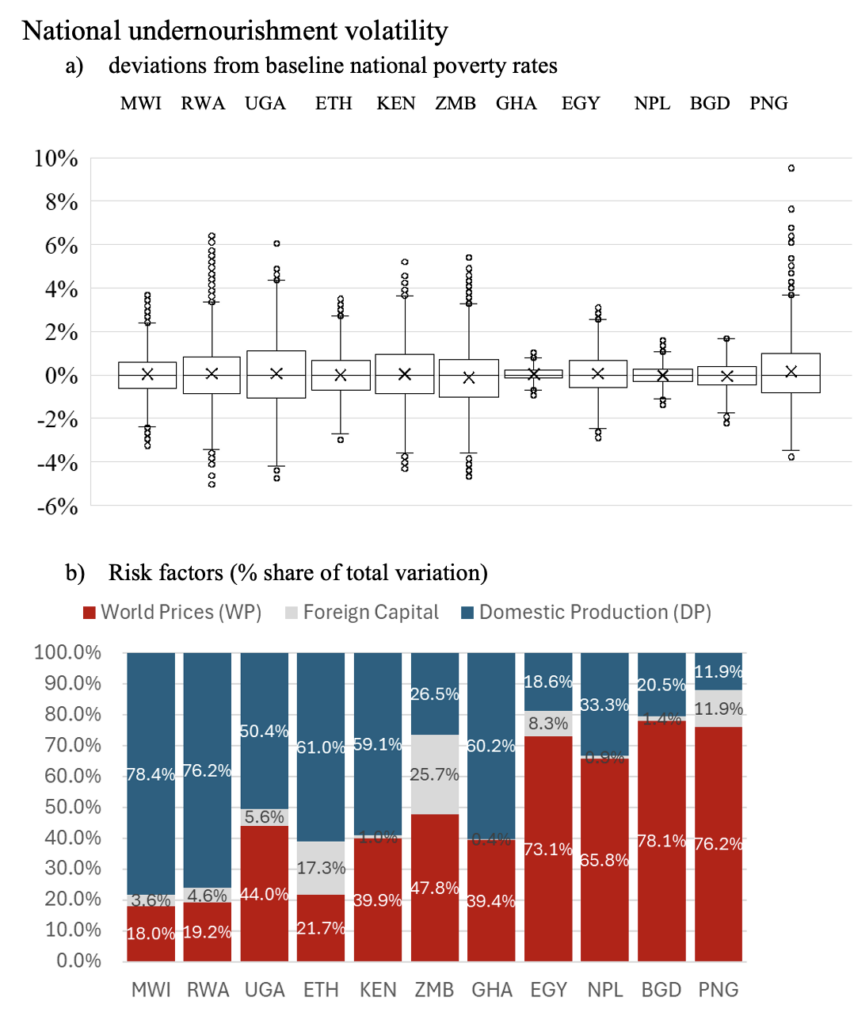
By unpacking the data across 11 countries (Bangladesh, Egypt, Ethiopia, Ghana, Kenya, Malawi, Nepal, Papua New Guinea, Rwanda, Uganda, and Zambia), we found that national vulnerability is not uniform (Figures 1 and 2). Instead, countries generally fall into two distinct risk typologies, each requiring a different policy response:
1. Domestic yield-dependent economies (the agronomic story)
In low-income, heavily agrarian economies like Malawi, Rwanda, and Uganda, the primary systemic risks are domestic. In these countries, the physical availability of staple crops like cereals and roots directly drives aggregate output and household calorie supplies. Traditional agricultural interventions remain central. This suggests that risk mitigation should focus on agronomic resilience: expanding irrigation infrastructure, improving decentralized food storage, or adopting drought-resistant seeds to buffer against extreme weather.
2. Macro-dependent economies (the macroeconomic story)
In resource-dependent economies like Papua New Guinea and Zambia or open middle-income economies like Kenya and Nepal, a different reality predominates. For example, in Kenya, external shocks account for more than 60% of the variation in national poverty, driven heavily by fluctuations in the global prices of its main exports (coffee and tea). In Zambia, shocks to global copper and mineral prices, or sudden reversals in foreign capital inflows, can constrain the state’s capacity to import food and/or affect household purchasing power. In these countries, remedies should focus on macroeconomic stabilization. Finance ministries and central banks can take the lead through foreign exchange reserve management, strategic trade diversification, and counter-cyclical social safety nets designed to protect purchasing power during global price spikes.
Figure 1
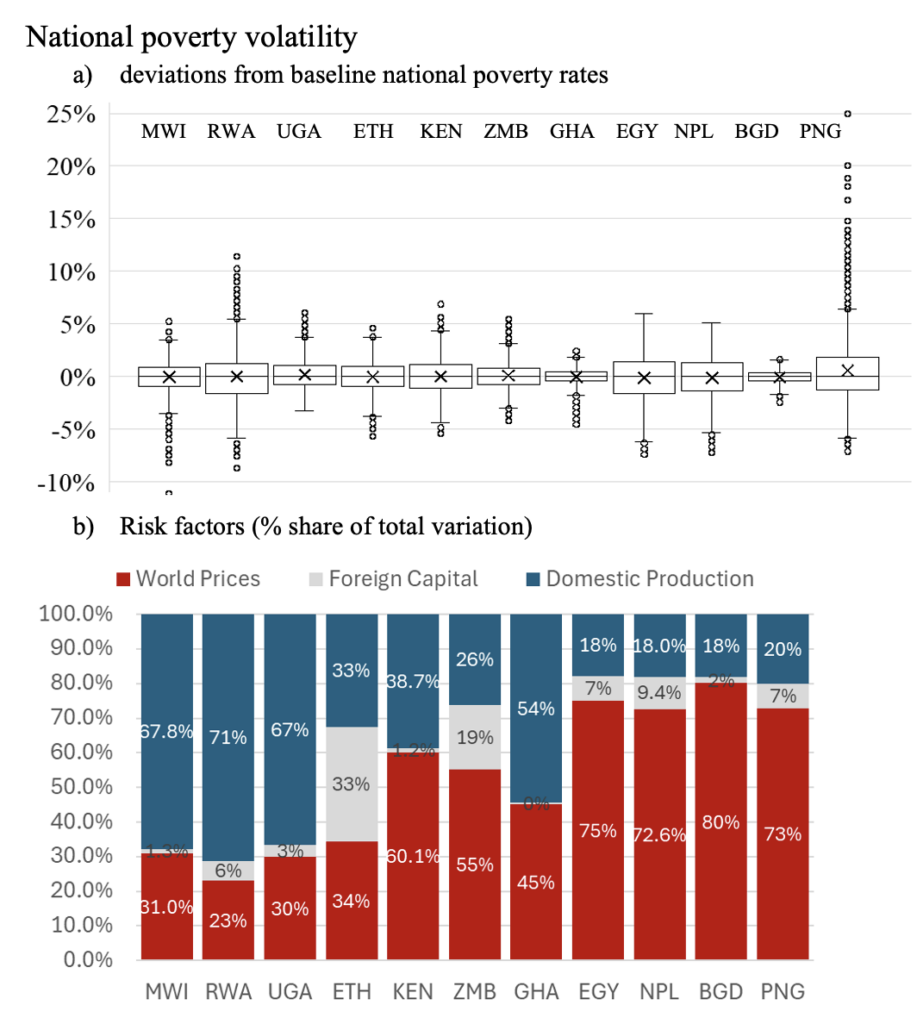
Figure 2
Moving from reactive to proactive policy
Our approach provides a powerful tool for policymakers. By acknowledging the compounding nature of domestic and external risks, governments and development partners can move from reacting to crises toward proactively identifying the most consequential risks to their economies and targeting mitigation efforts there, before disaster strikes.
Having identified the primary sources of economic volatility, subsequent research will evaluate the efficacy of targeted risk management strategies. Future analyses will focus on simulating and comparing alternative policy responses. These range from productivity-enhancing investments and the adoption of yield-stabilizing technologies that directly narrow production uncertainty to broader structural transformations such as diversifying production toward less volatile agricultural subsectors or reducing the economy’s overall reliance on highly volatile sectors.
Askar Mukashov is a Research Fellow with IFPRI’s Foresight and Policy Modeling (FPM) Unit; Eleanor Jones is an FPM Program Manager. This post is based on research that is not yet peer-reviewed. Opinions are the authors’.
This work was supported by the United Arab Emirates and the CGIAR Program on Policy Innovations.
Reference
Mukashov, Askar; Robinson, Sherman; Arndt, Channing; Thurlow, James; and Thomas, Timothy S. 2026. Systematic risk profiling: Assessing compounding economic risks in developing countries. Economic Modelling 157(April 2026): 107511. https://doi.org/10.1016/j.econmod.2026.107511