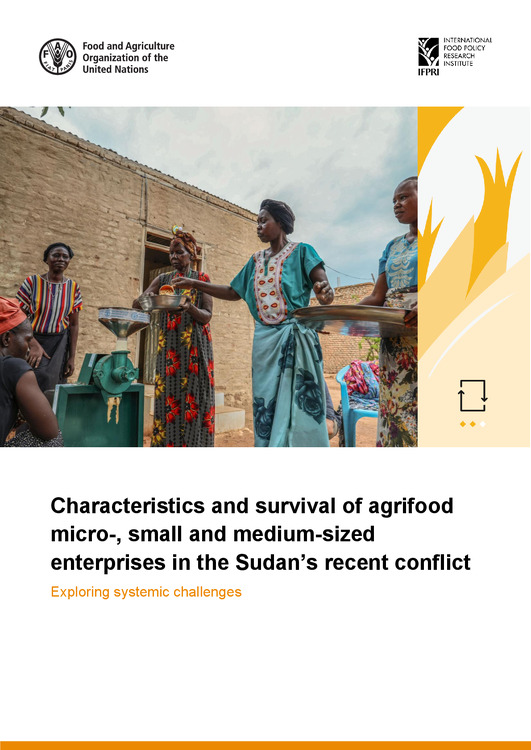
Characteristics and survival of agrifood micro-, small and medium-sized enterprises in the Sudan’s recent conflict: Exploring systemic challenges
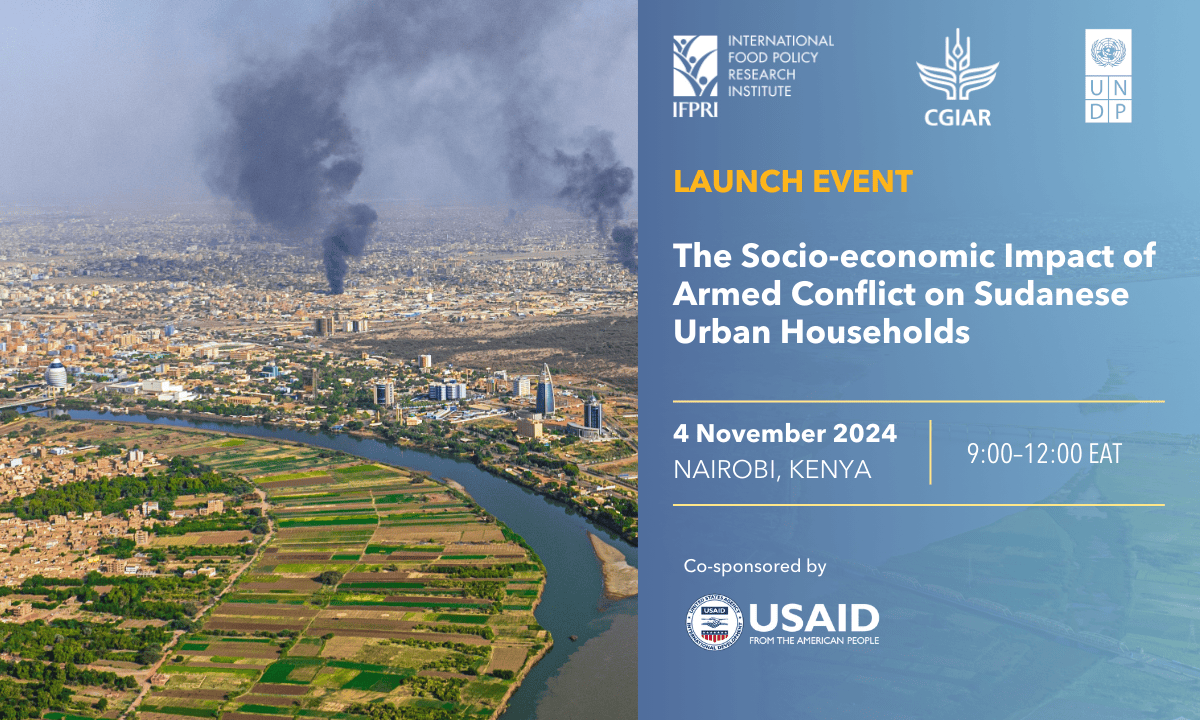
The outbreak of violent conflict in the Sudan in April 2023 severely disrupted agrifood systems (AFS), markets and livelihoods. Micro-, small and medium-sized enterprises (MSMEs) are playing a critical role in sustaining food supply, employment and economic activity. This paper examines which firm-level characteristics are associated with higher levels of operational continuity among MSMEs that have continued operations during the ongoing conflict. The analysis uses nationally representative data from a survey of MSMEs in 2024 by IFPRI and the UNDP, conducted through computer-assisted telephone interviews across 13 states of the Sudan. It links firm-level outcomes with locality- or district-level conflict exposure data from the Armed Conflict Location & Event Data (ACLED). The empirical analysis focuses on 785 enterprises that were operating prior to the conflict and continued operations thereafter. Firms’ post-conflict operational status is measured using an ordered categorical variable ranging from no operations to full operational capacity, and an ordered logit model is used to estimate how firm characteristics are associated with operational recovery.
Descriptive results indicate substantial disruption among surviving firms: 57 percent of enterprises relocated at least once, 62 percent experienced temporary closure, and only 19 percent were operating at full capacity at the time of the survey. Average monthly sales declined sharply, particularly for non-agricultural AFS enterprises, and permanent employment fell across all enterprise types. Econometric results show that sector affiliation and commodity type are not significant predictors of a firm’s operational level. Instead, operational outcomes are strongly associated with value chain position, firm size, financial inclusion, formality, owner characteristics, and pre-conflict enterprise location. Input dealers display significantly higher odds of operating at higher capacity relative to producers, while firms in support services such as logistics, transport and packaging face significantly lower odds. Small and medium-sized firms, female-owned enterprises, firms with bank accounts, and enterprises that were not financially constrained prior to the conflict are more likely to be sustaining higher operational levels. In contrast, registered firms, those with multiple pre-conflict branches, and those located in high-intensity conflict areas, particularly Khartoum, are significantly less likely to be operating at higher capacity.
The findings highlight that enterprise resilience during conflict is shaped more by structural and institutional characteristics than by sector alone. Policy responses should therefore prioritize restoring midstream value chain functions, expanding access to conflict-adapted financial services, and supporting and protecting logistics and transport networks, particularly in relatively safer states that have become hubs for displaced firms. Strengthening these enterprises is essential, not only for firm survival, but also for maintaining AFS functioning and supporting broader economic stabilization in fragile and conflict-affected settings.
Authors
Gupta, Ishika; de la O Campos, Ana Paula; Schuster, Monica; Bertini, Raffaele; Siddig, Khalid; Kirui, Oliver K.; Abushama, Hala; Mohamed, Shima; Rakhy, Tarig
Citation
Gupta, Ishika; de la O Campos, Ana Paula; Schuster, Monica; Bertini, Raffaele; Siddig, Khalid; et al. 2026. Characteristics and survival of agrifood micro-, small and medium-sized enterprises in the Sudan’s recent conflict: Exploring systemic challenges. Rome, Italy; and Washington, DC: Food and Agriculture Organization of the United Nations; and International Food Policy Research Institute. https://doi.org/10.4060/ce1448en
Keywords
Africa; Northern Africa; Capacity Building; Agrifood Systems; Agricultural Sector; Agro-industrial Complexes; Small and Medium Enterprises; Microenterprises; Conflicts; Impact Assessment; Markets; Livelihoods; Agricultural Value Chains; Vulnerability; Resilience; Food Supply; Food Security; Financial Inclusion; Logistics; Research Methods; Data Collection