





Key takeaways
- Food insecurity measures often disagree. Different indicators can suggest very different trends and identify different countries as most vulnerable.
- Data gaps hinder accurate monitoring. Low-income and crisis-affected countries are the least likely to conduct the surveys needed to track food insecurity.
- Stronger country-led surveys are essential. More coordinated, high-frequency data collection could improve food security monitoring and policy responses.
The newly released State of Food Insecurity and Nutrition in the World 2026 (SOFI 2026) rightly emphasizes that “Today’s global challenges compel us to urgently address hunger, food insecurity and malnutrition as multiple crises increasingly disrupt global agrifood systems.” A critical first step in addressing food insecurity is rigorous and timely monitoring, which is pivotal for tracking development targets, for responding to these multiple crises, and for allocating scarce foreign aid to the populations most in need.
Since 2014, SOFI reports have commendably published an increasingly broader suite of indicators to monitor global and regional food insecurity. Worryingly, however, these indicators often differ on whether global food insecurity is rising or falling and on which countries are most insecure. In a new article in the journal Food Policy, I raise some constructive questions about these conflicting results and make the case for coordinated investments in more country-driven high-frequency survey systems to improve the accuracy, timeliness, and efficiency of food insecurity and nutrition monitoring.
More metrics have led to mixed messages
Food security is achieved when all people, at all times, have physical and economic access to sufficient safe and nutritious food that meets their dietary needs and food preferences for an active and healthy life. For many decades, the international development community relied on the UN Food and Agriculture Organization’s (FAO) modeled estimates of the prevalence of undernourishment (PoU) to track global food insecurity. However, conceptual and methodological problems with this indicator led the FAO to also develop the Food Insecurity Experience Scale (FIES), which asks individuals to self-report specific experiences like worrying about not having enough food (indicating moderate food insecurity) or going a whole day without eating a meal (severe food insecurity). Since 2014, FIES indicators have been collected by the Gallup World Poll in over 150 countries, though mostly with survey sizes of just 1,000 individuals per country.
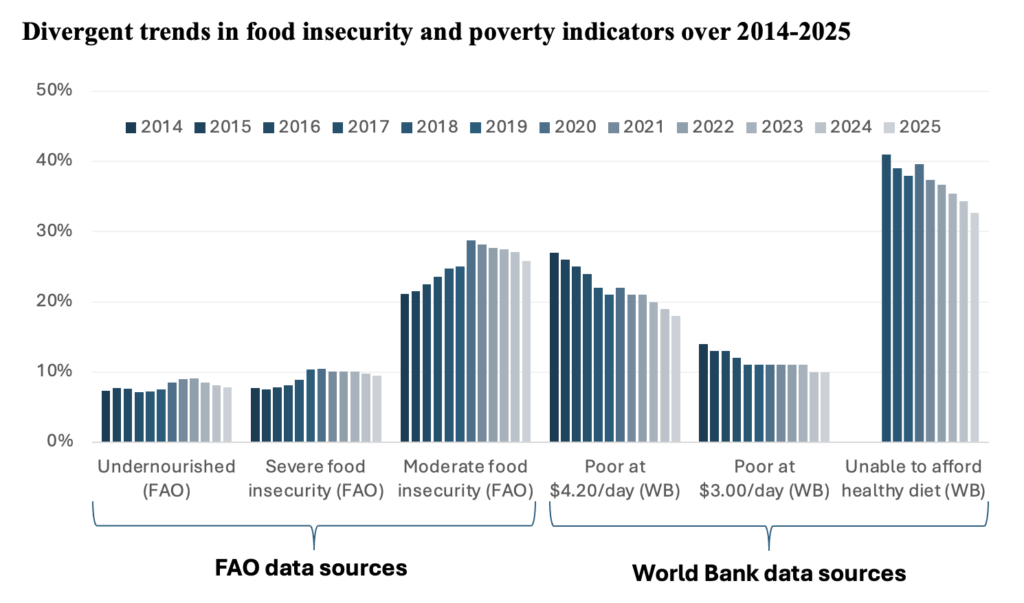
Both the PoU and FIES indicators trended upwards from 2014 until the COVID-19 shock in 2020 (Figure 1), and sharply so in the case of moderate FIES-based food insecurity: from 21% in 2014 to 29% in 2020. This led multiple SOFI reports during this period to conclude that global food insecurity was rising from 2014 onwards, then falling modestly post-pandemic.
Yet this contrasts with World Bank estimates that the $4.20/day poverty rate fell from 27% to 22% over 2014-2020. Progress on extreme poverty ($3.00/day) was more modest (14% in 2014 to 11% in 2020). At the same time, a new World Bank indicator of the share of people unable to afford a healthy diet declined every year except 2020 (COVID-19), from 41% in 2017 to 33% in 2025.
In summary, Figure 1 shows a frequent disconnect between food insecurity indicators produced by the FAO (including the Gallup World Poll) and poverty and diet affordability indicators produced by World Bank sources (including national income/expenditure surveys). Of course, all of these indicators are methodologically different, and poverty measurement only indirectly captures food insecurity through poverty lines generally based on caloric requirements. But this divergence still begs the question: why are different measures generating mixed messages?
Figure 1
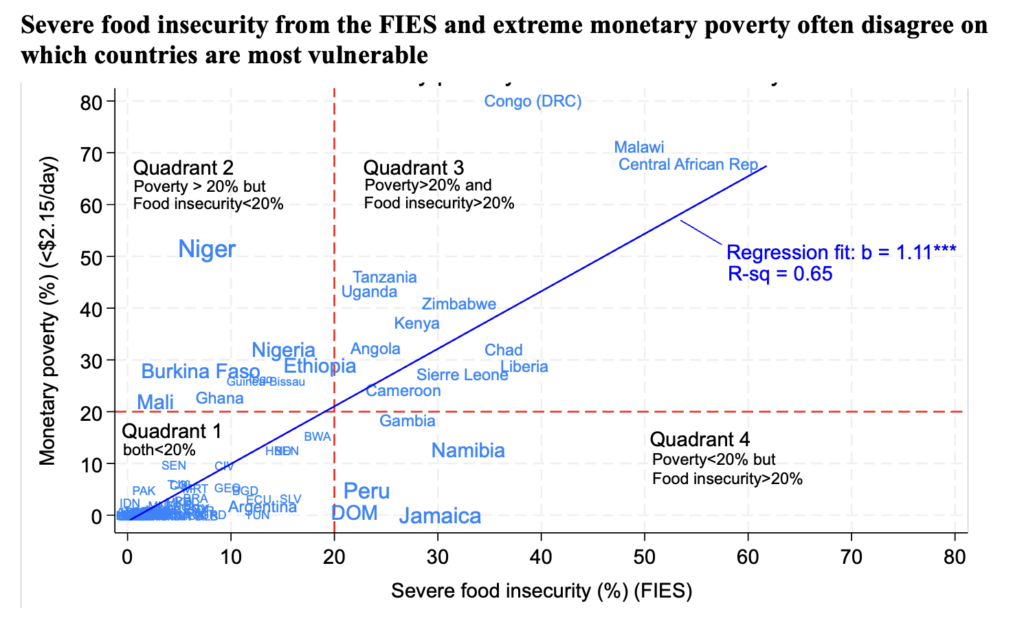
Unfortunately, these respective food insecurity indicators don’t just disagree on global trends—they also differ on which countries are most insecure. Figure 2 shows a cross-country comparison of FIES-based severe food insecurity against extreme monetary poverty, with a regression line showing the predicted relationship between the two indicators and the various country observations illustrating variation around that line. Strikingly, there are large and systematic outliers where poverty is high but FIES-based food insecurity is low (quadrant 2), or where poverty is low but FIES-based food insecurity is high (quadrant 4).
Take Niger, for example. The FIES suggests severe food insecurity was just 7.7% in Niger in 2021, compared to an extreme monetary poverty rate of 50.6% (multidimensional poverty in Niger is even higher at 90%, making it one of the poorest countries in the world). Niger is not the only African outlier in quadrant 2: Burkina Faso, Mali, Nigeria, and Ethiopia also have surprisingly low FIES-based food insecurity rates.
Now look at quadrant 4, which is populated by upper middle-income countries like Jamaica, Peru, and the Dominican Republic, which have poverty rates under 5% but FIES-based food insecurity greater than 20%—around four times higher than Niger. Clearly, the FIES data look implausible in these instances.
Other independent studies have raised similar concerns. Wambogo et al. (2019) find that the Gallup-based FIES indicators in sub-Saharan Africa don’t perform as expected in many countries, and the authors also question the indicators’ cross-cultural comparability. Using non-Gallup household surveys in West Africa, Lain et al. (2024) find that the FIES has weak correlations with other food and nutrition insecurity indicators and fails to produce the expected spatial patterns. For example, the FIES indicators suggest food insecurity is worse in southern Nigeria than in northern Nigeria, despite the north’s much higher rates of poverty and child malnutrition. Collectively, then, this body of evidence suggests that the FIES is not producing food insecurity estimates that are comparable across countries and regions.
Figure 2
Going back to the prevalence of undernourishment is not an option
The FAO’s development of the FIES was a worthy goal, however, because the traditional undernourishment indicator—the PoU—has serious limitations. Food insecurity is surely a construct that should be measured at the individual or household unit. However, the PoU first uses food balance sheet (FBS) estimates of all the calories available for consumption in any given country—213 billion kilocalories per day for the Democratic Republic of Congo, for example—and then models a simulated distribution of that aggregate calorie supply across individuals based on very limited information on a given country’s economic inequality.
Per the PoU approach, then, calculated changes in undernourishment must come from shifts in the total supply of calories for consumption in a country and/or changes in the modeled inequality of calorie consumption. Over 2014-2022, the FAO data suggests rising inequality of calorie consumption has driven upwards trends in undernutrition. However, in my study, I don’t find any survey-based evidence for rising income inequality in LMICs.
Should we instead focus on monitoring poverty or the unaffordability of healthy diets?
Monetary poverty is a fairly direct measure of the “access” dimension of food insecurity, and my study shows that it does a better job at predicting cross-country variation in child stunting (low height for age) and wasting (low weight for age) than the FIES or PoU indicators. The SOFI 2026 report also commendably highlights the unaffordability of healthy diets as a nutrition-sensitive food insecurity indicator, one that also facilitates deep dives into the costs of specific food groups and how they can be reduced through food system interventions.
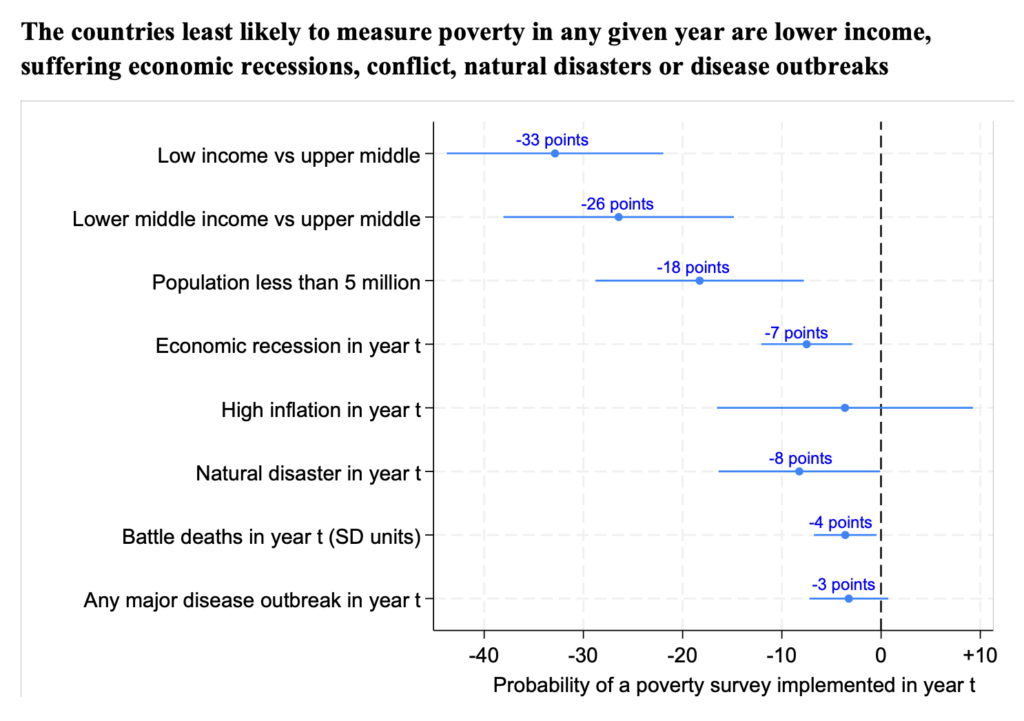
The challenge for these indicators is that they both rely on the same set of household income or expenditure surveys, which are in very short supply in poorer countries. Figure 3 shows regression estimates of the various factors that predict whether a given country in a given year has conducted a household survey that can be used to measure poverty or healthy diet unaffordability.
A low-income country is a whopping 33 percentage points less likely to have a survey than an upper middle-income country. Surveys are also much less likely to be conducted when any kind of shock or crisis—economic recessions, conflict, natural disasters, and disease—is affecting a country, even though it is precisely in such circumstances that new surveys are most needed!
The World Bank cannot control how frequently countries decide to undertake government-led surveys, and it makes logical and highly transparent efforts to estimate regional and global trends in the presence of so many data gaps. But those data gaps are serious and systematic, and more frequent surveys in poorer and more shock-affected countries are the only real means of filling this gap. At the same time, while the unaffordability of healthy diets is reported on an annual basis for a wide range of countries, they too rely on World Bank estimates of income/expenditure distributions rather than annual income/expenditure monitoring.
Figure 3
Towards a new vision of global food security monitoring
With each indicator having its limitations, and with the need for rigorous and timely food security monitoring continuing to rise, what is the best way forward?
First, let’s prioritize bottom-up rather than top-down food security monitoring by investing more resources into multi-agency coordination to support rigorous and high-frequency welfare monitoring systems in developing countries. These new coordination institutions would bring together multiple UN agencies (FAO, World Food Programme, UNICEF, UN Development Programme), along with the World Bank and national government and non-government partners, to implement higher-frequency surveys that monitor a wide array of welfare indicators, including different types of food insecurity indicators. At present, most international agencies still conduct surveys in a siloed fashion—often with little collaboration with national agencies—taking no advantage of the huge economies of scale that would emerge from jointly setting up rigorous multi-purpose survey systems. The institutional barriers to coordination are formidable—setting up the mechanisms for survey coordination would require participation from the highest-level UN and World Bank leadership—but such efforts would pay off in the long run. At the very least, the UN could promote much greater coordination across its own agencies.
Second, monitoring should be conducted at higher frequency in the most food-insecure countries. In 2015, Chris Barrett and I made this argument in the Proceedings of the National Academy of Science (PNAS) journal, emphasizing that developing regions will be increasingly exposed to climate change and extreme climate shocks. Eleven years later, the developing world is very much confronting a climate crisis and has also been hard hit by COVID-19 and other global economic shocks and major conflicts. Yet the COVID-19 pandemic also demonstrated how cost-effective high-frequency welfare monitoring can be implemented by phone even in conflict-affected countries such as Myanmar.
Third, we need more independent validation (and invalidation) analyses of different food insecurity indicators, especially experiential indicators like the FIES. Proponents of the FIES have made bold claims on their cross-cultural comparability, but these claims need to be revisited. We need to work harder to test the true mettle of experiential indicators, which is why I argue that multiple indicators should be collected in large-scale national surveys and then rigorously compared and tested, as in Lain et al.’s (2024) study in West Africa. This multi-indicator approach will also allow countries to assess which indicators work best in their specific contexts.
Lastly, there is tremendous potential to cost-effectively monitor the affordability of healthy diets at high frequency using existing national food price surveys along with high-frequency wage data to proxy for incomes. Comparing poor people’s wages to the cost of a healthy diet can accurately and cheaply monitor healthy diet affordability for non-farm wage-dependent communities, as we argue in a study on “the wages of the poor” also published in Food Policy.
Is the world getting more food insecure or less food insecure? To our detriment, we really do not know. But given the growing and increasingly complex crises facing the world, the development community must take bold action to redress this uncertainty.
Derek Headey is a Senior Research Fellow with IFPRI’s Development Strategies and Governance Unit. Opinions are the author’s.
Reference
Headey, Derek D. 2026. The state of global food insecurity measurement: A mix of methods, and a mix of messages. Food Policy 142 (August 2026): 103121. https://doi.org/10.1016/j.foodpol.2026.103121