





Key takeaways
- Malawi faces a high El Niño risk heading into the 2026/27 growing season. Past El Niño events have reduced maize production, increased food insecurity, and strained household livelihoods across the country.
- Early action is critical to limit those impacts and avert a potential humanitarian crisis. Farmers can strengthen resilience through drought-tolerant crops, crop diversification, improved soil management, and other measures.
- Government and partners should move quickly to prepare social protection systems, enable well-functioning food markets, and coordinate response efforts before shortages emerge.
Second in a series. Read the first post here and the third here.
El Niño events are extended periods of warmer-than-usual sea surface temperatures in the eastern tropical Pacific that alter global atmospheric circulation, affecting seasonal rainfall patterns in many parts of the world. Currently, El Niño is strengthening rapidly. NOAA’s Climate Prediction Center forecasts a greater than 90% chance of a very strong El Niño in 2026-27 and a nearly 70% chance that its peak strength will exceed that of all previous El Niño events since 1950. Meanwhile, the Iran war and disruption of shipping through the Strait of Hormuz have driven up prices of fuel and fertilizers.
Together, these overlapping shocks pose potentially serious threats to food production and food security, though the specific impacts vary by geography and timing. This is the second in a series of blog posts focused on impacts in Ethiopia, Kenya, Malawi, and India and on the global food system as a whole. These posts will reflect a combination of economic modeling and policy research and inform an early October policy seminar.
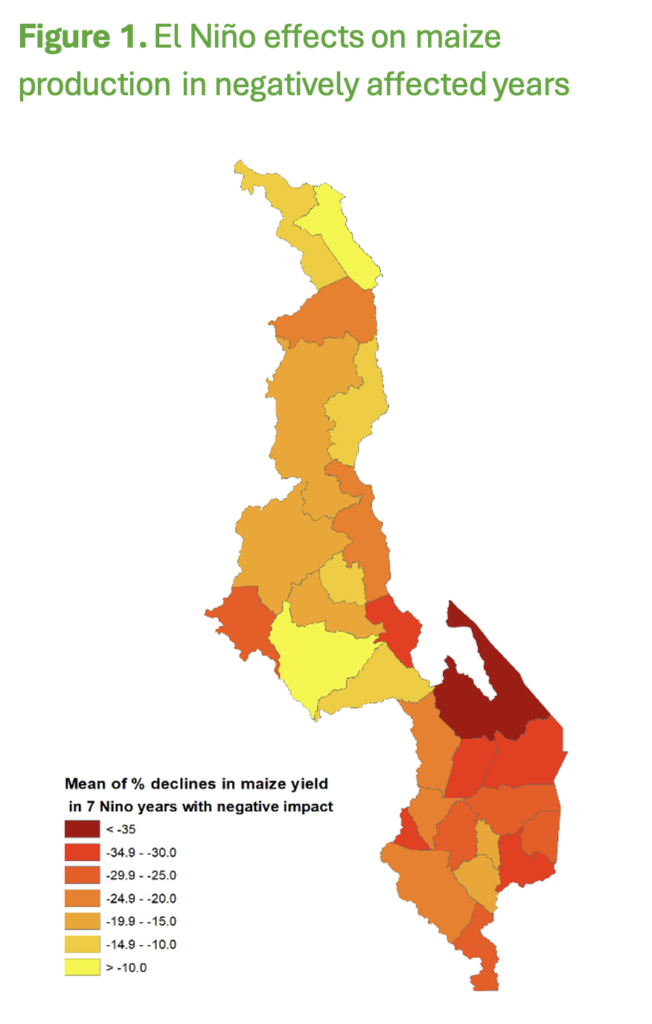
A strong El Niño has developed in the Pacific Ocean, raising the risk of below-normal rainfall and prolonged dry spells during Malawi’s coming agricultural season (November 2026 – March 2027), especially in the southern parts of the country. While no forecast is ever certain, history suggests that Malawi should take the threat seriously. Since reliable record-keeping began in the 1980s, two out of three El Niño events have negatively affected food production, reducing maize harvests by an average of 22.5% in the affected years (Figure 1).
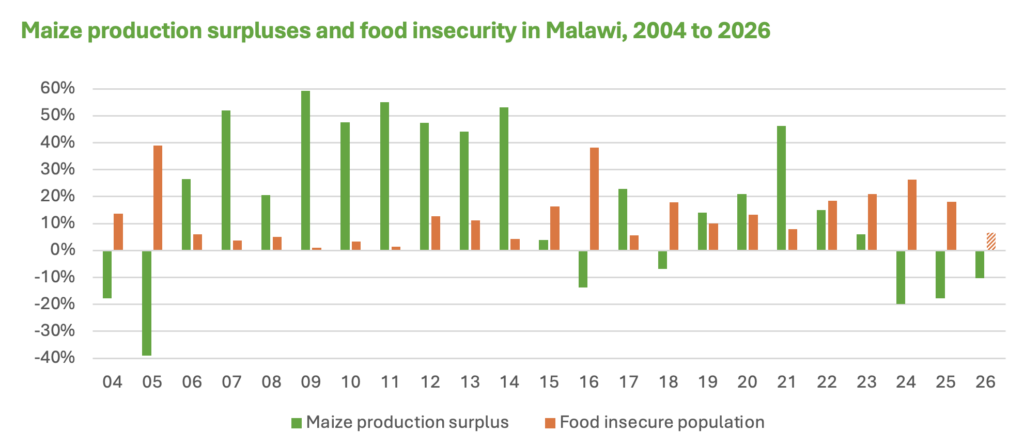
The risk is acute because Malawi remains heavily dependent on rainfed agriculture and rainfed maize is the country’s dominant staple crop. When the rains fail, the consequences extend far beyond the farm. During the 2023/24 El Niño, for example, national maize output fell by about 23%, from 3.5 million to 2.7 million metric tons, leaving production below the country’s annual needs. Lower harvests reduce household food stocks, raise food prices, and increase the number of families needing public assistance. Following the last El Niño-affected harvest, 5.7 million people (26% of Malawi’s population) faced acute food insecurity (Figure 2).
Figure 2
Worse, compared with the 2023/24 El Niño, Malawi enters this season in a more vulnerable position. Although the 2026 harvest was better than the previous two years, national production still appears to have fallen short of consumption needs. At the same time, the ongoing conflict in the Persian Gulf has pushed up global fuel and fertilizer prices, increasing production costs for farmers and raising the cost of transporting food and other essential goods. Many households are already struggling with elevated living costs, leaving them with limited capacity to absorb another major shock.
Thus, an El Niño-induced decline in agricultural production would reverberate well beyond the farm sector, affecting food prices, incomes, employment, and economic growth across the country. IFPRI simulation models suggest that, depending on the severity of weather impacts and market disruptions, the combination of a strong El Niño and the Gulf-related price shock could reduce Malawi’s GDP by between 1% and 7%.
A poor harvest is not inevitable
Malawi cannot control what happens in the Pacific Ocean or its effects on rainfall in Southern Africa. What it can control is how well it prepares. An El Niño, even this year’s strong one, does not guarantee disaster: some El Niño years have produced reasonable harvests, and the actions taken by farmers, government, development partners, and agribusinesses over the coming months could significantly influence the eventual outcome.
Whether El Niño becomes a manageable shock or a humanitarian crisis for Malawi will depend in part on decisions made in the coming months. Many of the measures that can soften the impacts of El Niño must be put in place well before crops are planted or food shortages materialize. This will require rapid mobilization across government, development partners, agribusinesses, and farming communities. Government agencies should urgently communicate practical drought-resilience measures to farmers and support their implementation, while policymakers and program managers prepare to scale up social protection if food supplies fall short.
Success will likely not mean avoiding all impacts of El Niño. Rather, it will mean reducing those impacts, protecting vulnerable households, and ensuring that a climate shock does not become a humanitarian crisis.
Crop management strategies
A key priority is helping farmers manage production risk. Seasons with uncertain rainfall call for careful decisions about what to plant and how to plant it. For many farmers, a diversified portfolio of crops may provide a better balance between resilience and productivity than reliance on a single staple crop, but the best choice depends on each household’s access to land, labor, cash, and markets. It also depends on location: farmers in drought-prone parts of southern Malawi face different risks and crop choices from those in wetter parts of the Northern Region.
Early-maturing and drought-tolerant maize varieties can help reduce the risk of crop failure when rains start late or dry spells occur.
Diversifying beyond maize can provide an additional layer of protection. Crops such as cassava, sorghum, millet, sweet potato, cowpea, and pigeonpea generally cope better with drought or are vulnerable to drought at different stages of growth. This allows farmers to spread risk across time and crops: planting different crops, or planting at slightly different times, can reduce the likelihood that a single dry spell destroys an entire harvest. Intercropping maize with drought-tolerant legumes such as cowpea and pigeonpea can provide another layer of insurance while also improving soil fertility.
Yet these options also involve trade-offs. Early-maturing or drought-tolerant maize varieties typically have lower yield potential under good growing conditions, and the seed is often more expensive. Farmers therefore face a trade-off between maximizing yields and reducing risk. Sorghum and millet are typically less productive than maize, while cassava and sweet potato are difficult to store after harvest.
Where and how to apply these solutions will depend on local conditions. Overall, there is much uncertainty about how the upcoming El Niño event will play out in any specific location, but especially in the Central Region. There is therefore no single crop recommendation that is appropriate for all farmers everywhere in Malawi.
Small changes can make a big difference. Many effective drought-management practices do not require major investments and can be implemented relatively quickly.
Conservation agriculture, minimum tillage, mulching, planting basins, appropriate plant spacing, and good weed control can improve soil moisture retention and help crops survive periods of water stress. Better fertilizer management can also increase resilience by improving plant health and nutrient uptake. These practices are often worthwhile regardless of whether the season ultimately turns out dry or not.
At the same time, farmers should remain alert to threats that often accompany drought conditions, including pests such as the fall armyworm. Early detection and response can prevent localized problems from becoming much larger losses.
Reaching out to farmers
Communicating these varied techniques effectively and persuading farmers to adopt them is essential. Malawi’s existing agricultural extension structures can deliver these messages, particularly the Department of Agricultural Extension Services and its frontline extension officers, supported by community radio and localized forecasts from the Department of Climate Change and Meteorological Services. Using a common platform would help avoid fragmented campaigns giving farmers overlapping or inconsistent advice.
Crucially, the advisories should clearly differentiate between generally recommendable no-regrets actions and decisions that should depend on each farmer’s individual circumstances.
Preparing for food insecurity before it arrives
Even if farmers take every possible precaution, a substantial chance remains that the 2027 harvest could be disappointing. For that reason, planning must extend beyond agricultural production.
Food insecurity often results not only from a lack of supply but also from a lack of purchasing power. Regional markets generally continue functioning during shortages, and grain often flows toward areas where prices are highest. This means that food may be available in markets even when many households cannot afford it. In such circumstances, well-targeted cash transfers can help vulnerable families access food while supporting local markets. Luckily, Malawi does not need to build a response system from scratch: its Social Cash Transfer Programme already has a mechanism for expanding assistance when climate shocks occur. Preparing the financing, triggers, and beneficiary lists in advance would allow this system to respond quickly when the need arises.
Malawi should also prepare for the possibility of a larger-than-normal food production deficit. The country has required substantial maize imports in recent years, and another poor harvest would increase that dependence. Regional markets generally move grain to where it is needed, but they can only do so if traders have access to foreign exchange and face no unnecessary policy or logistical barriers. Government should therefore focus on enabling trade rather than replacing services that markets can provide more effectively. If government, donors, or other agencies ultimately decide to import grain directly, acting early is likely to secure supplies at lower cost than waiting until shortages emerge.
The challenge is coordination, not just money
Responding effectively to El Niño will require resources, but many measures can be delivered through systems that already exist. Malawi has extension officers, weather services, social protection programs, and agricultural input delivery mechanisms. The challenge is ensuring that these institutions coordinate effectively and act quickly enough to make a difference.
Funding will remain a constraint. Although several financing mechanisms are available to support disaster response, much of the money can only be accessed once the impacts of drought have become visible. This makes early planning especially important. Decisions about priorities should be made before a crisis develops rather than in the middle of one.
A test of Malawi’s resilience
El Niño is fundamentally a reminder that weather shocks remain one of the greatest threats to Malawi’s development. A poor agricultural season can erase hard-won gains in food security, incomes, and poverty reduction. Yet it also presents an opportunity to demonstrate the value of preparedness.
Jan Duchoslav is a Research Fellow with IFPRI’s Development Strategy and Governance (DSG) Unit; Joseph Nagoli is a DSG Senior Research Coordinator; Andrew Jamali is the Acting Director of Knowledge and Learning at Malawi’s National Planning Commission (NPC); Grace Kumchulesi is NPC Director of Development Planning. All authors are based in Lilongwe, Malawi. Opinions are the authors’.
This work was supported by the CGIAR Science Program on Policy Innovations, the UK Foreign, Commonwealth & Development Office, the Embassy of Ireland in Malawi, and Coefficient Giving.