





Key takeaways
- An experiment in 180 Ethiopian communities tested how local leaders allocate social assistance. Researchers varied budgets and targeting rules to see who received support and how funds were distributed.
- When budgets were cut, leaders reduced payment size rather than coverage. Most households still received assistance, but transfer amounts fell sharply as leaders spread limited funds more widely.
- Giving leaders more discretion improved targeting. Flexible selection criteria helped them reach poorer and conflict-affected households that fixed rules were more likely to miss.
Republished with permission from VoxDev.
Shrinking humanitarian and international development assistance funding amid growing global crises has strained the operations of governments and humanitarian organizations. With the global humanitarian funding gap reaching $30 billion in 2025 (UN OCHA 2025), efficiency in the targeting of beneficiaries for social and humanitarian assistance is paramount. Under these conditions, downstream decisions will reflect trade-offs between program coverage (the number of beneficiaries) and depth (benefit size). Variations in available resources and discretion in beneficiary selection could shape how community leaders behave and manage these trade-offs.
Where dynamic administrative and social registries are scarce, governments and aid agencies often rely on community leaders to target program beneficiaries. Community-based targeting (CBT) draws on local information that standard survey-based approaches may miss to identify vulnerable households. But CBT also raises familiar concerns about favoritism and elite capture (Coady et al. 2004, Alatas et al. 2012).
In recent research on Ethiopia, we test how budget constraints and variations in targeting rules (rule-based criteria versus discretionary targeting) impact targeting outcomes (Abay et al. 2026). We find that community leaders respond to cuts in budget mostly by cutting transfer amounts, not the number of beneficiaries. Granting leaders discretion over the selection criteria allowed them to reach poor and conflict-affected households while reducing favoritism.
Testing targeting rules in rural Ethiopia
We conduct a CBT experiment in Ethiopia, where community leaders are typically involved in the targeting for social assistance, including the Productive Safety Net Programme (PSNP), Ethiopia’s flagship social protection programme (Berhane et al. 2014). Our study mimics existing targeting modalities of the PSNP in 180 rural communities to understand the implications of variations in the design of CBT on targeting outcomes, including targeting efficiency, shock responsiveness, and favoritism, to draw lessons for the changing humanitarian funding landscape.
Communities in our study were randomly assigned to four experimental groups. In each community, a six-member committee of local leaders ranked 20 randomly sampled households within their villages according to need and allocated cash transfer funds among them. Communities in the first group were assigned a hypothetical budget of 20,000 birr (about $360 at the time of survey) and leaders were instructed to apply five predefined (rule-based) selection criteria. Communities in the second group were allocated a real 20,000 birr budget under the same rule-based targeting. A third group received a smaller real transfer budget of 10,000 birr under the same fixed targeting criteria. The last group received a real 20,000 birr budget, but leaders were allowed to set their own beneficiary targeting criteria. Comparing the two groups with real but differing budgets (real 20,000 vs. 10,000 birr) identifies the impact of budget constraint, while comparing the two real 20,000 birr groups identifies the effect of discretion.
We set no beneficiary quota and no minimum or maximum transfer limits with the intention of uncovering community leaders’ preferences in the absence of these restrictions. To measure pro-social tendencies, we gave leaders the option to retain up to 10% of the budget allocated to each community for administrative costs, in addition to remunerations for their participation in the targeting exercise. They therefore had to decide how to balance coverage, transfer size, and their own claim on the funds.
A smaller budget produced smaller transfers, not a much shorter beneficiary list
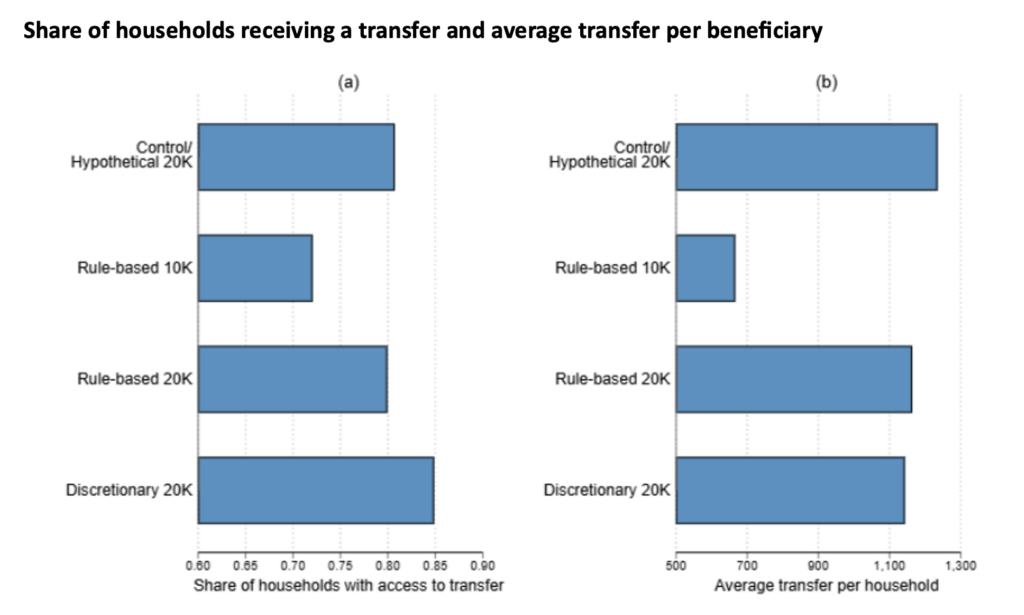
Halving the budget allocated to communities reduced the number of households receiving transfers by only 8-9 percentage points, from a base of about 80%. Average transfers among recipients, by contrast, fell by 43%. Community leaders adjusted to the budget cut almost fully by spreading smaller payments across a broadly similar group of households.
Depending on the experimental group, exclusion errors (denying transfers to deserving households) ranged from 7% to 25%, while inclusion errors (making transfers to less deserving households) ranged from 70% to 82%. Leaders appeared to place more weight on avoiding exclusion than on restricting support to households above the national poverty line. This pattern is consistent with leaders facing social and reputational costs when a visibly needy community member is left out.
These targeting choices have serious implications for the ultimate impacts of the transfer program. Larger transfers can generate greater welfare gains per dollar than smaller ones (Banerjee et al. 2015, Kondylis et al. 2021). If local leaders prioritize coverage during budget cuts, transfer payments to households may become too small to achieve meaningful impact.
Figure 1
Discretion allowed reaching the poor and vulnerable better
Predefined selection rules are often intended to make targeting more consistent and less vulnerable to capture. In our experiment, discretion improved several measures of targeting performance. For the same budget level, 95% of households in the poorest consumption quintile received transfers when leaders had discretion to set the selection criteria, compared with 82% under predefined rules. Our regression estimates indicate that poor households were 9-11 percentage points more likely to receive transfers under discretion than under the rule-based approach involving a similar budget.
Discretion also made targeting more responsive to conflict. While greater exposure to conflict events was associated with lower access to transfers due to logistical challenges of reaching these areas, it improved when community leaders were given discretion. Discretion allowed leaders to consider criteria the predefined rules did not capture—including whether a household lacked an able-bodied member or had many people to support—to select beneficiaries. The discretionary group had the lowest exclusion error and highest inclusion error. While it is difficult to make a normative judgement on whether this represents a good targeting outcome, it does suggest that community leaders’ idea of need includes a wider set of rules, including vulnerability and earning capacity, not only measured consumption.
Larger budgets and fixed targeting rules are linked to higher favoritism
Households with close ties to village leadership have better access to transfers. Under the rule-based real budget condition, a one standard deviation increase in connectedness to leaders is associated with a 4-5 percentage point increase in likelihood of receiving transfers. That advantage disappeared fully when budgets were halved. Discretion also seems to reduce favoritism: while its effect on whether connected households’ access to transfers was imprecise, connected households received smaller transfer amounts under discretion than under fixed rules.
The option to extract up to 10% of the transfer funds as administrative cost revealed another gap between hypothetical and incentivized decisions. Committees retained about 6% of a hypothetical budget but the maximum 10% under a real budget, and the percentage of leaders taking the maximum share increased from 45% to 93%. Our interpretation is that rule-based targeting does not create accountability on its own. Without a verification mechanism that they were followed, rules may provide cover for less effort in identifying deserving households. Discretion may make leaders feel more directly responsible for their targeting decisions and improve targeting accuracy.
Designing community-based targeting when budget shrinks
When budgets are tight, community-based targeting may lead to dilution of transfers more than reduced coverage. If program impacts depend on transfer size, implementers should not assume that local committees will preserve it. The potential trade-off between broad coverage and meaningful support needs to be taken into consideration in social protection/assistance programming.
The use of predefined targeting rules does not guarantee accountability, at least in our context. Allowing leaders to define selection criteria let them to use local information on poverty and conflict that rule-based criteria may not capture. This is not a recommendation for unchecked local authority over allocation standards, but rather an argument for the merits of allowing a degree of flexibility to accommodate local knowledge. Our experiment varied only budgets and discretion, not the degree of monitoring. Future work may find that rules paired with credible oversight work better than discretion.
Kibrom Abay is a Senior Research Fellow with IFPRI’s Development Strategies and Governance (DSG) Unit; Guush Berhane is a Senior Research Fellow with IFPRI’s Agrifood Innovation and Resilience Unit; Dan Gilligan is Director of IFPRI’s Poverty, Gender, and Inclusion Unit; Kibrom Tafere is an Economist with the Development Research Group of the World Bank; Alemayehu Seyoum Taffesse is a DSG Senior Research Fellow and Program Leader for Ethiopia, based in Addis Ababa. Other authors are based in Washington, D.C. Opinions are the authors’
This work was supported by the CGIAR Research Programs on Policy Innovations and Food Frontiers and Security.
Reference:
Abay, Kibrom A.; Berhane, Guush; Gilligan, Daniel O.; Tafere, Kibrom; and Taffesse, Alemayehu Seyoum. 2026. Targeting social assistance in fragile settings: An experiment in community-based targeting. Journal of Development Economics 182(June 2026): 103819. https://doi.org/10.1016/j.jdeveco.2026.103819