






Key takeaways
•AI excels at pattern recognition but lags in understanding, so to be useful it requires robust data, human-designed tests, and real-world validation.
•Limited data in low-income countries pose serious obstacles for researchers using AI tools.
•To maximize returns from AI, donors and governments should invest in the inputs AI cannot replace: surveys, local researchers, and national statistics systems.
In the early 1600s, the German polymath Johannes Kepler studied years of astronomical observations and discovered that planets move in ellipses. But Kepler had no idea why planets moved that way. He had found a pattern in the data. A few decades later, Isaac Newton identified the mechanism underlying Kepler’s laws of planetary motion—gravity.
In a recent study, Vafa et al. used this distinction to test a common claim about artificial intelligence: that if you train a model to predict well enough, it will eventually learn to understand the principles behind the data. They trained foundation models (i.e., based on large datasets) on planetary orbits. Like Kepler, the models learned to predict them accurately. But when tested on new physics tasks, they consistently failed to apply Newtonian mechanics that have been known for hundreds of years.
This distinction—pattern versus mechanism, prediction versus understanding—turns out to be a useful way to think about what AI means for development research. AI systems are already highly effective at finding patterns in existing data and generating testable hypotheses from them. This will supercharge the research process. But as development investment priorities increasingly focus on rolling out AI tools —real-time hunger monitoring, chatbot-driven extension services — it is important to remember that every hypothesis still needs testing, and every new context still needs data. For low-income countries—where the most urgent development policy questions remain unanswered, the data are thinnest, and the evidence gaps widest—AI tools face serious limitations, and that changes what we should invest in.
What AI can do and why it matters
The development field is already benefiting from the growing development and widening adoption of AI-enabled tools. The World Bank’s ImpactAI tool draws on thousands of randomized controlled trials, standardizes their findings, and lets policymakers compare interventions on a common scale — but only where those trials have been conducted. A public servant deciding between cash transfers and nutrition programs can get a structured comparison in minutes. Behind the scenes, agentic AI coding tools like Anthropic’s Claude Code and OpenAI’s Codex are transforming how researchers work day to day. A single researcher with an AI assistant can process and analyze data at a speed that would have required a small team just two years ago.
But AI can’t yet do the research itself
The most ambitious effort to use AI to push out the research frontiers comes from Project APE at the University of Zurich, where an AI system autonomously writes economics research papers from scratch: finding publicly available data, running regressions, producing full manuscripts. These papers compete in a tournament against publications from top economics journals, judged by another AI prompted to evaluate like a senior journal editor. As of March 2026, after 434 AI-generated papers and over 12,000 head-to-head matchups, humans were winning 96% of the time. The project’s own team warns that errors and hallucinations in the AI-generated papers are “very common and sometimes take a lot of effort to spot.” Still, the system’s rapid pace suggests that, over a year, it would generate hundreds of papers that outperform top-5 published economics papers (while in the past, one such paper might represent years of work by a full team).
The quality problem extends beyond tournament results. Academic publishers such as PLOS and Frontiers have stopped accepting submissions of papers based only on public health datasets because too many were AI-generated slop. The volume of low-quality AI output undermines the research environment, burying carefully human-designed studies in noise and making it harder for editors, policymakers, and researchers to identify evidence they can trust.
The narrowing problem
If the only problem were the limitations of AI as a research tool, we could work around them. But AI use is also changing research practice in disquieting ways. Analyzing more than 40 million research papers across the natural sciences, Hao and colleagues found that scientists using AI tools publish three times more papers, receive five times more citations, and become project leaders earlier. At the individual level, AI is a career accelerator. But the authors argue that collectively, AI adoption narrows research diversity, reduces collaboration, and concentrates work in data-rich areas. Areas with abundant structured data are disproportionately amenable to AI-augmented research, and that is where researchers concentrate.
Which topics are most likely to be left behind? The authors say those where data are scarce, including “critical scientific questions regarding the origins of natural phenomena, where data are necessarily reduced.” This description fits the topic of development research fairly well. The hardest policy questions in low-income countries are data-poor not by accident but by structural necessity, a point we return to below.
The real constraints are data and ideas
In high-income countries, functioning institutions generate data as a byproduct of their normal operations: tax authorities produce income records, health systems track patients. An AI system can sit on top of these administrative datasets and do genuinely useful work, because the data infrastructure already exists.
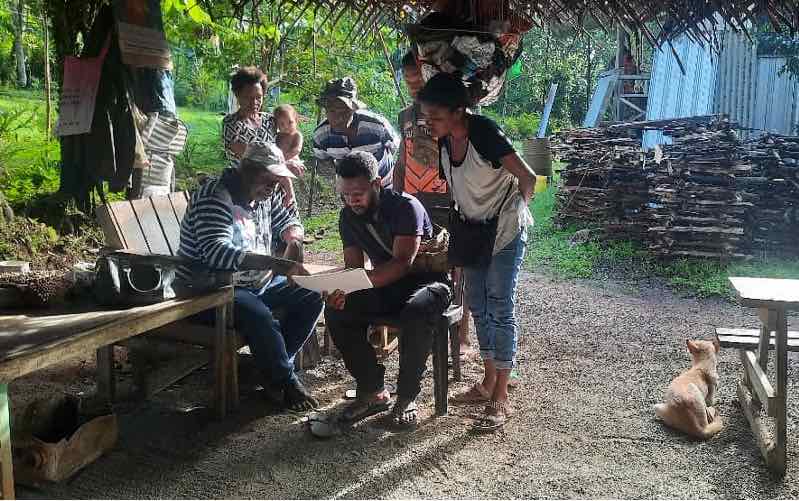
In the poorest countries, the informal economy is the economy. Subsistence production and consumption happen within the household and are not systematically recorded anywhere. Land tenure is often customary and unregistered. Health systems have massive gaps. The administrative data that AI feeds on simply does not exist at the scale or quality needed. For the most crucial statistics in development—poverty rates, crop yields, child anthropometry—there are still no reliable alternatives to in-person data collection. Satellites and phone surveys can complement but not replace boots on the ground.
AI could plausibly synthesize evidence from hundreds of existing evaluations. But someone still has to design the trial, negotiate with implementing partners, field the survey, and track households through displacement and drought. That is where knowledge is created.
Key investments for donors and governments in low- and middle-income countries
The temptation right now is to fund AI tools, dashboards, and data science capacity (such as AI training programs and data analytics units) in low- and middle-income countries (LMICs). That is not wrong, but it solves for the part of the research process that AI has already made fast and cheap — data processing and analysis. The binding constraints are the things AI cannot substitute for. These include (but are not limited to) large-scale survey programs such as the Living Standard Measurement Study, the Demographic and Health Surveys, and national household budget surveys; statistical systems such as civil registration, agricultural censuses, and administrative records; and local research capacity, including the PhDs, postdocs, and research positions in LMIC-based institutions that produce the ideas and contextual knowledge no algorithm can replace.
These investments may appear to be old-fashioned: more enumerators, more surveys, better administrative systems, more local researchers. But combining them with AI tools makes each of them more productive: better hypotheses to test, faster synthesis of results, smarter targeting of research effort. These investments, however, have to come first.
One day, AI may become Newton. But it can never pull data from thin air. The question is not whether AI will shape development research—it will and already is. The question is whether we invest now in the foundations that give it something to work with.
Kalle Hirvonen and Jessica Leight are Senior Research Fellows with IFPRI’s Poverty, Gender, and Inclusion (PGI) Unit. Opinions are the authors’.