


Key takeaways
- Research in northern Nigeria identified weak market linkages as a major barrier to solar irrigation adoption. A “missing middle” of limited coordination among farmers, suppliers, financial institutions, and government agencies is slowing the process.
- A demand-supply linkage event in Jigawa State brought key actors together to address this challenge. Participants shared information, built partnerships, and identified opportunities for expanding solar irrigation.
- Access to finance remains critical for scaling the use of solar-powered pumps. Discussions highlighted strong farmer interest in solar-powered irrigation, but underscored the need for affordable financing and repayment models that reflect agricultural production cycles.
Small-scale irrigation is one of the most cost-effective levers available for transforming smallholder agriculture in sub-Saharan Africa, and nowhere is the untapped potential larger than in Nigeria. The country’s agrifood system anchors the non-oil economy—contributing roughly 40% of GDP and about two-thirds of employment—yet production remains overwhelmingly rainfed, leaving some 41 million agricultural households exposed to an increasingly erratic climate.
Northern Nigeria, home to more than 60% of the country’s farming households, combines three assets that make it especially suited to solar-powered irrigation: abundant sunlight; extensive shallow groundwater; and strong, unmet farmer demand for affordable, off-grid pumping systems. Given volatile diesel and petrol prices, solar-powered irrigation is a climate-smart alternative that enables year-round, drought-resilient production. And yet only about 3% of Nigeria’s ~3.1 million hectares of irrigable land is under any form of irrigation—a persistent puzzle that recent research helps to explain.
The ‘missing middle’: Why solar irrigation stalls
The conventional diagnosis blames low adoption on farmers themselves—that they are unaware of the technology or too risk-averse or cash-strapped to invest. New evidence from IFPRI reframes the problem. In a study published in Agricultural Systems, Iraoya and Balana (2026) show that Nigeria’s irrigation bottlenecks are not necessarily or only due to farmer reluctance or lack of information but might well be the result of a “missing middle” of poorly coordinated intermediaries across policy, finance, and market supply chains.
Drawing on human-centered design workshops with 85 stakeholders across Kano, Oyo, and the Federal Capital Territory, and on nationally representative 2022/2023 National Agricultural Sample Survey microdata, the authors trace the constraint to fragmented government mandates, high lender risk perceptions, weak supplier networks, lack of involvement of women in agriculture, and pervasive information gaps.
The implication is important for policy and practice. The technology works and the demand exists; what is missing are the functioning links between the actors who together make a market—farmers, equipment suppliers, financiers, and the government that shapes the enabling environment. Fragmentation, not ignorance, is why irrigation underperforms. If the binding constraint is the missing middle, then the intervention is to build the middle: to connect the actors who normally operate in isolation.
Convening the ‘actors’ in Jigawa
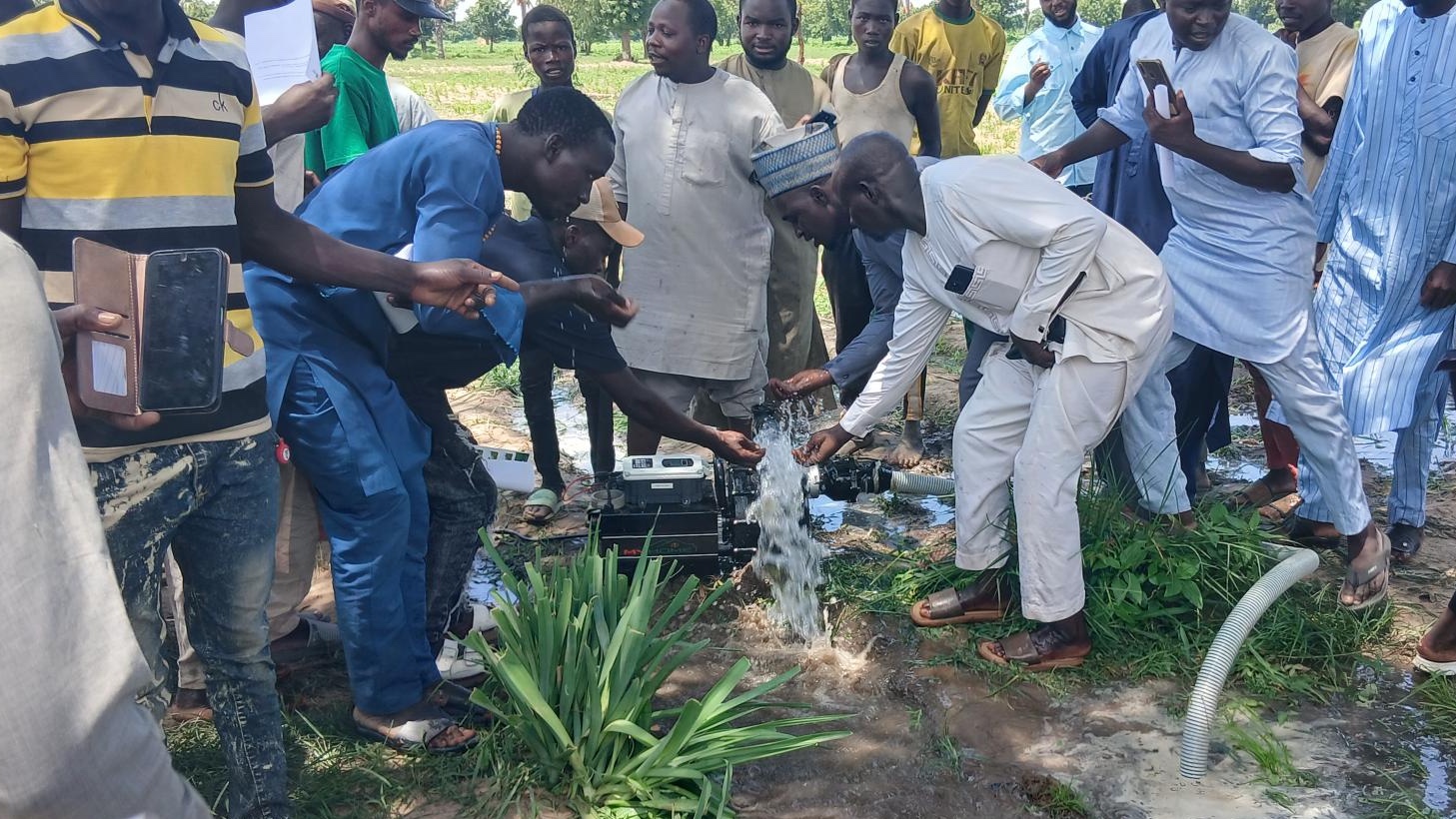
That was the logic behind a two-day event organized by IFPRI in collaboration with the Jigawa Agricultural Transformation Agency (JATA), with support from the CGIAR Scaling for Impact (S4I) Science Program, on July 20-21, 2026. It brought the full solar irrigation supply chain together: field demonstrations of solar-powered pumps and photovoltaic panels under real farming conditions on day one were followed on day two with a demand-supply linkage workshop convening close to 100 participants: farmers and farmer representatives, five equipment dealers, financial institutions, a risk-sharing enabler, women’s organizations, and government representatives. The event built directly on the team’s earlier work on the policy, finance, and technology-supply constraints that hold back small-scale irrigation in Nigeria.
What follows organizes the workshop’s lessons around the four linkages that, together, constitute the missing middle.
Farmers and technology dealers: Turning demonstration into transactions
On Day 1 demonstrations were held at three locations with more than 100 farmers at each site. Suppliers set up solar pumps of varying horsepower with two panel designs—rigid (static) and foldable—across both tube-well (groundwater) and surface-water regimes. This was a genuine demand-supply encounter, in pointed contrast to conventional extension demonstrations where the supply side is absent and no transaction can follow. Farmers were able to put their real questions—on access, affordability, servicing, and spare parts—directly to the people who sell and maintain irrigation equipment.
One striking illustration of how bringing different supply chain actors together can lead to real change was the offer by a traditional ruler and farmer, Alhaji Garba Wali Taura, of a warehouse to any solar irrigation dealer willing to establish an outlet in his community—a community-led solution to the weak supplier networks and thin rural distribution that the research has identified as a core barrier.
Farmers and financiers: From awareness to bankable terms
While Day 1 confirmed demand, Day 2 exposed the financing chokepoint. The recurring constraint already identified on Day 1 but further discussed on Day 2 was financing: farmers could identify the equipment they wanted yet could not readily reach terms on which to acquire it. As one financial institution representative put it:
“The challenge is no longer only access to solar technology. The challenge is access to the financing required to acquire it.”—Abubakar Adam, Jaiz Bank Plc.
Financial institutions—including Jaiz Bank, Sterling Bank, Bank of Agriculture, and TAJ Bank—presented their products, their agricultural lending experience, their assessment procedures, and the requirements and risk criteria behind their lending decisions. Two design lessons stood out. First, in a predominantly Muslim region, sharia-compliant products—leasing (ijara) and cost-plus (murabaha) structures (where buyer and seller agree on the markup of the item being sold)—are not a niche preference but a precondition for cultural acceptability and uptake. Second, repayment schedules need to be harvest-synced to match the irregular cash flows of smallholder production, alongside basic financial literacy support so that farmers can navigate credit terms with confidence.
Irrigation equipment dealers and financiers: De-risking the supply chain
The least visible—and arguably most decisive—linkage is the one between equipment dealers and financiers. Perceptions of high lender risk are a central pillar of the missing middle: banks hesitate to finance a technology whose quality, servicing, and resale value they cannot easily verify. Bringing vendors and financiers into the same room helped to begin dissolving that uncertainty. Pre-vetting and quality assurance of suppliers gives lenders confidence in the asset they are financing; guarantee and risk-sharing instruments spread the residual risk. Here the Nigerian Incentive-Based Risk Sharing System for Agricultural Lending (NIRSAL) plays a pivotal role, alongside affordable-technology providers such as Farmworld Technologies Ltd, Kickstart International, MJD Global, and NIMCY Agro Solar. A practical dividend emerged even during the workshop: equipment vendors began forming partnerships to offer complementary products—an early sign that a coordinated supplier ecosystem, rather than fragmented one-off sales, are within reach.
Enabling environment and coordination as a public good
None of these linkages holds without a coordinating hand. Rather than subsidizing solar-powered irrigation pumps, the government’s role is to supply the public goods that a fragmented market cannot provide itself: supplier prequalification and quality-assurance standards, credible convening, extension and advisory services—the “e-extension” agenda presented by the Jigawa Agricultural and Rural Development Agency (JARDA) is one example—and a durable platform that keeps the actors aligned after the workshop ends.
Participants reviewed and endorsed a roadmap for scaling the implementation of solar-based irrigation systems proposed by the state Ministry of Agriculture and Natural Resources. A steering committee consisting of IFPRI, JATA, JARDA, the Jigawa State Ministry of Agriculture and Natural Resources, financial institutions, equipment suppliers, and farmer representatives will oversee a phased 18-month process including targeting; financing and investment mobilization; capacity development for extension agents, artisans and farmers; pilot deployment and scale-up; and continuous monitoring, evaluation and learning. Notably, these state-level commitments map closely onto the co-created pathways proposed in the peer-reviewed evidence: a coordination platform, blended-finance mechanisms, supplier-hub models, and gender-responsive financing.
Key lessons and remaining gaps
Three lessons carry beyond Jigawa:
- The bottleneck is the middle, not evidently the farmer alone. Convening dispersed actors—assembling who sells what, at what price, where, under what warranty, and who will finance it on what terms—is itself an intervention.
- Finance is the main constraint. Solar pumps carry higher upfront costs but are, in many locations, more cost-effective over their lifetime than diesel or petrol pumps; without culturally appropriate, harvest-synced credit, that long-run advantage stays out of reach for most smallholders.
- In-person engagement resolves information asymmetry. Much of the value came simply from putting the right information in front of the people who need it, in one place, at one time.
Equally important are the gaps the event surfaced:
- Last-mile service and spare parts. Rural after-sales networks remain thin; the warehouse offer in Taura showed both the need and a possible community-led model.
- Lender risk and product design. Tailored irrigation loan products and scaled de-risking (guarantees, blended finance) are needed to shift lender risk perceptions.
- Gender and youth inclusion. Women and youth participation must be designed into financing and supplier models from the outset, not assumed.
- Data and information deficiency. Supplier hubs, mapping locations with sustainable water supply and market access, and shared market information can replace the ad-hoc, fragmented arrangements that currently dominate.
- From commitments to contracts.The decisive test is whether workshop momentum converts into signed financing agreements and new sustainable solar-pumping systems on smallholder farms.
Policy implications
For Jigawa and for northern Nigeria more broadly, the priorities are coherent: create a standing platform for solar pump sales and distribution so linkages outlast any single event; scale blended finance and guarantees while mainstreaming sharia-compliant, harvest-synced products; build the supplier network through hub models, prequalification, and quality assurance that also anchor last-mile servicing; and embed gender-responsive financing throughout.
Above all, the Jigawa State Ministry of Agriculture and Natural Resources Permanent Secretary, Auwalu Ado Shehu, frames success not by the quality of presentations, but by the number of farmers who own functional solar irrigation systems, the hectares brought under irrigation, the jobs created, and the incomes raised—tracked through a robust monitoring, evaluation, and learning framework.
A replicable, testable model
The Jigawa event is best understood as a proof of concept: a low-cost, repeatable way to assemble a fragmented market and test whether doing so shifts adoption and financing terms. If the momentum converts into contracts and installed systems, the model offers a practical template for scaling solar-powered irrigation across northern Nigeria—turning the region’s abundant sun, groundwater, and farmer demand into the year-round, climate-resilient production the country needs. The missing middle is not destiny; it is a design problem, and one that partners in Jigawa have shown can be tackled.
Hyacinth Edeh is a Senior Research Analyst with the IFPRI Nigeria office; Bedru Balana is a Senior Research Fellow with IFPRI’s Agrifood Innovation and Resilience Unit; Maryam Abdullahi is the Project Lead on Value Chain Development and Market Access at the Jigawa Agricultural Transformation Agency (J-ATA); Oliver Kirui is a Research Fellow with IFPRI’s Development Strategies and Governance Unit and Nigeria Country Program Leader. Opinions expressed here are the authors’.
This work was undertaken as part of the CGIAR Scaling for Impact (S4I) Science Program.
The Google Gemini AI tool was utilized exclusively to optimize sentence structure and flow of the narrative text of this post. All core findings, strategic framing, and conclusions were independently authored by the team.
Reference:
Iraoya, Augustine Okhale; and Balana, Bedru. 2026. Uncovering bottlenecks and innovative solutions for scaling small-scale irrigation through a system approach and design thinking: Evidence from Nigeria. Agricultural Systems 236(June 2026): 104742. https://doi.org/10.1016/j.agsy.2026.104742