

Key takeaways
- An IFPRI study in Nigeria found that farmers using a digital advisory platform sold more than similar non-users, although they did not grow more. Those using Crop2Cash earned more from crop sales by selling a larger share of their harvest, despite seeing little change in yields.
- The gains came through markets, not yields. Farmers credited better seed, storage advice, and links to buyers who paid for quality, while their yields and farming practices changed little
- Designers should build around what farmers value and judge their tools against farm-level results. Measures such as income, sales, and active use matter more than registrations, downloads, or call volumes.
“A quality good doesn’t necessarily need to be taken to the market; the buyers will come and seek it out themselves,” a farmer told us in a focus group in Nigeria.
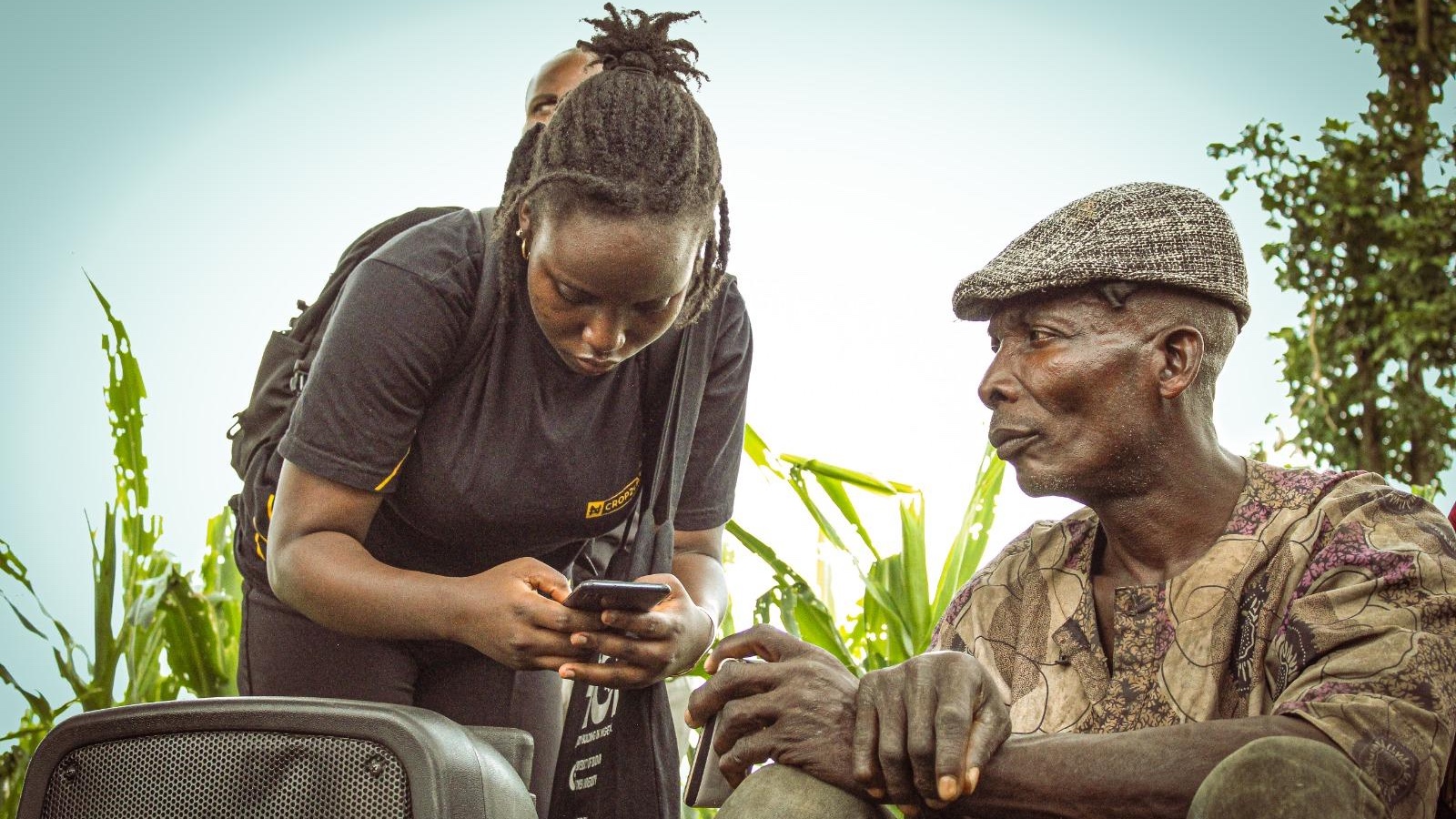
That farmer uses Crop2Cash, a Nigerian agrifintech company that gives advice through three channels that can all be accessed through a basic feature phone: text messages, field agents, and the National Hotline for Agriculture, a toll-free number where farmers ask a question out loud in Hausa, English, or Yoruba, and an AI-powered voice system answers. The advice comes with a marketplace for seed and fertilizer that farmers can order from by phone, a mobile wallet, and credit scoring that helps farmers get loans.
In our recent paper, we compared the experiences of 1,276 Crop2Cash users with 545 similar farmers who did not use it in Kaduna, Jigawa, and Niger States, and we listened to 172 farmers in 23 focus groups. We expected to find users growing more. Instead, what stood out was that they were selling more. This suggests that the value of digital agricultural advisory services extends beyond helping farmers make production decisions to supporting how they market and sell their produce.
Most of these farmers did not use the AI-powered hotline. Of the 998 users who received advice, 506 got it by text message, 239 called the hotline, and 253 got it only from agents or the customer line.
What farmers valued: Selling more
On average, Crop2Cash users’ yields were no higher than those of comparable non-users, and users did not adopt more of the 19 sustainable practices the platform promoted than non-users. But they sold more of their harvest, and their crop sales were about ₦161,500 ($106) a year higher, 24% above the non-user average.
Farmers explained how. Certified seed that Crop2Cash recommended produced grain that looked better, and some buyers paid more for it. Storage tips let farmers hold grain until prices rose. Price information and knowledge about or personal introductions to bulk buyers meant some no longer had to accept the first offer at the farm gate. Across the whole sample, however, average prices did not differ, so most of the difference came from selling a larger share of the harvest.
This matters most where farmers already grow enough and the problem is selling it. In many surplus-producing areas, farmers lack buyers, storage, and price information, so they sell at harvest, when prices are lowest. There, advice that helps farmers sell may benefit incomes more than advice that only raises yields. Where farmers cannot grow enough to feed their families, production advice matters more. Importantly, this was not a randomized trial, so these are differences between users and carefully matched non-users, not proof that the platform caused them.
What this means for advisory app design
Farmers valued help with selling. Designers can build on that. Based on what farmers told us, we suggest the following:
Use the market as the way in. Most farm advice asks farmers to spend money now for a reward they cannot yet see. Farmers told us they preferred to act on advice when it was tied to a buyer or a price. Platforms could send price alerts with tips on meeting buyers’ quality standards and share buyers’ requirements before planting.
Choose the channel for the farmer, not for the technology. The hotline works on the cheapest phone, in local languages, at any hour, for about ₦300 ($0.20) a session; however, a voice-only channel cannot see an unknown pest. Photos and satellite data can help, but each step trades reach for detail: photo diagnosis requires a smartphone, mobile data, and a reliable signal, and satellite images can be used to evaluate a stressed field but not what is under a leaf. Most farmers here had basic feature phones, not smartphones. Field agents, who can look at the field, teach farmers to use the tools and introduce them to buyers, filled part of the gap, but only 161 of 1,276 users had ever met one.
Give the hotline and agents different jobs. The hotline can answer routine questions cheaply and at scale. This can free up agents to do other tasks: they can look at fields, teach farmers to use the AI/digital tools, and introduce farmers to buyers. Farmers trusted agents most and valued the human expert above the AI service, so the hotline should support that relationship, not replace it.
Check the advice, not just the digital tool. Establishing a channel for agricultural advice alone is not enough; its content should also be monitored and reviewed. For example, we found that users applied more agrochemicals and less organic fertilizer than non-users. While we did not measure soil health, this direction runs against sustainable soil management and should be monitored. When the same company gives advice and sells inputs (as in this case), an independent body, such as a research institute, should review the content.
Get the basics right first. Farmers reported a number of problems. Late delivery of inputs and loans was the complaint they raised most often. The phone network that carries hotline calls was available only about 42% of the time, and the hotline did not cover all local languages.
Design for women from the start. Women made up only 16% of users. Women were less likely to own phones, while many lacked the ID needed to register and agents were mostly men. Crop2Cash could offer free ID enrollment at farmer sign-up events, working with an existing licensed partner. Where an agent went door to door, the gap was smaller, and female agents were the fix that farmers, extension agents and input buyers suggested most often.
What this means for measuring impact
The numbers digital platforms usually report say little about what farmers gain from using them. Our findings have several implications:
Registrations are not reach. Crop2Cash had 357,466 registered farmers. Yet only about 35% were active in a year, and about 3,000 bought inputs or took loans through the platform over three years (Figure 1).
Figure 1
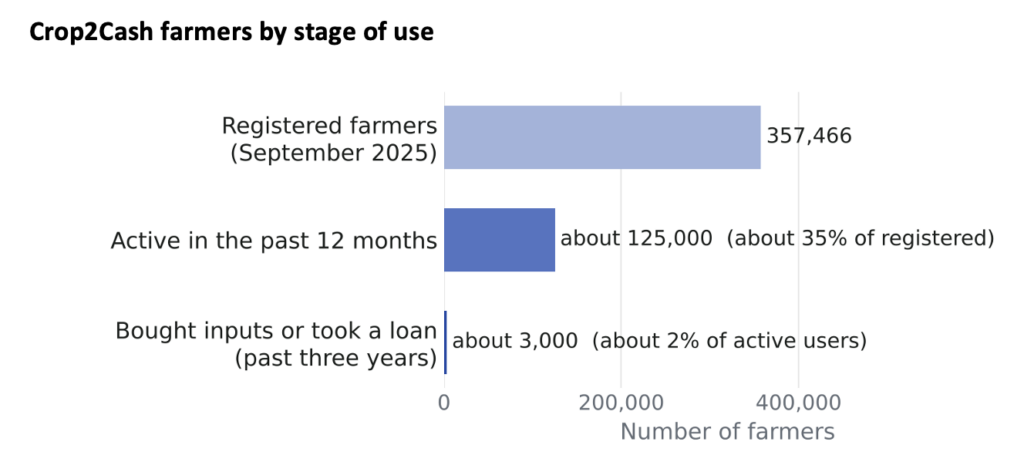
Note: The last group covers three years, so percentages are approximate.
Calls are not results. Company staff told us the AI hotline was tracked mainly by call time and whether the services led to product sales or loans provided to farmers. Whether farmers acted on advice and their change in behavior and farming practices, yields, income, food security, or soil health are not tracked.
Productivity changes are only part of the story. Had we looked only at yields, we would have missed the important variations in farmer behavior that we found.
Ask farmers what they would pay for. In our survey, 89% of farmers said they would subscribe to an expert advice service and 78% to an AI service with the same content, at average amounts of ₦1,848 ($1.22) and ₦1,460 ($0.96) a month, respectively. Stated amounts are not actual payments, but they show that farmers valued the human expert more, and both amounts were far below the value associated with use.
Averages hide who benefits. Differences in outcomes were largest among farmers with no access to government extension (suggesting the platform helped in filling that gap) and not clear among those who had access.
What should happen next
Designers and developers: start from what farmers want to achieve, often a better sale, and use it to make the payoff of new practices visible. Then test whether linking prices to practices changes what farmers do.
Funders: Support active use, retention, and farm-level results, not sign-ups or headline reach, and ask platforms to report them.
Evaluators: Compare users with similar non-users, and measure sales, income, practices, and food security, not only yields and call volumes.
Digital advice, with or without AI, can reach farmers cheaply. Whether it helps them depends on whether it speaks to what they value. For many farmers in Nigeria at least, they are looking for better markets for their products.
Catherine Ragasa is a Senior Research Fellow with IFPRI’s Agrifood Innovation and Resilience Unit based in Washington, D.C.; Opeyemi Olanrewaju is a Research Analyst with IFPRI’s Development Strategies and Governance Unit based in Abuja, Nigeria. This work is based on research that is not yet peer-reviewed. Opinions are the authors’.
Read the full study. Building or evaluating a farm advisory tool? Tell us what you measure: c.ragasa@cgiar.org.
This study was funded by the UK Foreign, Commonwealth & Development Office (FCDO) through Global Research and Technology Development (GRTD), the UK government’s flagship research and innovation portfolio for international development.
Disclaimer: This blog is based on IFPRI Discussion Paper 2457, “Selling Better Rather than Growing More.” The authors used an AI tool (Claude, Anthropic) to help draft and edit the text from that paper. The authors reviewed, revised, and checked all content against the original research, and they are responsible for the final text and any errors.
Reference:
Ragasa, Catherine; Olanrewaju, Opeyemi; Ma, Ning; Alvi, Muzna; Durojaye, Kola; and Awoyemi, Emmanuel. 2026. Selling better rather than growing more: Mixed-methods evidence on a private digital advisory platform for smallholders in northern Nigeria. IFPRI Discussion Paper 2457. Washington, DC: International Food Policy Research Institute. https://hdl.handle.net/10568/186208