


Key takeaways
- Afghanistan depends heavily on its neighbors for food: in 2024, Pakistan and Iran supplied 42% of its food imports, and much of the rest reached the country through their ports and roads.
- The closure of the Pakistan border in October 2025 and the Iran war from February 2026 disrupted both routes. Less than half of the goods Pakistan had supplied were replaced, and consumer price inflation rose from 2% in September 2025 to about 8% in August 2026.
- A simulation suggests that these price increases have pushed up to 2.7 million more Afghans below the poverty line and further reduced living standards for those already below it.
On October 12, 2025, Pakistan closed its main border crossings with Afghanistan after armed clashes with the Taliban. They have remained closed since. Less than five months later, the start of the Iran war on February 28, 2026, choked off a key alternative route for Afghanistan trade through the Persian Gulf, and Iran, like Pakistan, an important trading partner, suspended its food exports.
Our April 2026 analysis suggested that this predicament posed risks for Afghanistan’s trade, economy, food prices, and food security. A new analysis shows that rising inflation has pushed as many as 2.7 million Afghans into poverty and worsened the country’s humanitarian crisis.
This post examines how the two shocks moved through Afghanistan’s food import system, how far they pushed up consumer prices, and what the resulting price increases mean for poverty.
A food system that depends on its neighbors
Afghanistan’s food supply is highly vulnerable to external disruptions due to the landlocked country’s reliance on a small number of neighbors and routes for access to world markets.
It is among the world’s most import-dependent economies, with imports of $11.7 billion in 2024–25, equivalent to about two-thirds of GDP, and nearly seven times the value of exports. Food accounts for about a quarter of all imports: in 2024, Afghanistan imported food worth $2.6 billion, or 24% of the value of its total imports, a share that remained about the same in 2025. Afghanistan imports nearly half of its staple cereals (46% in 2021-23); most of which is wheat, along with more than half of its rice and almost all of its cooking oil and sugar, according to FAO.
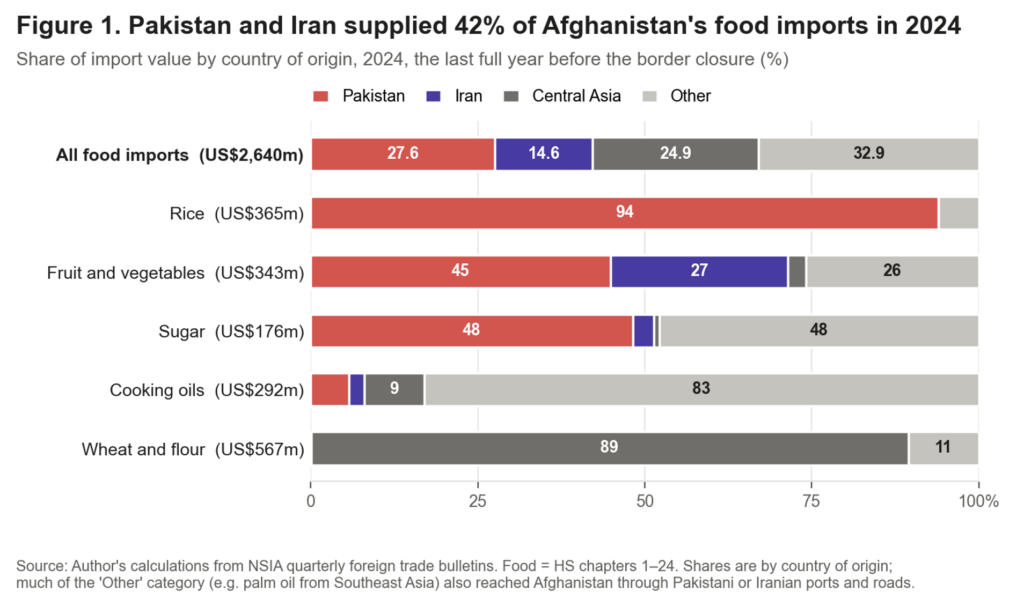
Pakistan and Iran account for a large part of this trade: in 2024, the last year before the trade disruptions, Pakistan supplied 27.6% of Afghanistan’s food imports and Iran 14.6%, or 42.2% together (Figure 1). This import dependence was even more concentrated for individual staples, as Pakistan supplied 94% of imported rice, nearly half of imported sugar, and 45% of imported fruits and vegetables, while Iran supplied another 27% of fruits and vegetables and held a near-monopoly on several processed foods, such as pasta and sauces.
Only wheat and flour came mainly from Central Asia. Much of the rest of Afghanistan’s food imports, including cooking oil, arrived by sea through Pakistani or Iranian ports. This means that the share of food imports arriving from those two neighbors, either as suppliers or as transit routes, was considerably larger than 42%.
Afghanistan also entered 2025–2026 with little cushion for a one-two punch of economic shocks, as drought, the return of millions of migrants, and sharp cuts in aid had already strained household budgets in a country where nearly half of the population was poor at the time of the last national household survey.
Shock one: Pakistan closes the border
The 2025 border closure cut off the flow of food from Pakistan itself, including most imported rice and much of Afghanistan’s supplies of fresh produce and pharmaceuticals, as well as commodities arriving via Pakistan seaports. The country’s share of Afghanistan’s food imports plunged from 27.6% in 2024 to 3.3% between October 2025 and March 2026.
Traders turned to other suppliers, notably countries in Central Asia, whose share of Afghanistan’s food imports rose from 24.9% to 41.9% over the same period. However, this could not come close to making up the difference. Imports of products for which Pakistan was a major supplier fell by $577 million in the two quarters after the closure, while imports of those same products from other countries rose by only $250 million, replacing only 43% of the lost imports.
The replacement rate for food products was somewhat higher, at 54%. In other words, just over half of the food Afghanistan had previously bought from Pakistan was replaced by other suppliers, compared with only about a quarter of non-food products. Nevertheless, it was a significant shortfall. Rice imports in the first quarter of 2026 were 17% lower in volume than a year earlier, and imports of fruits and vegetables were 43% lower.
Shock two: The Iran war hits the alternative route
Following Pakistan’s border closure, Afghanistan relied increasingly on Iran both as a supplier and as a transit route. By January-February 2026 about 60% of its imports were coming from or through Iran. Thus, the outbreak of war struck the corridor on which Afghanistan had only just become most dependent.
In early March, Iran suspended exports of food and agricultural products as part of broader trade restrictions intended to protect domestic supplies. Imports from Iran fell by 13.8% and imports transiting Iran fell by 9.4% in a single month. By mid-2026, shipping disruptions due to the closure of the Strait of Hormuz had more than doubled transportation costs for Afghan importers. Humanitarian assistance was affected as well, as the World Food Programme had to reroute its aid shipments overland through seven countries at three times its usual transport cost.
Prices: Most of the increase came early
Consumer price inflation rose after the Pakistan border closure, but by less than the scale of the disruption might suggest. Overall inflation increased from an annual rate of 2.1% in September 2025 to 7.7% in January 2026. It then inched further upward after the start of the Iran conflict, peaking at 8.6% in April, before dipping back to 7.8% in August 2026. These numbers, elevated but in single digits throughout, point to some resilience in trade and in domestic supplies.
However, that aggregate conceals what matters most for poor households. While food inflation was at 8.0% in August, the rate for bread and cereals—the core of the Afghan diet—reached 13.7% (though below its May peak of 18.2%) (Figure 2). Market prices tell a similar story, with rice prices rising by about a third between October 2025 and January 2026.
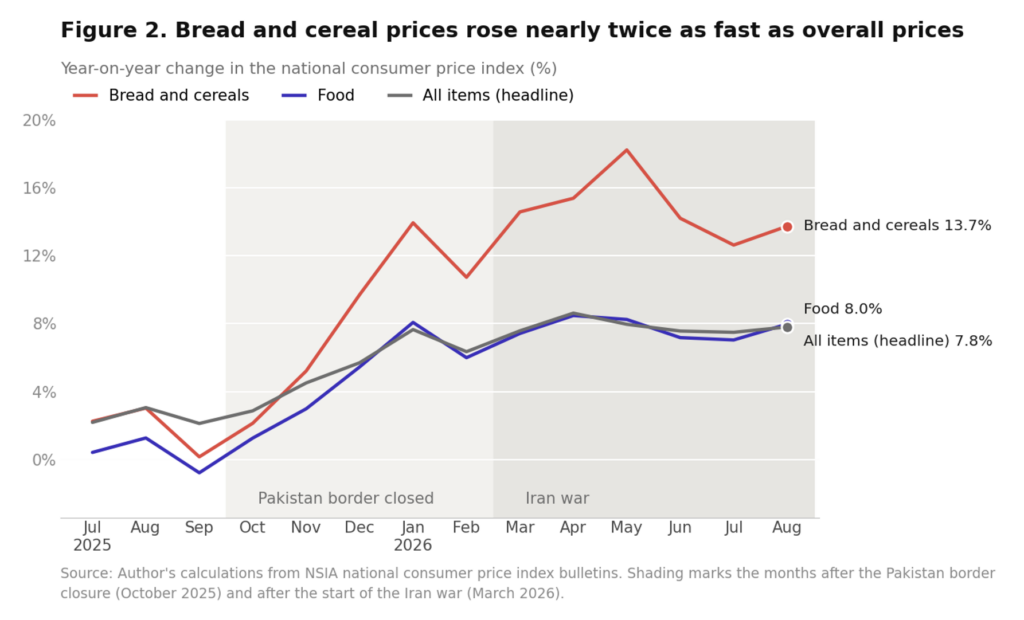
The early upsurge indicates that, despite efforts to reroute trade, the Pakistan closure caused most of the increase in inflation and the Iran war prolonged it. It also suggests that price increases were largest among goods dominated by imports from Pakistan. The exchange rate played little role, as the afghani remained relatively stable throughout the period, indicating that higher prices reflected disrupted supply rather than currency depreciation.
Poverty: Up to 2.7 million more people below the line
Although we can track prices almost in real time, it is much harder to discern how inflation is affecting households, as there are no recent household survey data available. In lieu of that data, we have simulated the effect of these price increases on households, knowing that the poorest spend the largest share of their income on basic cereals and thus have experienced the highest levels of inflation of any income group.
To estimate what these price increases mean for households, we used a difference-in-differences approach to separate the inflationary effect of the shocks from normal seasonal price movements, comparing each month’s year-on-year price change with the corresponding change in September 2025, just before the closure, and used the resulting food and non-food price increases to update the national poverty line.
Measured in this way, food prices were about 9% above their usual seasonal path by January 2026 and remained 8%-9% above it through the summer, while the overall consumer price index was 5%-6% above its usual path. The updated poverty line was then applied to the consumption patterns recorded in Afghanistan’s last national household survey, the 2019-20 Income, Expenditure and Labor Force Survey, in which 47.1% of the population was living below the poverty line.
It is important to note that this approach does not estimate the current poverty rate. The simulation holds household incomes and consumption patterns fixed at their 2019-20 levels, so the results answer a counterfactual question: had price increases of this size occurred when the 2019-20 survey was conducted, how many more people would have fallen below the poverty line?
The results should therefore be read as a rough measure of households’ exposure to the shock rather than as a count of the poor today, since they do not capture changes in wages and incomes since 2019-20, the ways in which households cope with higher prices, or humanitarian assistance.
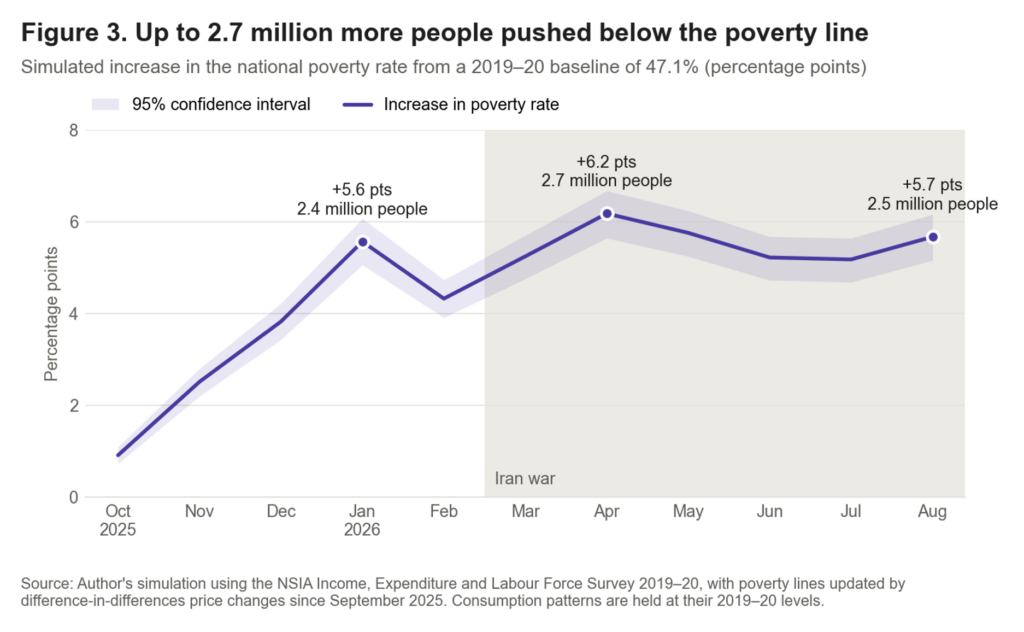
The results show the poverty rate rising by 5.6 percentage points by January 2026, peaking at a 6.2-point increase in April and standing at a 5.7 point increase over baseline in August (Figure 3). This corresponds to about 2.4 million more people below the poverty line in January, 2.7 million at the April peak and 2.5 million in August than there would have been without these price increases.
The shock also deepens poverty for those who are already poor: among the poorest fifth of the population, the average shortfall from the poverty line widens from 44.7% to 48.3%.
These estimates capture only the effect of higher prices; several other factors have likely added to the pressure on households. Social protection in Afghanistan is limited and has long depended on international aid, and the decline in external grants has reduced the capacity to respond to shocks. At the same time, the country faces increasing demand for food and basic services as nearly 3.7 million people returned from Iran and Pakistan from March 2025 to March 2026,
In addition, the Taliban’s restrictions on women’s education and employment had already reduced female labor force participation to one-third , leaving many households with fewer earners as prices rose, while farmers who might have expanded production to replace lost imports faced fertilizer prices that were about 27% higher.
Why food security remains vulnerable
With one of Afghanistan’s two main transit routes closed and the other running through a country at war, the country’s food supply remains highly exposed to further disruption, and more households remain at risk of falling into poverty and food insecurity.
Despite efforts to redirect trade toward Central Asia, the region supplied only a small share of the replacement in the two quarters after the closure (October 2025 to March 2026), compared with the same months a year earlier, and most of its increase came in wheat, flour and fuel that Afghanistan was already importing from the region rather than in the goods Pakistan had stopped sending.
Reliance on Central Asia is itself a source of vulnerability; the region accounted for 42% of Afghanistan’s food imports, supplying 98% of imported wheat and flour, which means that any export restriction or transport disruption along this route would directly affect the supply of the country’s main staple.
Moreover, because Central Asia is also landlocked, and its suppliers could not fill most of the gap, most of the redirected trade moved toward Iran in the months before the conflict there began. That left Afghanistan dependent on a corridor which then became vulnerable in its own right because of the impacts of war, including energy shortages and damage to infrastructure, as well as UN sanctions reimposed in 2025 in response to noncompliance with the Iran nuclear deal.
Food imports from India, mainly sugar and rice, also tripled after the border closure, from $44 million during October 2024-March 2025 to $142 million for the same period a year later. But with no land route through Pakistan these goods can reach Afghanistan only by air, through the air freight corridors that India announced in November 2025, or through Iranian ports such as Chabahar, both of which are costly, contributing to the rise in food prices
The risk of rolling impacts on Afghanistan’s population is already materializing: the October 2026 Integrated Food Security Phase Classification (IPC) analysis reported that 15.9 million people are currently facing high levels of acute food insecurity (IPC Phase 3 or above), 2 million more than in the same period last year. It also projects further deterioration ahead, with 19.2 million people expected to reach Phase 3 or above, 2.3 million more than the same period last year. Among the drivers it identifies are food prices, high unemployment, the return of migrants and reduced humanitarian funding.
Afghanistan’s options
If Afghanistan is to weather this crisis and build resilience going forward, the evidence points to several options for reducing the exposure of the food supply to future shocks, each of which involves trade-offs.
Strengthening domestic food production and value chains, from better storage and processing to closer links between farmers and markets, could reduce the country’s reliance on imported staples such as wheat, rice, and vegetables. Challenges include water scarcity, recurrent drought, and the high cost of fertilizer and other inputs. Some foods, such as cooking oil, will continue to depend largely on imports.
Developing new, more reliable transit routes would also offer more protection than adding new suppliers whose goods still pass through the same imperiled corridors. New routes require infrastructure investment and regional cooperation that take time to build. Finally, strategic food security monitoring and humanitarian planning that take account of risks in neighboring countries, not only of harvests and market conditions, would be better able to anticipate and prepare for shocks of the kind that Afghanistan has experienced over the past year.
Sediqa Zaki is a Research Analyst with IFPRI’s Markets, Trade, and Institutions Unit. Opinions are the author’s.