


Key takeaways
- El Niño-driven weak rainfall and high global fuel prices threaten Ethiopia’s economy and food security in 2027, IFPRI modeling suggests. National GDP could fall 0.4%–1.1% below baseline, with almost all of the loss attributable to El Niño.
- Relatively small national economic losses could still push an additional 905,000 people into poverty and 2.8 million into undernourishment, with the largest impacts potentially in the eastern highlands.
- Advance planning for additional food assistance is needed. Needs, most intense in rural areas, would likely peak between June and August 2027, while continued conflict could further worsen outcomes.
Fourth in a series. Read the first post here, the second here, and the third here.
El Niño events are extended periods of warmer-than-usual sea surface temperatures in the eastern tropical Pacific that alter global atmospheric circulation, affecting seasonal rainfall patterns in many parts of the world. Currently, El Niño is strengthening rapidly. NOAA’s Climate Prediction Center forecasts a greater than 90% chance of a very strong El Niño in 2026-27 and a nearly 70% chance that its peak strength will exceed that of all previous El Niño events since 1950. Meanwhile, the Iran war and disruption of shipping through the Strait of Hormuz have driven up prices of fuel and fertilizers.
Together, these overlapping shocks pose potentially serious threats to food production and food security, though the specific impacts vary by geography and timing. This is the third in a series of blog posts focused on impacts in Ethiopia, Kenya, Malawi, and India and on the global food system as a whole. These posts reflect a combination of economic modeling and policy research and informed an October 8 policy seminar.
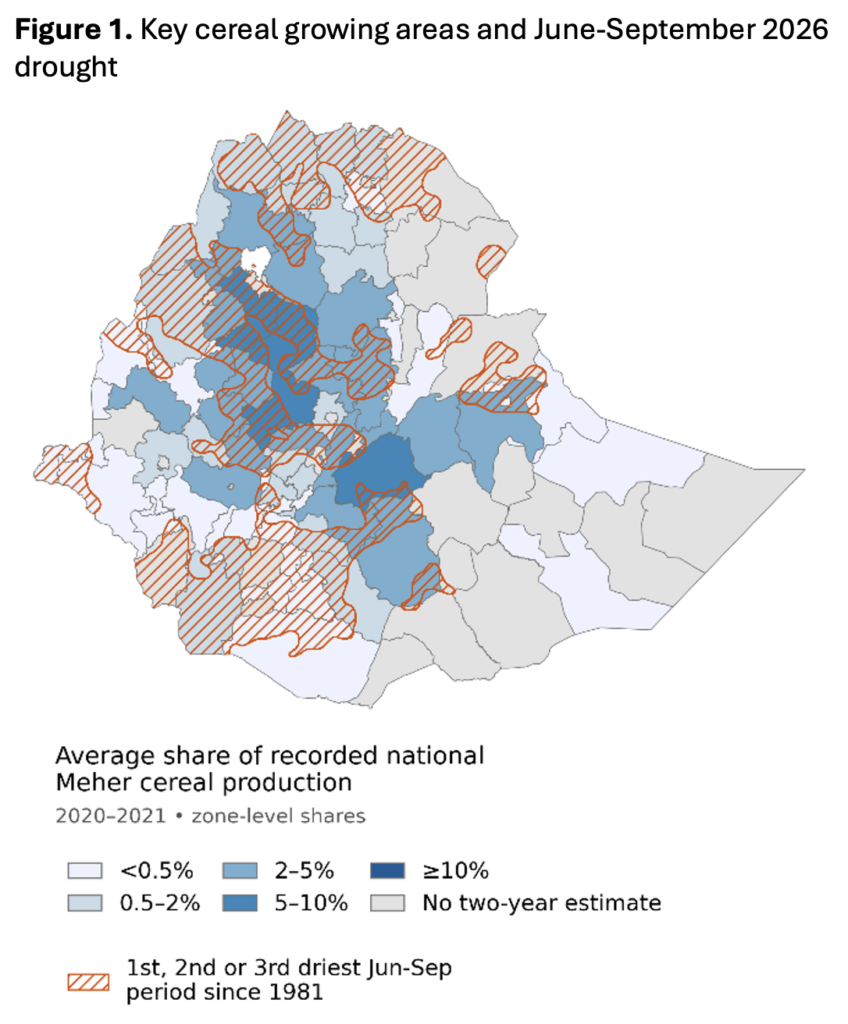
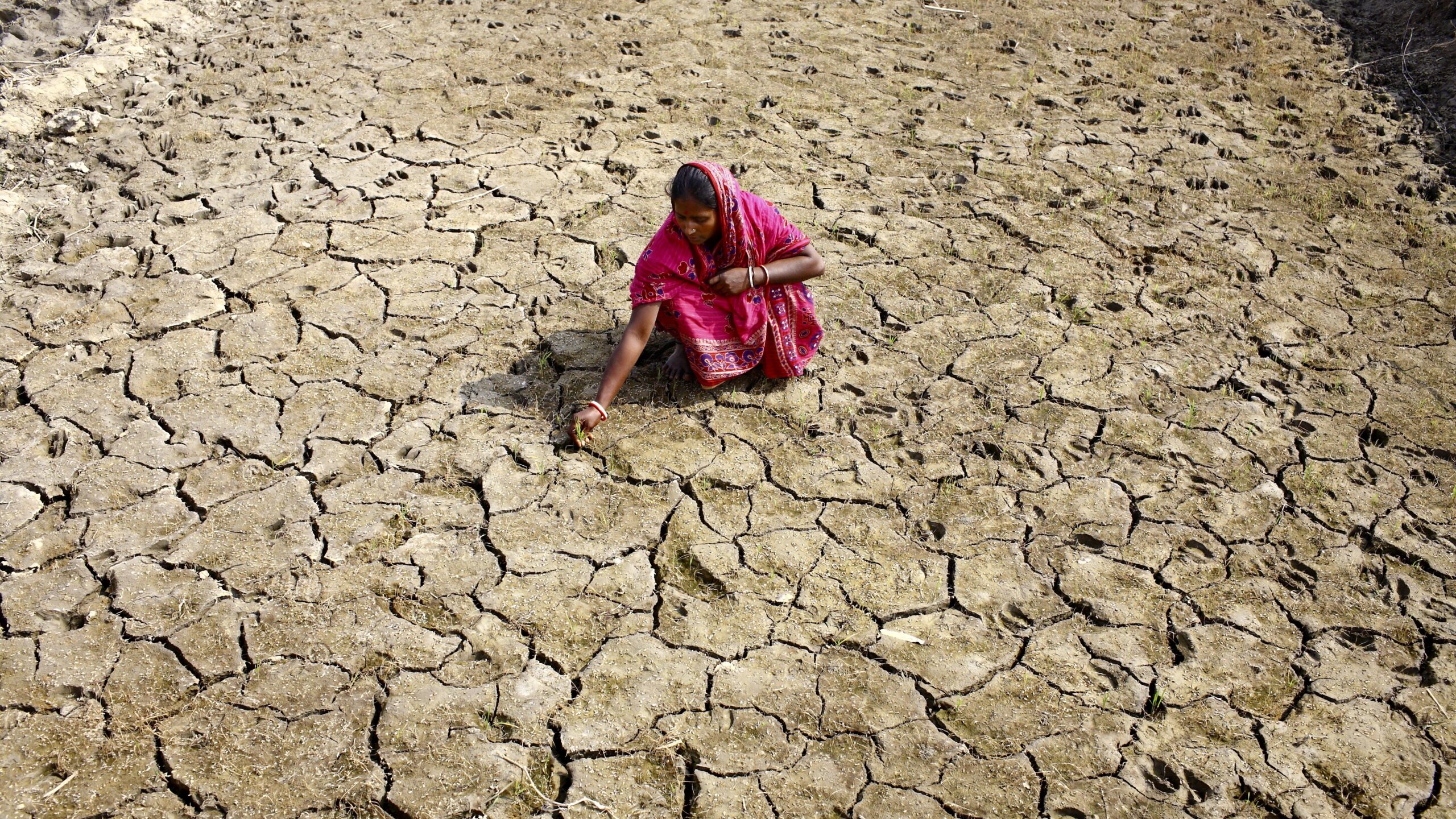
Ethiopia’s main rainy season (kiremt) runs from June through September and often performs poorly during El Niño events. In many important crop-producing areas during the current record El Niño, the season has been one of the driest on record (Figure 1). While no formal crop assessment has been conducted, satellite imagery and field reports suggest planted areas have shrunk and crop conditions have worsened, particularly in northern and eastern cultivated areas.
Meanwhile, high global energy prices resulting from the conflict in Iran have driven up domestic prices in Ethiopia. As of August 2026, local fuel prices were roughly 40% higher than at the start of the year.
These overlapping shocks are likely to have reduced October-December meher harvests. What are the likely impacts on Ethiopia’s economy and the well-being of its population in the coming year? An IFPRI model shows El Niño is likely to cause the most damage. It is the major contributor to a potential drop in GDP of as much as 1.1% below baseline that could cause significant hardship, pushing an estimated nearly 1 million people into poverty and 2.8 million into undernourishment. These impacts pose looming challenges that will require preparation by the government and international aid organizations.
The model
We employed RIAPA, IFPRI’s standard computable general equilibrium (CGE) model. Calibrated to an extended version of a 2022 Social Accounting Matrix (SAM) for Ethiopia, it represents 15 household groups and a detailed national economy, including 36 agricultural subsectors. This allows us to model both the direct effects of
lower crop yields and higher input prices, and how those shocks propagate through food prices, employment, household incomes, and the wider economy. Changes in poverty and the prevalence of undernourishment are estimated with the aid of a linked microsimulation model.
We first established a prewar, business-as-usual baseline in which national GDP grows by around 5% per year through 2027, with somewhat faster growth outside agriculture than within. We then updated this baseline to incorporate what is already known about the effects of the Iran war on fuel prices in 2026, which provides our revised economic outlook for 2027, before considering the more uncertain effects of El Niño.
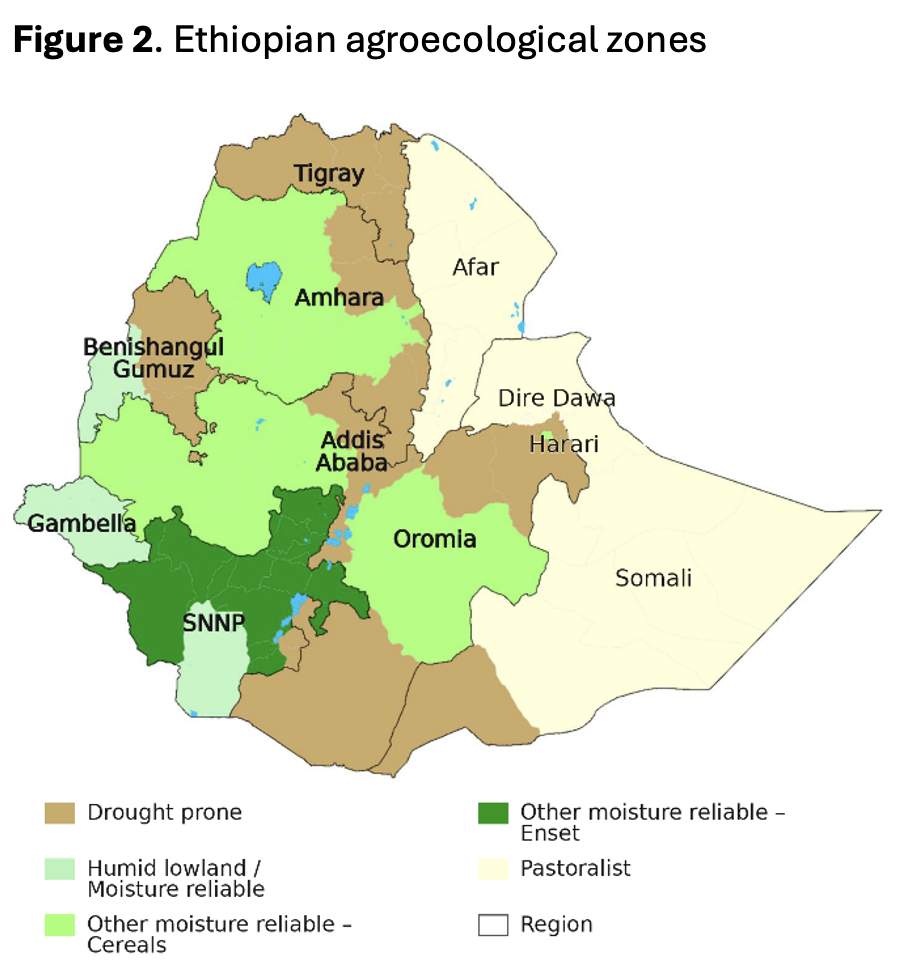
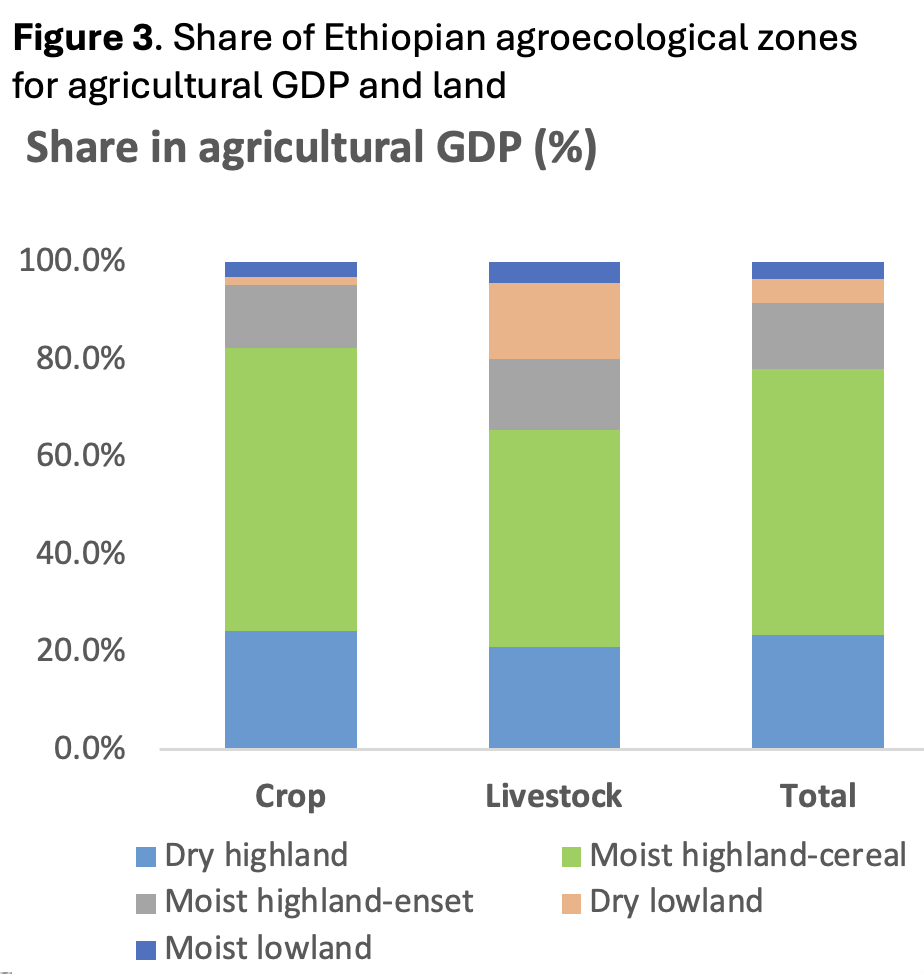
In addition, unlike IFPRI’s other recent El Nino/Iran modeling, the Ethiopia modeling is subnational, allowing for further disaggregation of results across five agroecological zones (Figure 2). Among those, the moist highland-cereal systems dominate Ethiopia’s agricultural GDP, accounting for 54.6% of total agricultural value added, driven by both crops (58.0%) and livestock (44.6%) (Figure 3). The dry highlands are the second-largest contributor at 23.6%, with relatively balanced contributions from crops and livestock.
Strait of Hormuz impacts
Model results show that high global fuel and fertilizer prices due to the closure of the Strait of Hormuz are likely to have relatively little effect on national and agricultural GDP in 2027.
Those prices remain high. Brent crude oil prices averaged roughly $113/barrel in September, nearly 72% higher than in January 2026, and the World Bank’s fertilizer price index has averaged 165.5 over the course of 2026 thus far, 20% above the same period in 2025.
Within Ethiopia, however, the impacts are muted.
Given the timing of Ethiopian fertilizer procurement, high prices are unlikely to have had a significant impact on this year’s long rains season, though they may have a stronger effect on input costs in 2027.
Therefore, for this analysis, we limit the impacts of the Iran conflict on the Ethiopian economy to the effects of high fuel prices. We assume that oil prices average $94 in 2026 relative to a prewar Brent crude baseline of about $67 per barrel and will remain at this level in 2027.
Yet the model shows high fuel prices having little effect on national and agricultural GDP in 2027, partly due to stronger export performance associated with exchange rate depreciation. In net terms, the agricultural sector remains unaffected while input costs in the trade and transport sectors slow the service sector’s performance marginally.
How El Niño changes the outlook
Using the above 2027 economic outlook as a baseline, the model suggests it is El Niño’s impacts that are likely to slow Ethiopian economic performance, particularly in agriculture, with reverberating effects on household spending, food security, and nutrition. Notably, these impacts are considerably more uncertain than those tied to global market prices.
Given the lack of large-scale crop assessments, we constructed three potential scenarios for the meher season harvest, which typically occurs from October through December and accounts for more than 95% of annual agricultural production. These scenarios consider a range of information, including:
- Seasonal rainfall performance across cropped areas.
- The spatial pattern of crop losses during the 2015/16 El Nino-induced drought based on that year’s Agricultural Sample Survey data from Ethiopian Statistical Services (ESS).
- GEOGLAM’s Crop Monitor for Early Warning, published October 1, 2026, which downgraded meher season cereal production prospects to “Poor.”
- Information from local assessments and key informants, including Famine Early Warning Systems Network (FEWS NET) reports and an IFPRI rapid assessment in the dry highlands of North Shewa and North Wollo that suggested an average decline in land under maize and sorghum cultivation of about 6%.
- USDA Foreign Agriculture Service data on historical and 2026 crop production.
Based on this information, the three scenarios are defined as follows:
- Mild Scenario (1% decline in agricultural productivity at the national level): Despite sharply reduced total rainfall, rainfall distribution is generally good after a late start to the season, limiting crop losses.
- Moderate Scenario (2% decline in agricultural productivity at the national level): A combination of seasonal rainfall deficits, a late start of season, and dry spells reduce area planted and yield, especially in the dry highlands and lowlands.
- Severe Scenario (3% decline in agricultural productivity at the national level): Drought results in significant crop losses in the dry highlands and lowlands
These productivity changes cause comparable declines in agricultural GDP. Based on historical drought impacts and rapid assessment data, we further assume that these national losses are largely driven by losses in the drought-prone highland and lowland agroecological (Figure 2). Each of these three production scenarios is then overlaid on the fuel price scenario, with impacts reported for 2027.
Likely El Niño-driven impacts
GDP and agricultural production
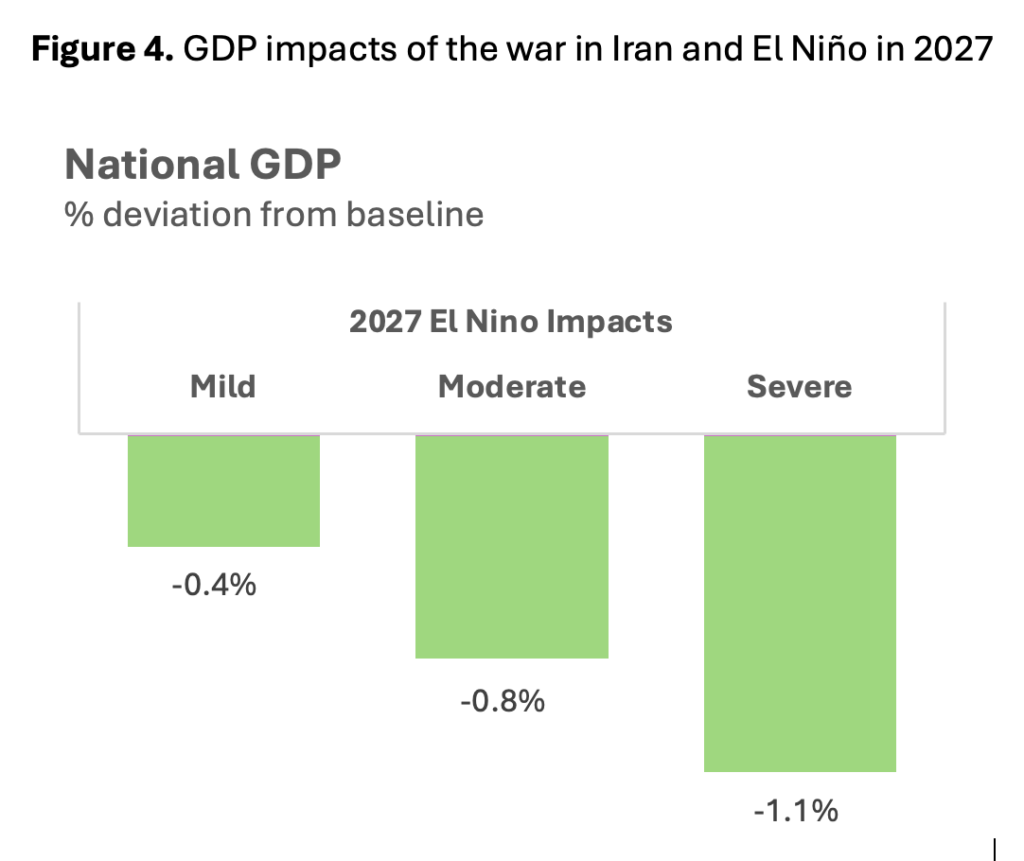
Under these combined assumptions, national GDP losses range from 0.4% to 1.1%, averaging 0.8% (Figure 4). Almost all of these losses are attributed to El Niño impacts.
Substantial production losses occur in the dry highlands (−9.6% total agriculture; −10.8% crops) and dry lowlands (−6.5% total agriculture; −8.7% crops), but only small effects are seen in moist highland and moist lowland systems (Figure 5).
The decline in agricultural GDP can be roughly decomposed into land-use and total factor productivity effects using rapid assessment estimates of a 6% reduction in cropland in drought-prone areas and a 14%–23% land share in value added in these regions.
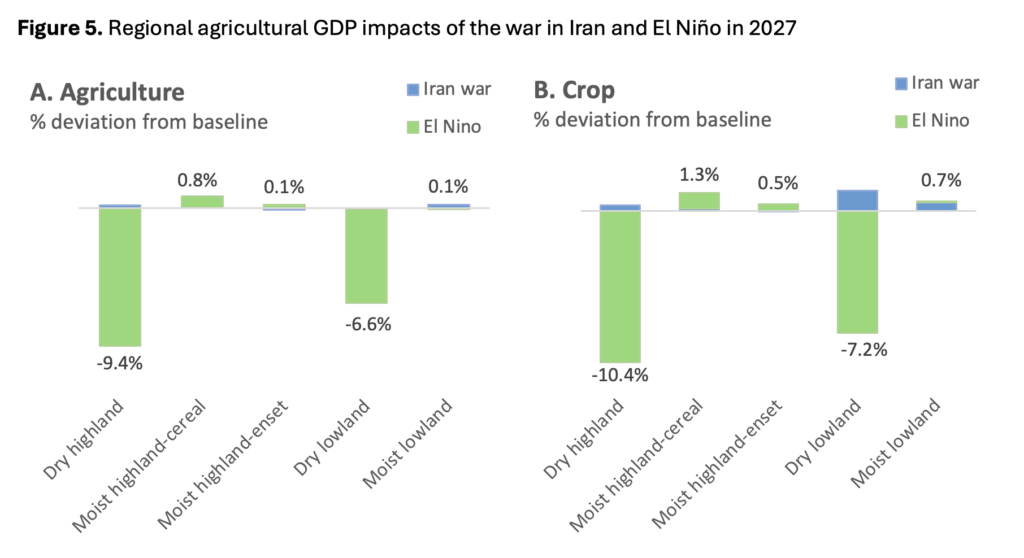
Land-use reduction accounts for approximately 0.8-1.4 percentage points of the agricultural GDP decline in drought-prone lowlands and highlands, respectively, with the remaining 5.7 and 8.2 percentage points attributable to declining total factor productivity.
Overall, the findings highlight the greater vulnerability of dryland agricultural systems to climate-related shocks, as compared to wetter areas of Ethiopia.
Food prices and spending
The fuel price shock alone lowers agricultural commodity prices by 0.4% relative to baseline (Figure 6, Panel A). This happens because higher fuel costs push up prices more for non-agricultural goods and services than for agricultural products. Agricultural products therefore become cheaper in comparison. Because the model measures prices against a fixed overall price index, it reports this as a decline in agricultural prices—not necessarily a fall in prices paid in birr.
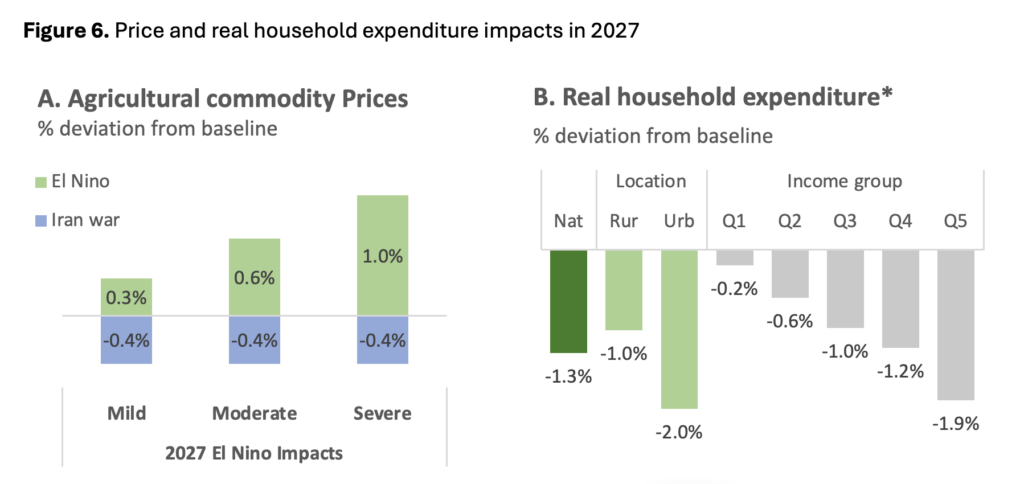
*Note: Panel B presents results for the “average” El Niño scenario. Q1-Q5 are expenditure quintiles.
By contrast, lower production under the El Niño scenarios pushes agricultural commodity prices up by 0.3%–1.0%. National agricultural price increases are smaller than those estimated for Malawi and Kenya because productivity losses are smaller and concentrated in Ethiopia’s drought-prone zones.
Higher agricultural prices under El Niño and lower economic activity reduce household purchasing power. Overall, real household expenditure falls by an average of 1.9%, with losses ranging from 1.3% in the “Mild” scenario to 2.5% in the “Severe” scenario. Urban households experience larger losses (2.8%) than rural households (1.5%). In rural areas, higher returns to land partly offset declining farm and nonfarm wages.
Real expenditure losses are generally larger among richer households for two reasons. First, the contraction in services disproportionately affects sectors employing higher-income urban households. Second, the energy price shock raises the prices of industrial goods and services that account for a larger share of richer households’ consumption.
Poverty and undernourishment
These price and income effects have a significant impact on the population’s well-being. We consider two measures of well-being: changes in poverty and undernourishment. Poverty is measured using the international $3.00-a-day poverty line, while people consuming less than approximately 1,850 kcal per adult equivalent per day are considered undernourished.
Under the baseline trajectory, 30.2% of Ethiopians (42.6 million people) are poor, and 20.2% (28.5 million) are undernourished in 2027. In the projected (“Moderate”) El Niño scenario, the combined shocks push an additional 905,000 people into poverty (Figure 7, Panel A) and 2.8 million into undernourishment (Panel B). The poverty and hunger effects are proportionally higher or lower under the “Severe” and “Mild” El Niño scenarios.
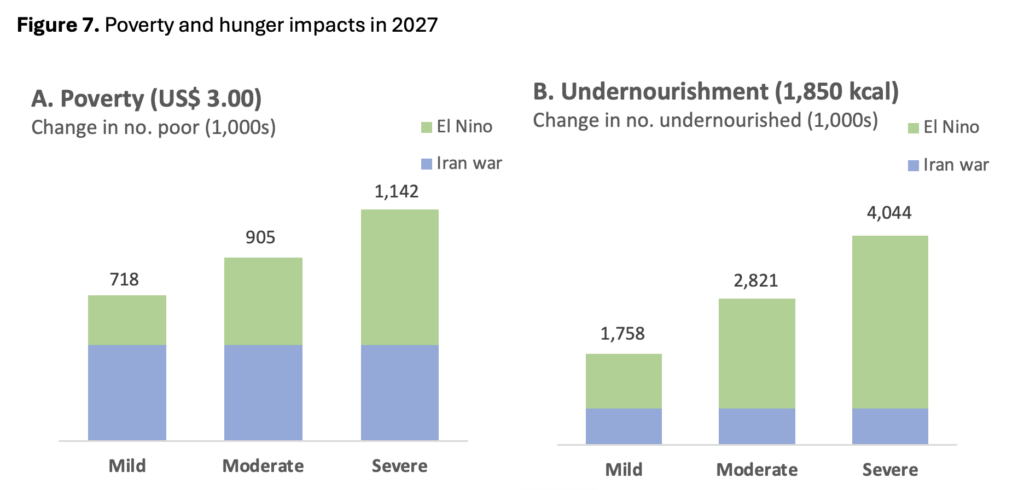
Despite its limited GDP effect, the Iran war shock accounts for about half of the increase in poverty (472,000 people), but only about 24.8% of the increase in undernourishment (699,000 people. Meanwhile, both poverty and undernourishment impacts are strongly rural, with more than 57% of those falling into poverty and about 76% of those becoming undernourished living in rural areas.
These results raise the possibility of significant emergency food assistance needs in 2027, especially given that our model already incorporates the cash and food transfers typically provided under the country’s Productive Safety Net Program. Advance planning will be necessary to meet these needs, which will likely peak between June and August, especially given recent reductions in humanitarian contributions by key donors. The current conflict in northern Ethiopia could further exacerbate poverty and undernourishment, though its specific impacts are hard to predict.
Conclusion
Ethiopia faces substantial economic and social risks in 2027, particularly from climate-related shocks, the model indicates.
Despite the Iran war’s likely limited impacts on agriculture and the broader economy, it may have significant effects on both poverty and undernourishment through higher domestic prices of a wider set of food and non-food commodities.
El Niño poses a considerably larger risk to the economy (with GDP falling −0.8% nationally and −2.0% in agriculture) and livelihoods. Drought-prone regions could experience 6.6%–9.4% declines in agricultural GDP, resulting in pressures on agricultural prices, household welfare, poverty, and food security. These risks underscore the importance of timely and targeted policy responses to mitigate the impacts and protect vulnerable households, above and beyond the current safety net. At the same time, substantial uncertainty remains regarding future GDP, poverty, and undernourishment outcomes. Ongoing conflicts in parts of the country, if unresolved, could further exacerbate food insecurity and compound the effects of climate-related shocks.
Emerta Aragie is a Research Fellow with IFPRI’s Foresight and Policy Modeling (FPM) Unit; Chris Hillbruner is Head of the Global Food Security Program in IFPRI’s Markets, Trade, and Institutions Unit. Opinions are the authors’.