





Key takeaways
- Kenya faces significant economic and food security risks from overlapping El Niño impacts and fuel and fertilizer price shocks associated with the war in Iran, a model shows.
- Potential impacts include slower economic growth, particularly lower agricultural production, and higher food prices, although the magnitude and distribution of these effects remain uncertain.
- Food security could deteriorate sharply following the shocks. Under one scenario, nearly 756,000 additional people could fall into poverty, while approximately 4.9 million more people could become undernourished.
Third in a series. Read the first post here and the second here.
El Niño events are extended periods of warmer-than-usual sea surface temperatures in the eastern tropical Pacific that alter global atmospheric circulation, affecting seasonal rainfall patterns in many parts of the world. Currently, El Niño is strengthening rapidly. NOAA’s Climate Prediction Center forecasts a greater than 90% chance of a very strong El Niño in 2026-27 and a nearly 70% chance that its peak strength will exceed that of all previous El Niño events since 1950. Meanwhile, the Iran war and disruption of shipping through the Strait of Hormuz have driven up prices of fuel and fertilizers.
Together, these overlapping shocks pose potentially serious threats to food production and food security, though the specific impacts vary by geography and timing. This is the second in a series of blog posts focused on impacts in Ethiopia, Kenya, Malawi, and India and on the global food system as a whole. These posts reflect a combination of economic modeling and policy research and inform an October 8 policy seminar.
El Niño events can significantly influence Kenya’s seasonal rainfall patterns, growing seasons, and national economy.
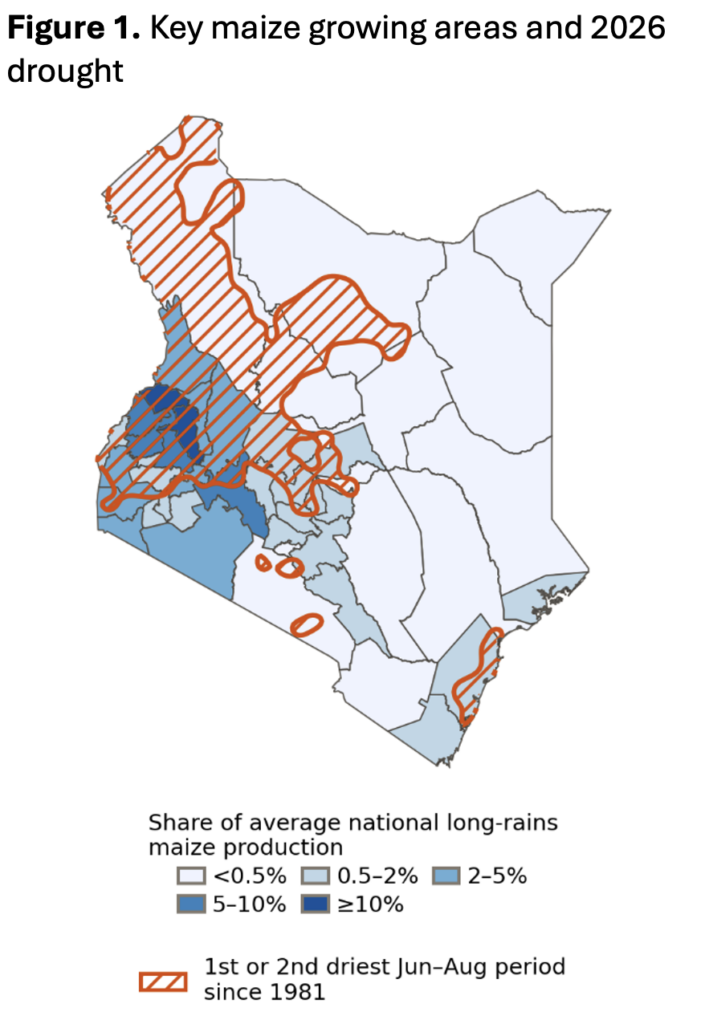
Most commonly, El Niños result in above-average “short rains” (October-December) that can both support crop production and cause flooding. The “long rains” (May-August) have typically not seen El Niño impacts, but 2026 has been atypical, with drought affecting much of western Kenya as a very strong El Niño has developed. Many areas have experienced the driest or second driest June-August period since at least 1981 (Figure 1) and crop assessments by the Ministry of Agriculture suggest substantial impacts on 2026 long rains season, which usually accounts for about 70% of crop production. Livestock authorities have also linked reduced milk deliveries to drought and inadequate fodder.
At the same time, the war in Iran has disrupted supply chains and raised fuel and fertilizer costs.
How are these overlapping shocks likely to affect Kenya’s agricultural production and economy as a whole?
Our modeling suggests that the effects of El Niño-driven drought will far exceed the impacts of higher fuel and fertilizer costs—resulting in national GDP losses as high as 1.5% in 2026, depending on the scenario, along with a substantially higher drop in agricultural GDP. Under one scenario, this could in turn push more than 750,000 people into poverty and an additional 5 million into undernourishment.
The model
To estimate these impacts, we employed RIAPA-AI (Rural Investment and Policy Analysis with artificial intelligence), a conversational interface built around IFPRI’s standard computable general equilibrium (CGE) model that allows users to quickly generate rigorous simulations of national economies.
Kenya’s RIAPA-AI is calibrated to a slightly aggregated version of a 2022 Social Accounting Matrix (SAM) for Kenya. This SAM includes 15 household groups and represents the national economy through 46 production sectors, comprising 20 agrifood subsectors (12 primary agricultural and eight agro-processing) and 26 industrial and service subsectors.
This allowed us to model both the direct and indirect effects of lower crop yields and higher input prices and how those shocks propagate through food prices, employment, household incomes, and the wider economy. Changes in poverty and modeled dietary energy inadequacy were estimated with the aid of a linked microsimulation model.
Strait of Hormuz impacts
While the market disruptions of the Iran war continue to reverberate globally, the model suggests their impacts on Kenya are likely to be mild.
First, our simulations assume baseline fertilizer prices persist because most Kenyan fertilizer procurement occurred before April 2026, reducing exposure to the subsequent spike in global fertilizer prices, though these high global prices may have a stronger effect on domestic input costs in 2027. Further, the Kenyan National Fertilizer Subsidy Programme can partly cushion farmers against higher international prices, although timely availability, eligibility, and distribution determine effective access.
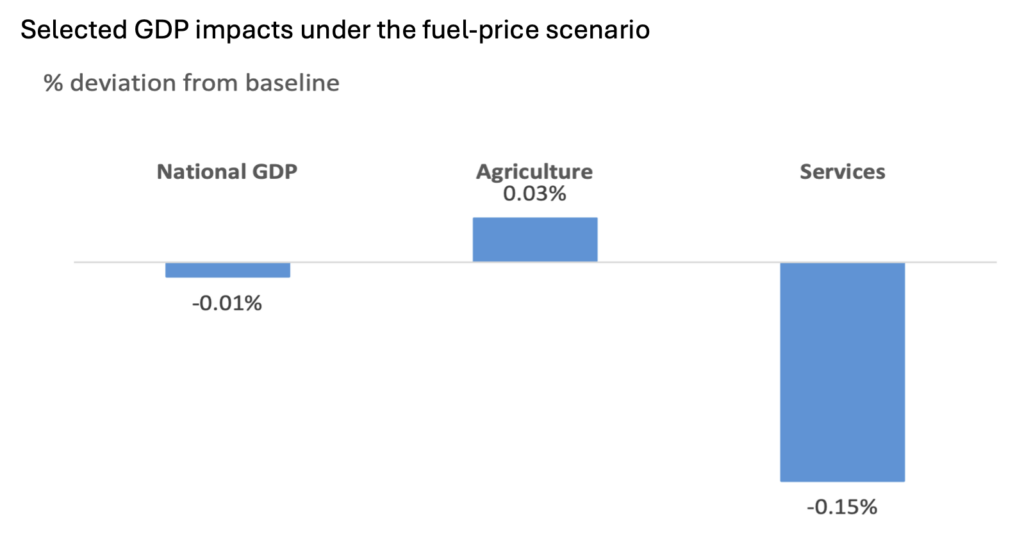
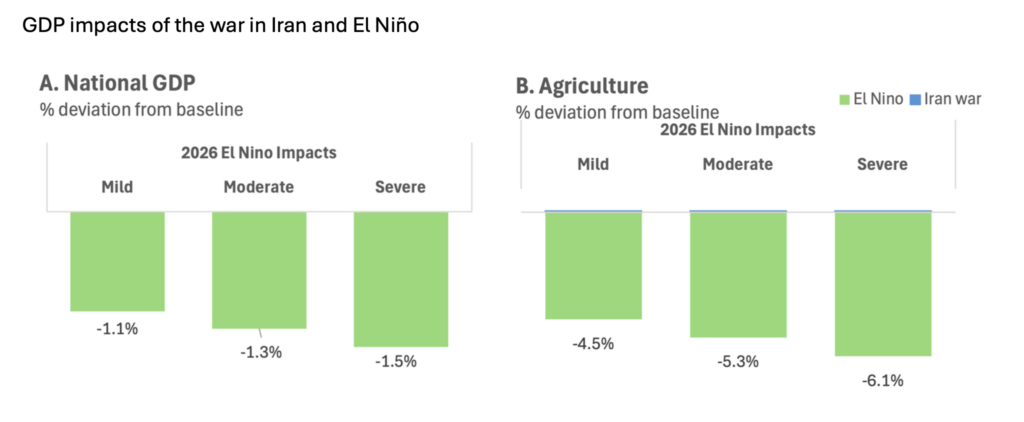
Higher fuel prices, meanwhile, are having only marginal GDP impacts, the model suggests. For this analysis, we assumed annual average Brent crude prices of $94 per barrel in 2026 against a no-conflict baseline of $67 per barrel, an increase of about 40%. Under these assumptions, national GDP falls by about 0.01% relative to the no-price-shock baseline (Figure 2). Agricultural GDP increases by nearly 0.03%, partly due to stronger export performance in the sector associated with exchange rate depreciation, while service-sector GDP falls by about 0.15% as trade and transport input costs rise.
These limited effects on GDP stem partly from Kenya’s government-to-government petroleum import arrangements that can ease financing and foreign-exchange pressures, and the temporary fuel Value Added Tax (VAT) reduction from 16% to 8% announced in April 2026 has cushioned pump prices.
Figure 2
How El Niño changes the outlook
When weather-related impacts are added to the model, the economic picture worsens significantly.
The model includes three agricultural production scenarios: Mild, Moderate, and Severe. For instance, for the maize sub-sector, we assume a 13% (Mild), 15% (Moderate), or 18% (Severe) decline in national productivity across the three scenarios. For livestock, we assume a 7%, 8%, or 9% decline in productivity. For scenario implementation, these productivity shocks are aggregated to the appropriate RIAPA-AI sector groups using production weights (e.g., cereals group for maize, sorghum, rice, and wheat). Each of these three production scenarios is then overlaid on the fuel price scenario, with impacts reported for 2026.
The three agricultural production scenarios were based on several data sources including the Kenya Food Security Steering Committee’s July 2026 rapid assessment of long rains production, a review of historical rainfall and crop production data, and statistical models of 2026 long rains crop production produced by NASA Harvest in collaboration with the Kenyan Ministry of Agriculture and Livestock Development. The model also considered the share of annual production generated during the long rains season, assumed near-average short rains crop production, and accounted for some uncertainty in current production estimates.
GDP impacts
The model shows national GDP losses ranging from 1.1% to 1.5%, with a Moderate scenario loss of 1.3% (Figure 3, Panel A), while agricultural GDP losses range from 4.5% to 6.1%, with a Moderate scenario loss of 5.3% (Panel B). Almost all of the simulated national and agricultural GDP losses arise from the assumed weather-related productivity shocks. The effects of fuel prices do not show up in the national GDP numbers, but the small positive terms-of-trade effects are visible for agriculture, albeit vastly outweighed by El Nino’s negative effect.
Figure 3
Higher prices, lower purchasing power
Lower agricultural production places upward pressure on agricultural commodity prices, which rise by 6.7%–10.2% across the production-shock scenarios (Figure 4, Panel A). While benefiting the agriculture sector, these higher prices, together with lower economic activity, reduce household purchasing power: real household expenditure falls by 2.8% in the Moderate scenario (Panel B), ranging from 2.5% in the Mild scenario to 3.0% in the Severe scenario. Losses are larger for urban households (-3.4%) than for rural households (-1.6%), as declining farm and nonfarm wages are partly offset in rural areas by higher returns to land as agricultural supply tightens.
Richer households face higher losses for two main reasons. First, the contraction of the service sector disproportionately affects employment among higher-income urban households. Second, energy price shocks increase the prices of products and services predominantly consumed by richer households.
Figure 4
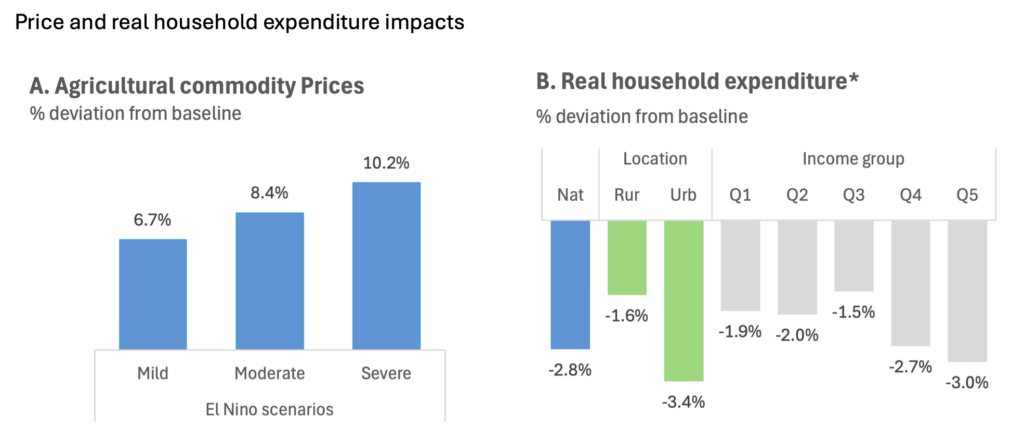
*Note: Figure 4b presents results for the “Moderate” El Niño scenario. Q1-Q5 are expenditure quintiles.
Poverty and undernourishment rise
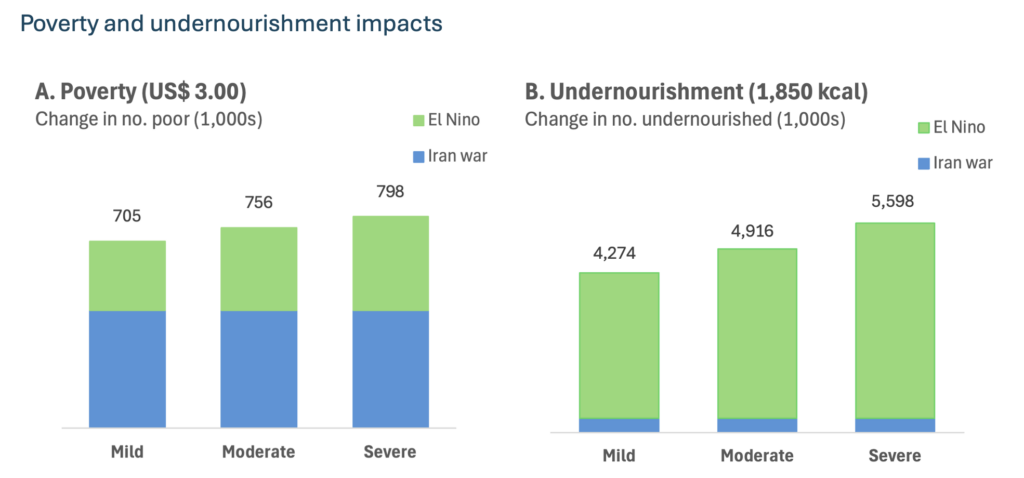
The model shows poverty increasing. In the Moderate combined shock scenario, the combined shocks push an additional 756,000 people into poverty (Figure 5, Panel A) and 4.9 million into undernourishment (Panel B), above the model baseline, in which 46.8% of Kenyans (27.5 million people) are poor, and 35.3% (20.8 million) fall below this hunger threshold.
Poverty is measured using the international extreme-poverty line of $3.00 per person per day in 2021 purchasing power parity (PPP) terms, while the linked model classifies people consuming less than approximately 1,850 kcal per adult equivalent per day as having inadequate dietary energy intake.
The Iran war shock accounts for over half of the increase in poverty in the Moderate scenario (444,000 people), but only about 8% of the increase in undernourishment (380,000 people). While poverty impacts are strongly urban, with more than 59.8% of those falling into poverty living in urban areas, undernourishment impacts are particularly concentrated in rural areas, with about 66.4% of those becoming undernourished living in rural areas.
Figure 5
Alternative short rains season outlook
The short rains season, just underway, is a source of uncertainty we accounted for in the modeling exercise, finding that it could result in impacts in either direction.
The August 31, 2026, seasonal outlook from the Kenya Meteorological Service Authority forecasted above-average October-December rainfall in most counties, with near-average to above-average rainfall in Turkana and parts of West Pokot, Samburu, and Marsabit. Above-average rainfall during the short rains season is often beneficial for crop production. However, very high levels of rainfall can damage crops and cause serious flooding.
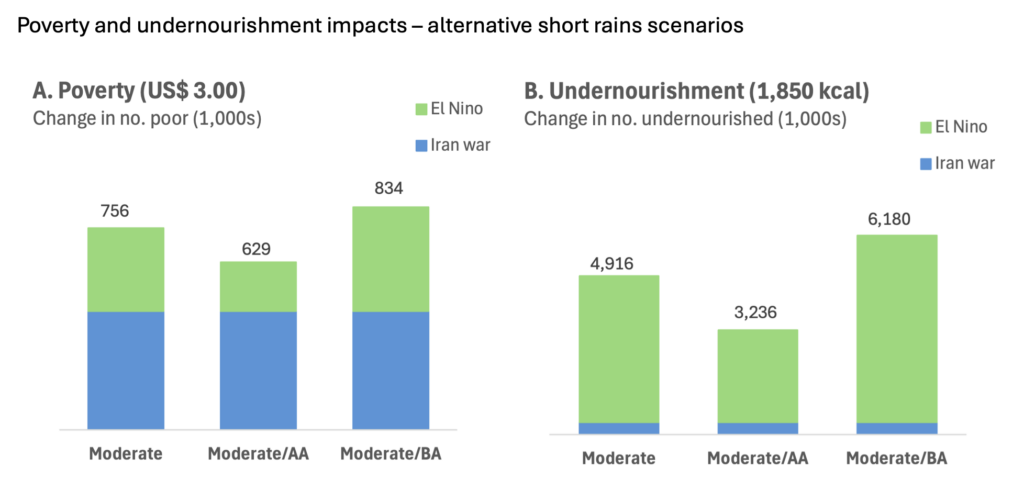
To account for this uncertainty, we compared our central scenario from above (Moderate long rains season production deficit + average short rains production) to two additional scenarios: 1. Moderate long-rains-season production deficit + 15% above average short rains production (Moderate/AA), and 2. Moderate long-rains-season production deficit + 15% below average short rains production (Moderate/BA).
In the Moderate/AA scenario, above-average short rains production offsets earlier production deficits, reducing national GDP and agricultural GDP losses by 0.4 and 1.6 percentage points, respectively (Figure 6) and reducing the number of additional people falling into poverty (-127,000) and undernourishment (-1.7 million) (Figure 7). By contrast, in the Moderate/BA scenario, poor short rains production drives increased GDP losses to 1.7%. Compared with the Moderate case, the Moderate/BA scenario raises additional poverty by 78,000 people and dietary energy inadequacy by about 1.3 million people (Figure 7).
Figure 6
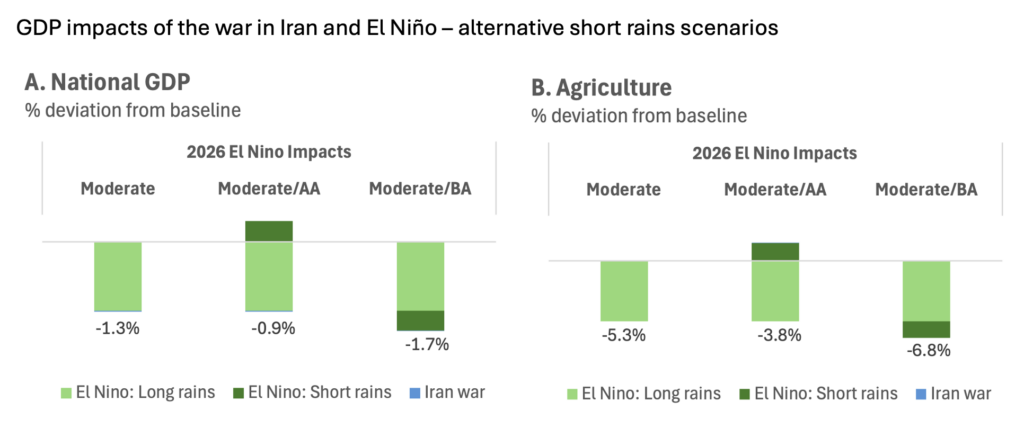
Figure 7
Conclusion
Overall, the analysis highlights the substantial economic and social risks facing Kenya in 2026, particularly from this year’s unusually strong El Niño. While the Iran war is expected to have a minimal effect this year, El Niño presents a considerably larger risk to the economy (a national GDP loss of 1.3% and a decline of 5.3% in agricultural GDP) and livelihoods.
The resulting pressures on agricultural prices, household welfare, poverty, and food security underscore the importance of making timely and targeted policy responses to mitigate the impacts and protect vulnerable households. Meanwhile, substantial uncertainty regarding future levels of GDP, poverty, and undernourishment persists. The forecast for above-average short rains (October–December) could have positive or negative effects, future cropping seasons may face fertilizer procurement and subsidy-budget pressures, and strong El Ninos, like the one currently in place, raise the risk of a fast transition to a La Nina, an event associated with increased drought risk in Kenya during the Mapril to June period.
A forthcoming blog post will focus more directly on the policy implications of these modeling results.
Emerta Aragie is a Research Fellow with IFPRI’s Foresight and Policy Modeling (FPM) Unit; Shadrack Mwatu and Adan Shibia are Senior Policy Analysts with the Kenya Institute for Public Policy Research and Analysis (KIPPRA); Chris Hillbruner is Head of the Global Food Security Program in IFPRI’s Markets, Trade, and Institutions Unit. Opinions are the authors’.