



Key takeaways
•Generative AI can close agricultural information gaps. A new AI voice agent offers tailored, real‑time advice to smallholder farmers, even in remote areas.
•Local language and context matter. Accurate speech recognition, vernacular terms, and natural conversation were key to the development process.
•Human-centered design is critical. Building trust, ensuring data governance, and integrating local experts and farmer feedback determine long‑term success.
Will the ongoing expansion of artificial intelligence technologies leaves certain segments of society behind as earlier digital transformations did? Generative AI (gen AI) applications that can automate a wide range of verbal and analytical tasks may be different. These show enormous promise to address gaps in productivity, market access, and income growth.
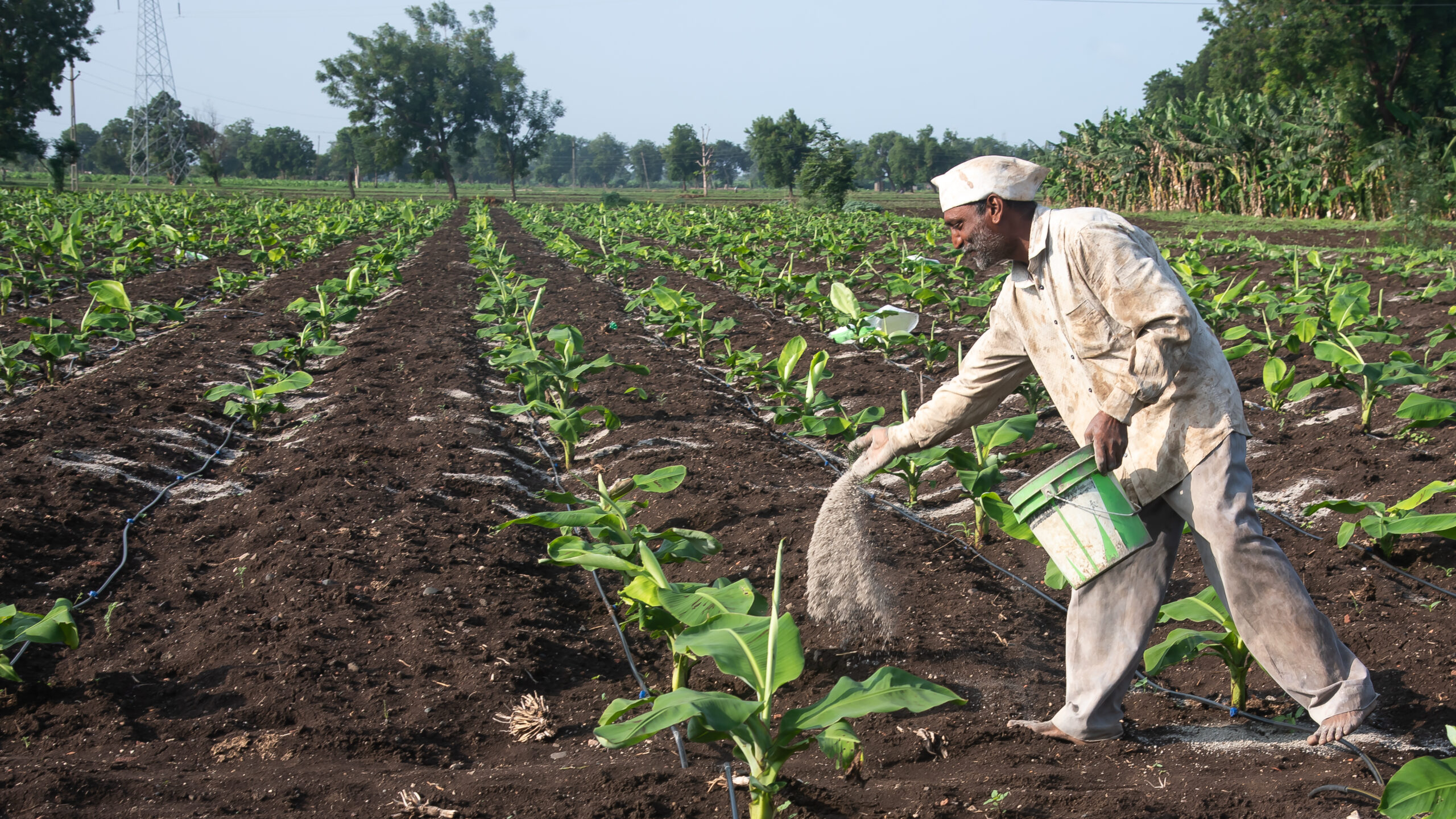
They can also benefit marginalized farming communities previously left behind by advances in other digital technologies. The lack of computers and computing power in rural areas, and later the patchy or nonexistent internet access, have long slowed efforts to support farmers with digital innovations. Today, smartphone apps for farming are often expensive, and call centers may be unreachable or not helpful for smallholders.
Today, gen AI systems accessible by mobile phone can deliver advice to smallholders on farming techniques, use of inputs, pest control, weather and climate impacts, and other topics, providing consistent and reliable information. But to be effective, such systems require careful development, including tailoring to local languages and practices.
In this post, we document various issues and challenges encountered in the process of developing a gen AI voice agent in India by the AI startup Farm Vaidya (FV). IFPRI served as a technical advisor to the project. The company’s voice AI agents communicate with Telugu-speaking farmers in southeast India through their mobile phones and provide immediate, context-specific advice on a wide range of issues. FV’s experiences offer specific lessons for designing and deploying gen AI-based agricultural advisory services.
The FV project is one example of broader efforts to develop and deploy AI models to address diverse agricultural needs. Gen AI tools can be used for predictive analytics that can forecast weather patterns, anticipate pest outbreaks, and determine optimal sowing and harvesting times, allowing farmers to take preventive action and reduce crop loss. AI-driven models can forecast commodity prices and arrival times in the market, helping farmers make informed decisions about when and where to sell their produce for better income. Finally, gen AI can accelerate research processes and the development of new, climate-resilient crop varieties by analyzing large genomic datasets and simulating various environmental scenarios.
Challenges in the development and deployment of gen AI
As FV put the initial building blocks for the design of the gen AI voice agent advisory services in place to meet the information needs of 90 million farmers speaking Telugu, developers encountered specific sets of challenges.
Existing large language models (LLMs) that power gen AI systems, trained on large datasets of information collected across the internet, often lack specific knowledge of crops, cultivation practices, and regional languages. Their answers remain generic and not tailored to local farming conditions. To address this issue, FV created more than 5,000 agriculture Q&A benchmarks across more than 100 crops—prompts and responses to provide a baseline for testing—and rigorously evaluated multiple LLMs to select the most capable models.
Moreover, LLMs do not always convey correct information. This could have serious consequences for farmers—leading to the loss of the entire crop through the wrong pesticide dosage, for instance. To address this problem, FV built a custom retrieval-augmented generation framework, restricting the sources for answers only to verified university and government advisories to ensure sound responses to farmers’ queries.
Communicating in local languages
Speech recognition by existing models often fails in real field conditions. For example, open-source speech-to-text (STT) models implemented by the company showed 50% or higher error rates due to dialects, slang, and noisy farm environments. In such cases, the system simply cannot understand farmers.
Agriculture-specific speech models remain underdeveloped and scarce; most existing speech systems have been trained on studio or read speech, not on real farmer conversations. In response, FV started building one of India’s first agriculture-domain STT initiatives. It collected real conversational farm audio to use in training its models, recognizing that listening accurately is the foundation of voice AI. It has gathered more than 30,000 hours across each of India’s 10 major languages, targeting a less than 3% word error ratio.
Many farmers use names for local crops and pests not found in textbooks or datasets—vernacular terms that pose serious challenges in the development of voice agents. To address this problem, FV teams traveled village to village, recording conversations and accumulating a dataset of more than 5,000 previously undocumented vernacular terms. These were incorporated into the model.
Improving reliability and consistency
Since LLMs may not always respond reliably or consistently to questions as an extension agent or crop scientist would, the system sometimes provided incomplete answers, wrong dosages, or skipped critical clarifying questions. To simulate real scientists’ responses, FV developed custom prompts through multiple iterations that made the agent ask counter-questions, validate context, and respond like a trained agricultural expert.
Responses often came across sounding robotic and textbook-like. As a result, farmers said, even correct answers felt unnatural. For example, sentence structures typically did not match how farmers speak. To address this, FV built conversational datasets of recorded real scientist-farmer dialogues and fine-tuned the models to deliver natural, local, human-like conversations.
In addition, during beta field trials, the FV platform supported more than 5,000 minutes of live farmer interactions in Telugu and Tamil among agriculture companies and NGOs. The system was tested under field conditions to validate its accuracy, usability, and the quality of responses. It can now help farmers resolve field-level queries in real time, take timely decisions, and ultimately improve crop productivity and income outcomes.
Finally, what seemed like “just building a voice agent” became months of fieldwork, failed experiments, and ground learning for the FV team—because in agriculture, gen AI agents must first learn to listen, speak, and think like a farmer.
FV’s efforts working with the existing infrastructure, data and knowledge bases, institutional arrangements, and policy systems to develop AI tools provide lessons for similar initiatives.
Lessons from the development of gen AI agents
FV’s development process offers a broader set of lessons for policymakers.
Effectively harnessing AI’s transformational potential for those left behind during the digital transformation era requires a policy approach that ensures equitable and sustainable outcomes. Public investments in rural digital infrastructure, such as internet connectivity and digital literacy, are necessary first steps to ensure that the AI transformation benefits smallholder farmers.
Developing AI tools in local languages and dialects is key to reducing the information gaps that exist in many digital systems and applications. In India, with 13 major languages spoken by roughly 1 billion people, ensuring inclusivity requires that AI models and voice tools are built with multilingual interfaces to reach illiterate and non-English-speaking farmers. Incentivizing local agritech startups through competitive funding can help in developing affordable, localized AI solutions tailored to specific regional needs and crops.
Voice agents and other gen AI-based agricultural advisory services cannot be deployed without carefully accounting for locality- and context-specific issues and challenges. Those efforts should be integrated into the overall research and innovation process. This will enhance reliability and validate the usefulness of the conversational tool. Ideally, a virtuous circle develops: as conversational agents gain more information on context-specific issues from users’ collective inquiries and responses, their responses will improve and trust among farmers will increase, supporting further adoption and use.
Farmers will also need training in the use of AI tools, for example, how to formulate the right prompts to get the answers they need. Gen AI tools must also be made available to all who need them; for example, apps developed only for smartphones will leave out many poor and marginal farmers.
The human element
Understanding the human element in the use of AI advisory tools is key for supporting farmers and encouraging behavior change. For example, adapting to evolving realities on the ground should be an integral component of gen AI agents, so that they closely mimic farmers’ changing needs across crop seasons and annual agricultural cycles. In addition, ensuring that AI tools promote sustainable practices requires working with local entities such as researchers, farmer groups, extension workers, and input dealers. Finally, developing a network of users from diverse backgrounds should be able to nurture the use and further development of the voice agent.
A final key component for the sustainable deployment of AI-driven agricultural advisory services is the establishment of transparent data governance, accountability, and regulatory systems. Clear policies and legislation regarding data ownership, privacy, and security are needed to build farmer trust. Mandatory transparency and independent audits are urgently needed for AI models used in agriculture. Stakeholders and local extension systems should be closely involved in designing and implementing such regulations.
The development and use of generative AI-powered agricultural advisory tools and services is likely to keep expanding and accelerating. FV’s experiences show that to be useful to farmers in India and elsewhere around the world, such tools should not be deployed without careful consideration of local languages, agricultural practices, and other factors. Communication is central to such efforts: the importance of sharing lessons among developers, practitioners, and the users of these innovative tools cannot be overemphasized.
Suresh Chandra Babu is a Research Fellow Emeritus with IFPRI’s Director General’s Office; Praveen Ramadugu is the CEO of Farm Vaidya, India. Opinions are the authors’.
This post is an output from the project on Methane Reduction in Rice Farming Systems in Tamil Nadu supported by the Global Methane Hub, which is thankfully acknowledged.