





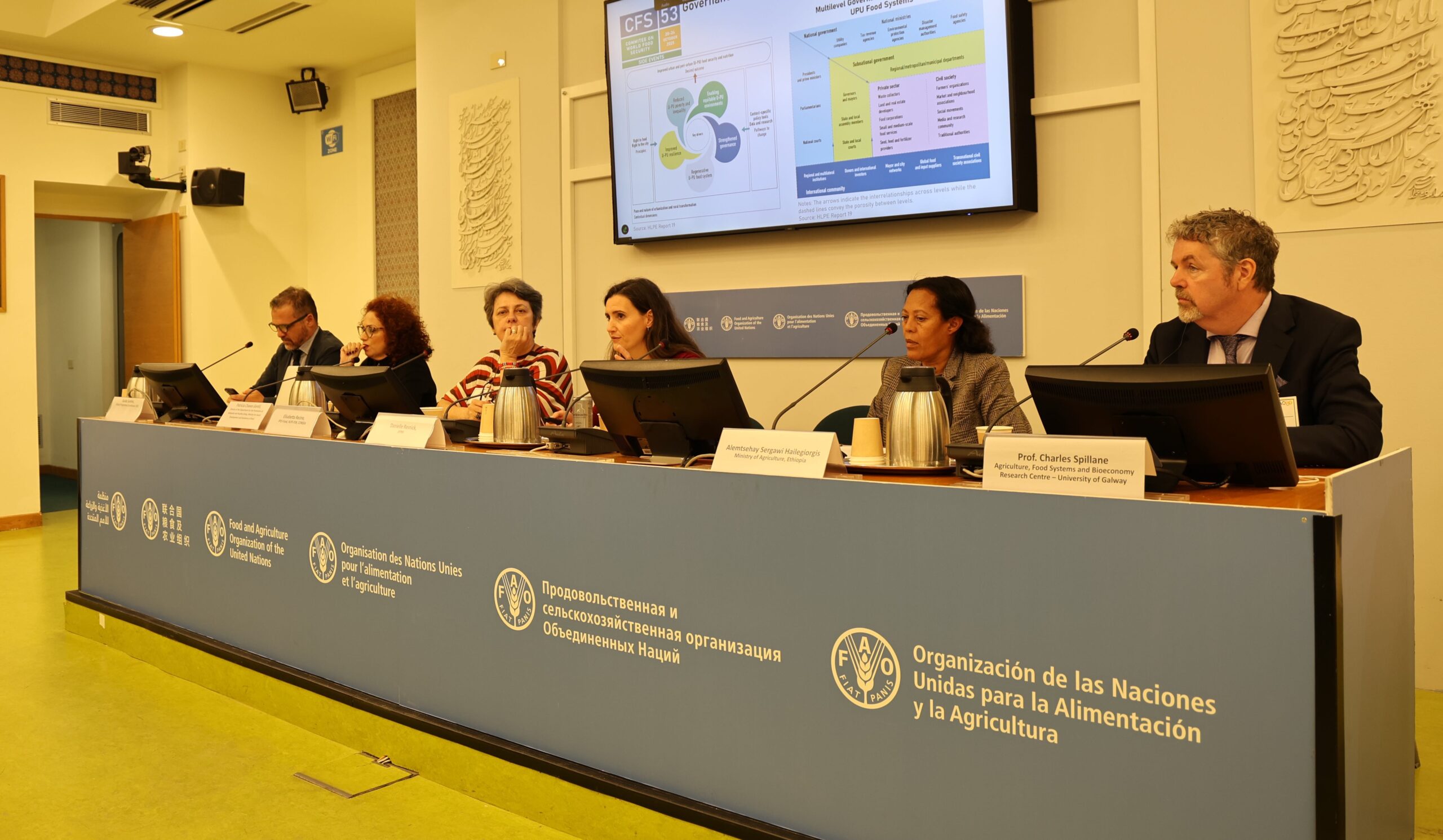
Each October, the global community focuses on the challenges facing rapidly growing cities and towns, starting with World Habitat Day early in the month and ending with World Cities Day. This year, the themes of “Urban October” were the subject of a side event at the 53rd Plenary Session of the Committee on World Food Security (CFS) on October 23 in Rome, cohosted by IFPRI and the CGIAR Science Program on Policy Innovations, along with many other global and national partner organizations.
The event explored how cities can lead the transformation of food systems in an era of climate change and multiple crises. Building on the findings of High-Level Panel of Experts (HLPE) Reports 19 on Strengthening Urban and Peri-urban Food Systems to Achieve Food Security and Nutrition, and HLPE Report 20 on Building Resilient Food Systems, the session highlighted innovative, multi-level governance approaches that link national policies with local action.
From HLPE 19 to HLPE 20: Framing food system resilience
Elisabetta Recine, President, Brazil National Food and Nutrition Security Council (CONSEA), opened the session by connecting the findings of HLPE 19 and 20, emphasizing that achieving resilient food systems requires governance grounded in rights, equity, and care. Cities are now home to over half the global population, she said, and while urban residents consume more than 70% of all food production, three-quarters of the world’s food-insecure people also live in cities—thus urban spaces are both vulnerable and innovative frontiers.
As HLPE 19 outlines, addressing the challenges of urban food systems requires holistic, inclusive governance, she noted. Such efforts must link food systems to related domains such as health, housing, and water, and incorporate the lived experiences of vulnerable groups. Another key element of urban food governance should be building resilience, a focus of HLPE 20. Resilience, Recine elaborated, means the capacity over time of agrifood systems to sustainably ensure access to safe and nutritious food for all, and requires rights-based governance, participatory foresight (“backcasting from our desirable futures”), and investment in diverse, equitable, and nature-integrity–aligned food systems.
Governing complexity: Bridging institutions for inclusive urban food systems
Danielle Resnick, IFPRI Senior Research Fellow, built on Recine’s framing, applying a governance lens to connect the HLPE reports with on-the-ground innovations, emphasizing how formal and informal institutions shape participation, decision-making, and accountability in urban and peri-urban food systems. Governance of these systems involves a dense web of actors across government levels, the private sector, and civil society, she said, whose coordination is often fragmented. She outlined three central challenges: Weak intergovernmental coordination amid varied degrees of decentralization, uneven subnational fiscal capacities that limit action, and disagreement over policies, especially those around informal markets.
Resnick added that political economy dynamics are particularly pronounced in urban and peri-urban areas where governance by opposition parties is more common and can therefore shape intergovernmental funding decisions.. She outlined a number of related approaches to overcome these barriers: Leveraging existing intergovernmental mechanisms instead of adding new ones, clarifying mandates and accountability metrics, developing cross-sectoral urban food strategies, and expanding food policy networks that elevate civil society innovations in advancing equitable and climate-resilient food systems.
Showcasing urban and peri-urban food system innovations
The session then highlighted practical examples from cities around the world, demonstrating how local actions can support global food security and resilience goals. Patricia Chaves Gentil, Director in Brazil’s Ministry of Development and Social Assistance, Family and Fight Against Hunger noted that in Brazil, 87.4% of the population lives in urban areas, and urban food insecurity affects over 5.2 million people. The Alimenta Cidades strategy aims to address that challenge. It is an intersectoral, multi-level program engaging federal, state, and municipal governments, civil society, and academia to expand production, access, and consumption of healthy foods in vulnerable urban territories. The strategy is structured around eight axes covering the entire food system, including production, processing, distribution, access, preparation, consumption, and food waste management. It is supported by complementary programs such as the Solidarity Kitchens and the Urban and Peri-Urban Agriculture Program, combining innovation, training, financing, and peer-to-peer city cooperation.
Barcelona has built multi-level governance spaces to address urban food challenges such as inequality, housing pressures, and climate change, explained Ana Moragues Faus, Associate Professor at the University of Barcelona and Director of the Food Action and Research Observatory (FARO). The city’s integrated urban food strategy connects municipal, metropolitan, and regional levels, reinforced through international networks like the Milan Urban Food Policy Pact and C40 Cities initiative. Barcelona combines formal governance mechanisms with civil society-led initiatives, using evidence from lived experiences, food mapping, and participatory platforms to foster resilience. Time, place, relations, diversity, and power shape food system transformation, she said.
Alemtsehay Sergawi, Head of the Food and Nutrition Office, Ethiopia Ministry of Agriculture, highlighted key lessons from the EcoFoodSystems Project workshops in Addis Ababa, which brought together city-regional food system stakeholders to assess policies, governance, and institutional frameworks. The workshops revealed that multi-sectoral engagement, high-level political commitment, clear accountability, and coordination across different levels of government are critical for successful programs, even as challenges such as climate change, resource constraints, and cultural practices can limit effectiveness. The Ethiopia workshops highlighted three key policy messages: First, policy coherence across sectors and governance levels—national, city, regional, and district—is critical; second, institutional and governance innovations can accelerate policy implementation; and third, stakeholder participation, representation, and ownership are essential to scale impact effectively.
Overall, the event, co-moderated by Guido Santini, Global Coordinator for the FAO’s City Region Food Systems Program, and Charles Spillane, Professor, University of Galway, Ireland, pushed discussions about urban food system resilience in new directions. Instead of focusing only on what policies are needed to advance such resilience, panelists offered concrete examples of how to implement urban food policies effectively and inclusively—despite the many complexities and diverse constituencies that such policies engender within governments and among the broader public.
Aditi Chugh is a Research Analyst with IFPRI’s Markets, Trade, and Institutions (MTI) Unit; Danielle Resnick is an MTI Senior Research Fellow and a Non-Resident Fellow with the Brookings Institution Global Economy and Development Program.