




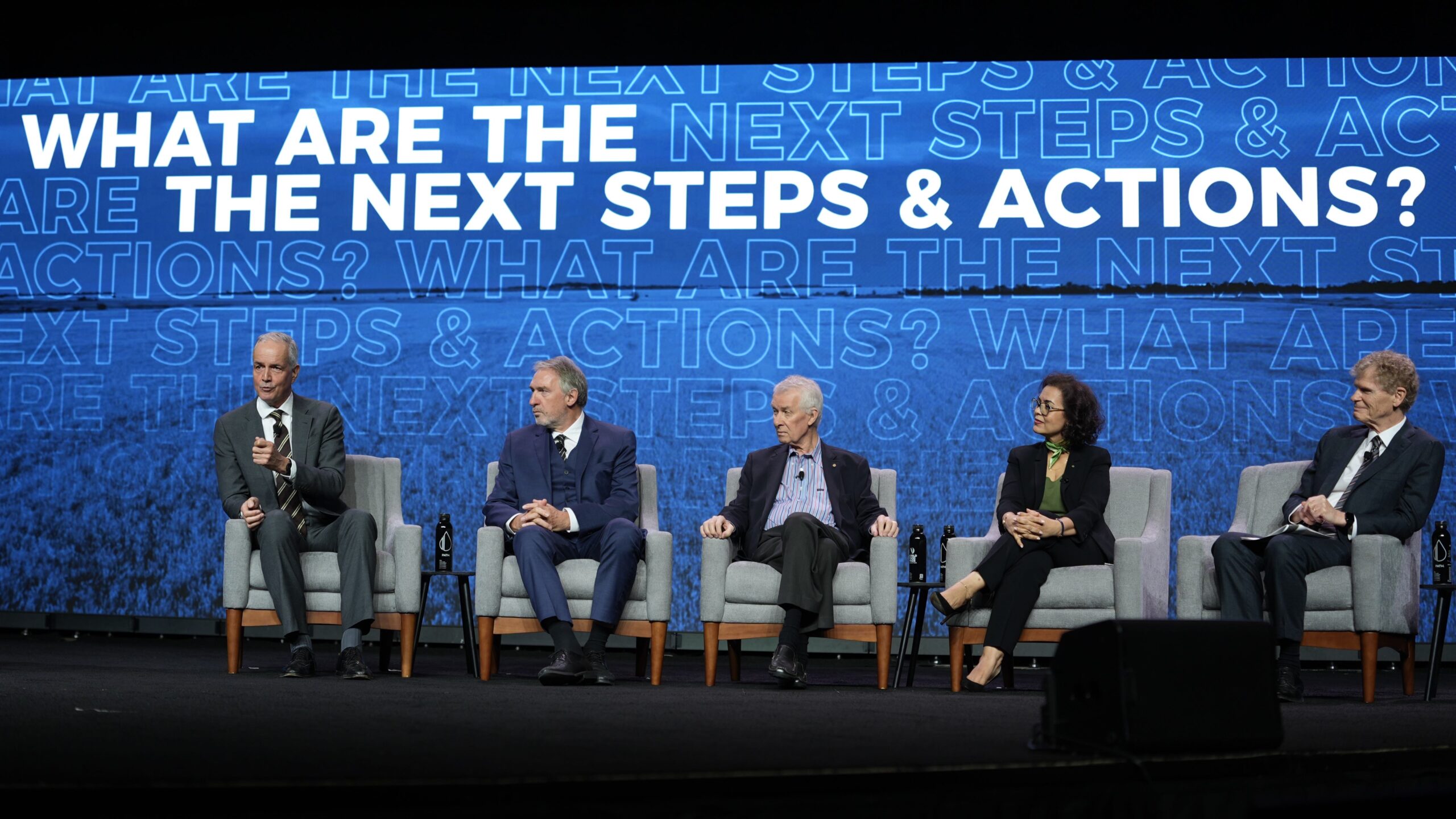
Conflict is a primary driver of recent food crises, while extreme poverty in fragile settings is only anticipated to rise in the years ahead—an increasingly dangerous dynamic that threatens the lives and livelihoods of millions of people. The central role of food security in ensuring global stability was the theme of an October 21 panel discussion at the 2025 Norman E. Borlaug International Dialogue, hosted by the World Food Prize Foundation in Des Moines, Iowa.
In front of an audience of food systems stakeholders spanning sectors and continents, IFPRI Director General Johan Swinnen, CGIAR Executive Managing Director Ismahane Elouafi, New England Biolabs Chief Scientific Officer and Nobel Laureate Sir Richard Roberts, and Council on Foreign Relations Senior Fellow Michael Werz took the main stage for a discussion on the theme “Peace on the Plate: A Legacy of Security,” moderated by 2024 World Food Prize Laureate Cary Fowler.
The conversation began with a straightforward question: What is the most urgent food security challenge we need to address? “Building resilience,” Elouafi said—especially among the 800 million small-scale producers that currently feed one-third of the world. To Roberts, overcoming political barriers to the adoption of biotechnologies like genetic modification is critical to tackle climate change and other 21st-century challenges for agriculture. Considering the increase in volatility and fragility in the past decade, Swinnen said, “we need to move beyond short-run thinking … we need to have a new policy paradigm in mind which combines immediate crisis response with investments that build resilience.” Werz emphasized the geopolitical imperative behind all of these priorities. Cooperation on global hunger, he said, “will be the litmus test of how we organize global governance and our world in the 21st century.”
Participants all stressed the urgency of advancing innovation and cooperation to address hunger. Facilitating more robust innovation systems among the least-developed, low-income countries remains a priority for CGIAR and the world to keep pace with evolving challenges, Elouafi said. Growth in middle-income countries, where investment in science is growing faster than in many high-income OECD countries, presents new opportunities for partnerships between donors and governments in the global South. Innovation continues to facilitate solutions and technologies that are changing how we undertake and use research. For example, data-driven modeling and artificial intelligence tools can help improve the ability to anticipate crises, Swinnen said. Information, finance, and insurance are also underutilized avenues for leveraging new technologies to build resilience across the agrifood value chain, he said.
Translating science to real-world food security impacts remains a major obstacle, Roberts said; better science communication should play a role in advancing science and research in today’s more politically polarized context. Panelists also agreed that addressing hunger must be seen as not just a humanitarian effort, but as integral to geopolitical strategy. As defense budgets grow and aid budgets shrink, Werz said, widening inequalities in food security must be understood as a threat to countries’ national security.
Looking ahead, the speakers outlined some hopes for change. High-income countries should support developing world scientists in efforts to utilize crop-improving biotechnology, Roberts said. Investment in innovation is also needed beyond the farm, Swinnen said, and “it is really crucial to bring in the private sector and the public sector.” In addition, the $800 billion governments spend each year on agricultural subsidies could be leveraged to mobilize private financing for transformation across all segments of agrifood value chains, he said. As for immediate next steps, Werz and Elouafi stressed that the weaponization of food in conflicts must end. UN Security Council Resolution 2417, which aims to outlaw the weaponization of food, passed in 2018 but has since been largely absent from global dialogue; that must change. It is time to speak up and stand up for people affected by hunger and conflict, Elouafi said—by failing to act, “we are losing our humanity.”
Maria DiGiovanni is a Research Analyst with IFPRI’s Director General’s Office.