





Globally, 2025 marked a year with some important achievements and notable setbacks in efforts to achieve healthier, sustainable food systems. In one key advance, over 40 governments committed to expanding national school meal programs to improve children’s health and nutrition. In addition, in a rare victory for multilateralism and the environment, the World Trade Organization’s Agreement on Fisheries Subsidies, which prohibits harmful subsidies that lead to overfishing and depletion of marine life, finally entered into force after 20 years of negotiations.
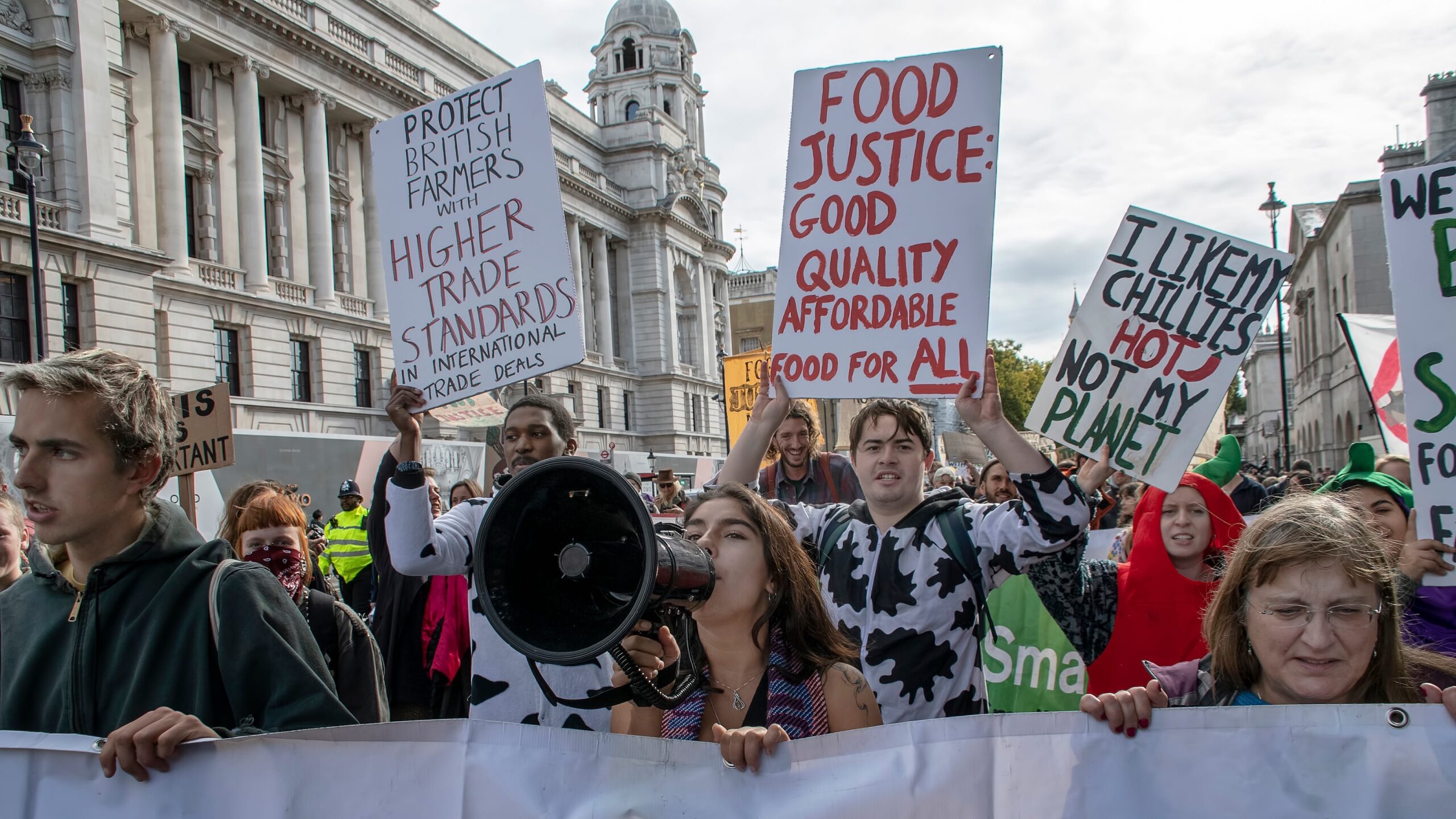
Among the reversals, there was the weakening of the European Union’s Farm to Fork Strategy, previously a cornerstone of the European Green Deal climate policy, as member countries responded to the political fallout from the 2024 farmer protests and a growing focus on food as a security issue amid geopolitical tensions. Brazil had a moment in the global spotlight as host of the annual UN Climate Change Conference (COP30) in Belém. However, this was overshadowed by a court case, backed by agribusiness associations with support from some elected officials, challenging the almost 20-year-old Soybean Moratorium meant to protect the Amazon from deforestation. And in Botswana, in a move intended to protect domestic producers, the government re-introduced a ban on imports of South African horticulture products in December—less than a year after lifting the previous ban, which had undermined low-income households’ access to fruits and vegetables.
Analyzing such policy shifts using political economy methods and tools can cast light on why setbacks (or advances) occur—and generate insights that can help guide future policy projects to success. Yet, too often, the practical utility of a political economy lens is overshadowed by theoretical frameworks and concepts (e.g., political settlements theory, constructivist institutionalism, the multiple streams framework, etc.) whose applications to food policy in particular are not always well-understood.
Focusing on individual case studies offers an alternative approach to glean insights into the complex political and economic dynamics pushing towards and away from sustainable, healthy food system goals, and to navigate them successfully. Most food system policy achievements and setbacks, including the ones noted above, involve decisions over laws, investment priorities, incentives, or sanctions; all of these have distributional consequences for an array of different groups. Assessing those decisions and their impacts, anticipating how food system policy decisions generate winners and losers—and predicting potential allies and opponents to reform efforts—are the core of political economy analysis.
To bring this practical perspective to political economy analysis, IFPRI will launch a new blog series in 2026 that will spotlight factors that facilitated or hindered progress on a select set of agriculture, nutrition, environmental, and health policies. Each post in the series will explore a single policy case study, identifying key lessons on what is working, or not working, in food systems policy today.
The series will include interviews with relevant government, civil society, academia, and private sector actors engaged in the policymaking process who can offer insider perspectives. Moreover, each case study will reflect on the unique political and institutional structures at play at different levels of government, and examine how scalable or applicable the lessons from one context might be elsewhere.
The first blog post in the series will focus on the 2024 Agreement on a Green Denmark, which placed a tax on livestock emissions—the first in the world. How did Denmark manage to do this at the same time many of its neighbors were concerned about levying taxes that might trigger farmer protests? The second post will focus on Mexico’s adoption of the General Law on Appropriate and Sustainable Food, a landmark legislative framework to uphold the country’s constitutional provision on citizens’ rights to nutritious foods. Why was the law finally adopted in 2024, after earlier efforts over the prior decade failed? Subsequent posts will examine a range of other unexpected achievements in various countries, including the removal of costly but popular agricultural subsidies, the lifting of trade bans that protected powerful interest groups, and innovations for ensuring food and agricultural policy continuity across electoral cycles and ministerial turnover.
The intention of the series is to build cumulative knowledge about the range of strategies and tactics that can be used by proponents of sustainable and healthy food system transformation—finding windows of opportunity for action, leveraging the work of policy champions, building unlikely coalitions, deploying savvy communication tactics, or innovating policy designs to neutralize potential opposition to reform.
Integrating such a political economy lens into food policy analysis can, in turn, inform the efforts of organizations like IFPRI in using high-quality evidence to exert impacts on policy. Indeed, as noted by Paul Cairney, a leader on policy process analysis, “When policymakers want to know ‘what works’, they refer to what is feasible politically, at least as much as the ‘technical’ feasibility and effectiveness of a policy solution.” Through practical examples of real-world achievements that overcame difficult odds, we intend to show promising ways to make policy politically feasible for a food system community likely to continue facing significant headwinds in 2026.
Danielle Resnick is a Senior Research Fellow with IFPRI’s Markets, Trade, and Institutions (MTI) Unit and a Non-Resident Fellow with the Brookings Institution Global Economy and Development Program. Opinions are the author’s.