





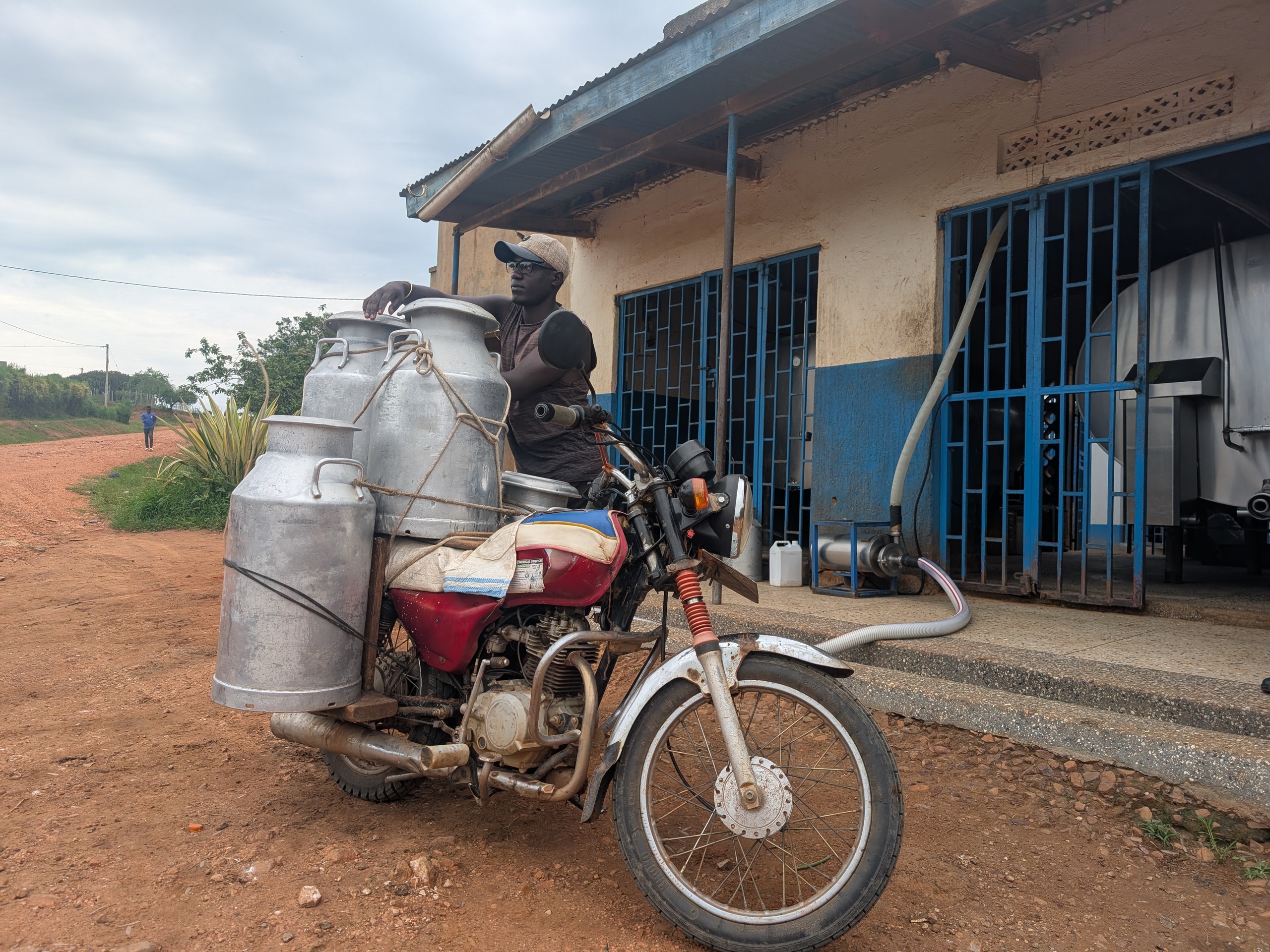
In many agricultural markets, the limited ability to measure product quality at the source and trace it through the supply chain remains a key barrier to improvement, as the absence of reliable quality information blunts incentives for upstream actors to invest in better practices. This challenge spans a wide range of value chains, but it is especially pronounced in the dairy sector. Milk from smallholder farmers is typically pooled and transported through multiple intermediaries before reaching processors, making it difficult to observe and reward high-quality production at any stage. The difference in dairy is that lapses in quality do not only reduce efficiency for processors; they can also undermine consumer confidence in the safety of the final product, potentially dampening demand and limiting market growth.
As part of a continuing research project to study these constraints, IFPRI, CIMMYT, and partners deployed about 150 milk analyzers at strategic points in Uganda’s southwestern milk shed. These devices measure key compositional indicators such as butterfat, protein, and water adulteration. The project’s theory of change posits that making quality visible and traceable will alter behavior across the chain. Specifically, the central hypotheses are that:
- Milk collection centers (MCCs) begin screening milk more systematically to reduce the risk of processor rejection.
- Processors start differentiating on quality, potentially by offering price premiums for higher-quality milk.
- Farmers invest in quality-enhancing practices to avoid rejection at the collection center and to capture part of any quality-based price premiums that pass upstream.
Our research revealed a significant improvement in milk quality following the introduction of the milk analyzers. However, changes in pricing behavior have not materialized to the extent expected. While analyzers reduced the risk of rejection at processing plants and helped identify adulteration, they have not yet generated meaningful price differentiation based on quality. These findings suggest that the full potential of milk analyzers will only be realized when downstream actors—processors and bulk traders—begin competing on quality, allowing price incentives to flow upstream to MCCs, traders and, ultimately, farmers.
Incentivizing quality

In follow-up research under the CGIAR Better Diets and Nutrition Research Program, we are working with 20 MCCs in Uganda to introduce a quality premium that directly incentivizes traders, one of the key intermediaries linking farmers to processors. This experiment seeks to understand how price signals at different points in the value chain influence sourcing behavior, investment in quality, and overall market dynamics.
Within each participating MCC, a randomly selected group of traders receives a per-liter bonus tied to the butterfat and solids-not-fat (SNF) content of the milk delivered, while others continue business as usual. For these traders, each 0.1 percentage point above the East African quality standards (minimum 3.3% fat and 8.5% SNF) earns an additional 100 Ugandan shillings (about $0.02) per liter, paid daily via mobile money. To test how traders respond when high-quality milk becomes harder to find, the study also includes a planned mid-experiment adjustment: the fat threshold required to qualify for a premium is raised from 3.3% to 3.9%, simulating dry-season scarcity conditions.
Findings
During the rainy season, when milk is plentiful and naturally of high quality, traders offered a quality premium mainly responded by scaling up the volumes they delivered. The data show a swift and sustained increase in quantities collected by traders in the treatment group during this period, Stage 1, consistently outpacing the control group. With high-quality milk already abundant, the most profitable response was simply collecting more of it. In this context, the premium effectively intensified trading activity rather than triggering stronger quality-based sourcing.
In Stage 2, once we raised the fat threshold to simulate scarcer, dry-season conditions, the pattern of responses shifted. Treated traders began delivering milk with consistently higher fat content than the control group, while the existing difference in volumes remained broadly unchanged. Under tougher quality conditions, in other words, the premium no longer generated further increases in quantity; instead, traders adapted by reallocating effort toward sourcing higher-quality milk. As a result, bonus payments in Stage 2 were driven more by compositional improvements than by expanded volumes—highlighting how traders adjust their strategies when high-quality milk becomes harder to find.

Source: Authors.
Looking ahead
As our work continues, the above data also will be complemented with short endline surveys for both traders and farmers to better understand behavioral adjustments behind these patterns. From the survey data, we will document whether testing practices changed, whether milk was more frequently rejected at farm gate, how sourcing strategies evolved, and whether any of the quality premium earned by traders was passed back to producers through higher farm-gate prices.
Looking ahead, it would be valuable to replicate this experiment at different points in the value chain—for example, by directly incentivizing farmers or by providing quality-based bonuses to milk collection centers—to identify which actor is best positioned to respond to quality signals, transmit those incentives upstream, and generate the greatest efficiency gains. Finally, our results capture short-run responses; longer-term effects may look quite different. As farmers adjust and adopt higher-return quality-enhancing strategies, such as investing in improved dairy breeds like Jerseys that naturally produce higher-fat milk, the impact of quality premiums on both milk quality and livelihoods is likely to grow.
Bjorn Van Campenhout is Senior Research Fellow in IFPRI’s Innovation Policy and Scaling Unit; Sarah Kariuki is Market and Value Chain Specialist at CIMMYT Kenya; Richard Ariong is Research Analyst at IFPRI Uganda; Jordan Chamberlin is Principal Scientist at CIMMYT Kenya; Benon Byarugaba is Senior Dairy Laboratory Technologist and Dennis Atuha is Senior Dairy Inspector at the Ministry of Agriculture, Animal Industry and Fisheries, Uganda. This post is based on research that is not yet peer reviewed. Opinions are the authors’.
This work was supported by the CGIAR Program on Better Diets and Nutrition.