




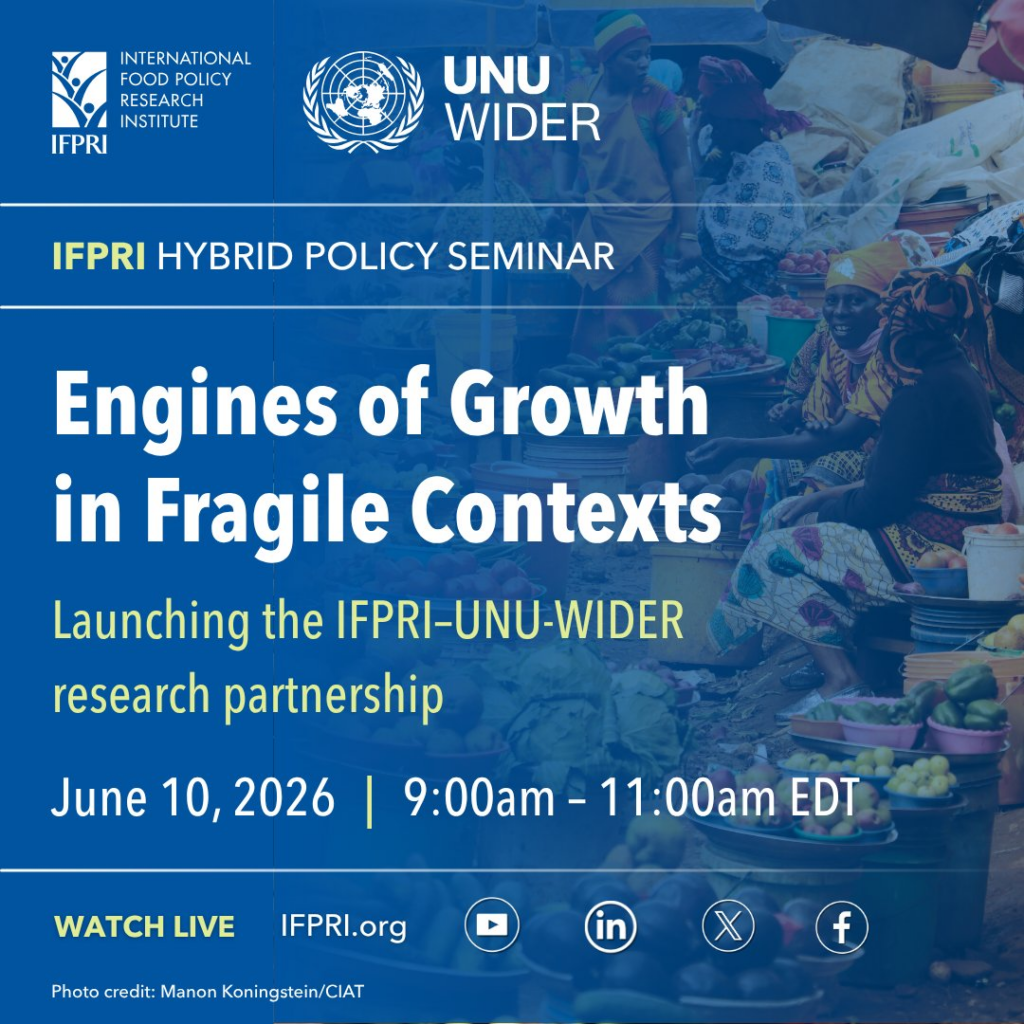
The International Food Policy Research Institute (IFPRI) and the United Nations University World Institute for Development Economics Research (UNU-WIDER) have signed today a Memorandum of Understanding (MoU) to strengthen collaboration on research, policy engagement, and knowledge exchange that promotes inclusive economic development and resilient livelihoods in fragile and conflict-affected contexts.
The partnership reflects a shared commitment to generating high-quality, policy-relevant research and ensuring that evidence informs decision-making in some of the world’s most challenging environments.
Under the MoU, the two organizations will collaborate across several areas of common interest, including joint research initiatives focused on mapping and measuring pathways to inclusive growth, as well as strengthening resilience in fragile settings. The partnership will emphasize translating research into actionable policy insights to support governments and stakeholders in designing effective interventions.
The collaboration will include knowledge-sharing activities such as seminars, workshops, and conferences, and will create platforms for researchers, policymakers, and practitioners to exchange expertise and lessons learned.
As part of the agreement, IFPRI and UNU-WIDER will consult regularly to align their work, share methodologies and tools, and identify opportunities for joint initiatives and coordinated resource mobilization.
Daniel Gilligan, Director, Poverty, Gender, and Inclusion Unit, IFPRI: “IFPRI and UNU-WIDER bring highly complementary strengths to this partnership. By combining IFPRI’s on-the-ground research and deep engagement with policymakers and development partners in fragile settings with UNU-WIDER’s expertise on conflict, fragility, and development, we can generate stronger evidence and help ensure that research informs practical solutions for some of the world’s most pressing development challenges.”
Patricia Justino, Director, UNU-WIDER: “Strong partnerships are central to UNU-WIDER’s work. I’m delighted to deepen our collaboration with IFPRI, bringing together complementary expertise, country knowledge, and policy networks to advance a vital new research agenda. Understanding why local economic activity takes root and expands in some fragile settings but stalls in others will help identify which policies can best support recovery before full stability is restored.”
Katrina Kosec, Senior Research Fellow, Poverty, Gender, and Inclusion Unit, IFPRI: “This partnership is built around a simple but important question: what enables some communities and local economies to remain resilient and continue progressing despite fragility and conflict? Through our joint work, we aim to generate evidence on the engines of growth in fragile contexts—from jobs and livelihoods to human capital, to collective efficacy and trust—and to identify the policies and programs that can help translate resilience into lasting development gains.”
This MoU marks an important step toward enhancing collaboration and maximizing the collective impact of both institutions’ work in advancing sustainable development outcomes in fragile and conflict-affected settings.
About UNU-WIDER
The United Nations University World Institute for Development Economics Research (UNU-WIDER) operates globally through partnerships and an extensive network of experts. As a distinctive blend of think tank, research institute, and United Nations agency, UNU-WIDER generates impactful knowledge that informs policymaking and implementation across local, regional, and global levels. Its work addresses three interconnected development challenges: persistent inequalities, violent conflict and its legacies, and limited fiscal space for public investment. The institute combines rigorous research with long-term partnerships, in-country engagement, capacity development, and global knowledge mobilization. www.wider.unu.edu
About IFPRI
The International Food Policy Research Institute (IFPRI) provides research-based policy solutions to sustainably reduce poverty and end hunger and malnutrition. IFPRI’s strategic research aims to identify and analyze alternative international and country-led strategies and policies for meeting food and nutrition needs in low- and middle-income countries, with particular emphasis on poor and vulnerable groups in those countries, inclusive development, and sustainability. It is a research center of CGIAR, a worldwide partnership engaged in agricultural research for development. www.ifpri.org
Media inquiries: Evgeniya Anisimova, IFPRI, e.anisimova@cgiar.org and Sami Husa, UNU-WIDER, sami.husa@wider.unu.edu.