





The International Food Policy Research Institute (IFPRI) and Dvara E‑Registry’s innovative Insurance Backed Loans for Climate-Smart Agriculture (CSA) Adoption initiative has been selected by the Global Innovation Lab for Climate Finance (“the Lab”) as one of eight global climate finance solutions to enter its 2026 incubation cycle. The cohort was chosen from a record 1,172 applications worldwide. [See the Lab’s global announcement here.]
The Lab—an initiative supported by a network of public and private investors—identifies and accelerates high-potential financial instruments that can mobilize investment for climate mitigation and adaptation in emerging economies. Over seven months, selected teams receive specialized technical assistance, stress testing, and preparation for investor engagement. Successful instruments will be eligible for grant funding of up to USD 250,000 to advance toward implementation.
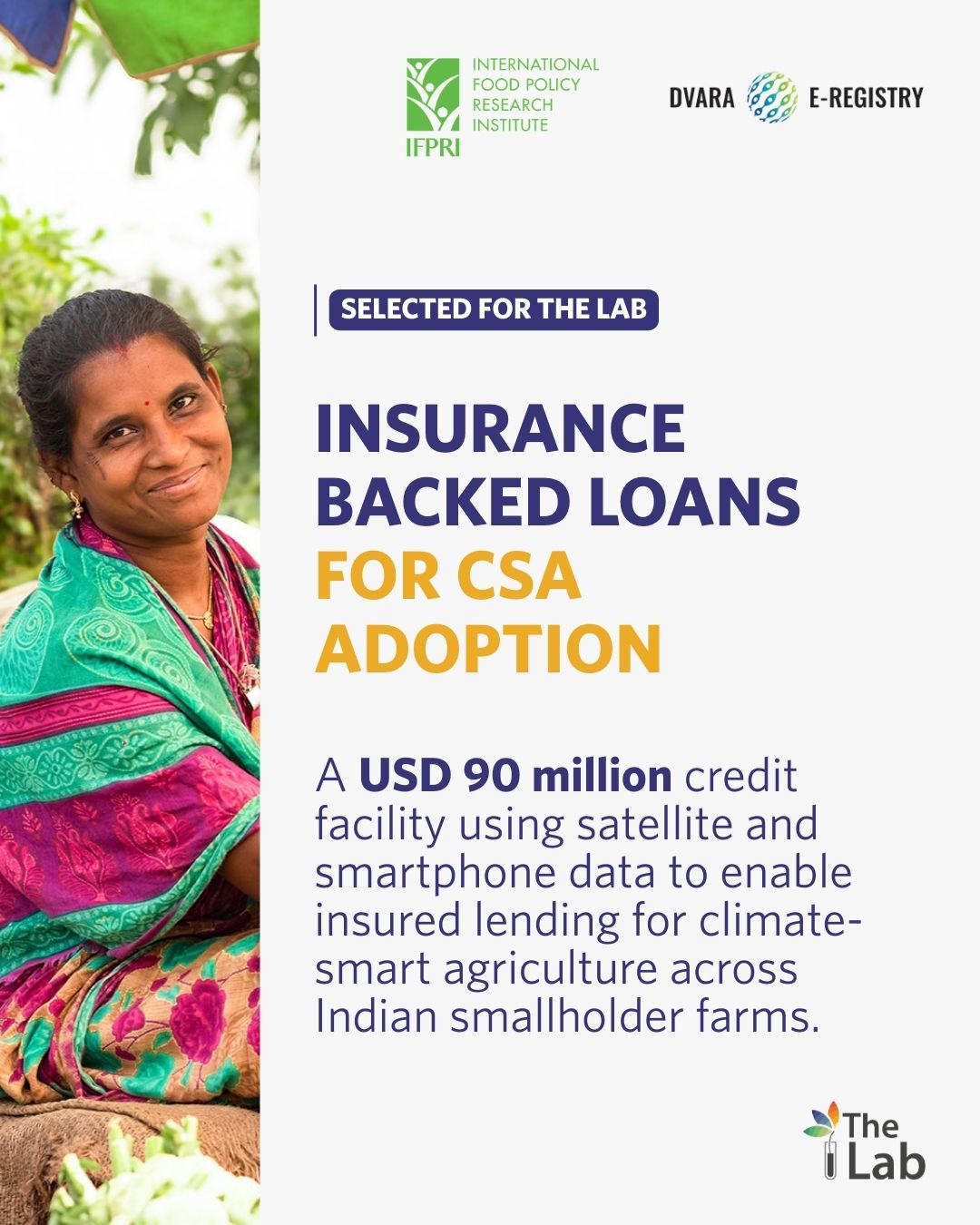
The USD 90 million Insurance Backed Loans for CSA Adoption facility, co-developed by IFPRI and Dvara E‑Registry, addresses long‑standing barriers preventing India’s smallholder farmers—especially women, tenant cultivators, and farmers without land titles—from accessing credit and insurance.
The facility integrates three innovations:
- Picture-based crop insurance, where farmers use smartphone images to document crop conditions and losses.
- AI-enabled credit scoring using satellite-based verification of cultivation practices, enabling lenders to assess creditworthiness without requiring land titles.
- Using digital tools to monitor CSA practices and reward farmers for using risk-reducing CSA practices through lower interest rates and insurance premiums.
This combined approach reduces risk for lenders, protects farmers from climate shocks, and creates incentives for adopting climate‑smart technologies such as seeds of drought‑resistant varieties, precision nutrient management tools, and water‑efficient irrigation.
The proposed facility aims to:
- Expand access to credit for 150,000 farmers, many from historically underserved groups.
- Increase adoption of climate-smart agriculture technologies.
- Strengthen on-farm resilience to extreme weather.
- Contribute to lower agricultural emissions and more sustainable farming systems.
“Through the Lab, we hope to strengthen the investment design, validate the risk-sharing architecture, and mobilize catalytic capital and strategic partnerships to test and scale the insurance-backed credit model. We see the Lab as a bridge from proof of concept to institutional-grade deployment,” said Berber Kramer, Senior Research Fellow, IFPRI, who leads the initiative from the IFPRI side.
Smallholder farmers in India face persistent challenges: limited collateral, lack of formal records, and index insurance products that often fail to capture actual losses. These constraints prevent many from investing in newer technologies that would strengthen their resilience to climate variability.
By relying on imagery and digital verification rather than land ownership documents, the IFPRI–Dvara solution creates a more inclusive and accurate mechanism for assessing credit and insurance claims. This model has the potential to reshape financial access for millions of farmers facing climate-related risks.
Learn more about this work and reach out to Berber Kramer for more information.
About IFPRI: The International Food Policy Research Institute (IFPRI) provides research-based policy solutions to sustainably reduce poverty and end hunger and malnutrition. IFPRI’s strategic research aims to identify and analyze alternative international and country-led strategies and policies for meeting food and nutrition needs in low- and middle-income countries, with particular emphasis on poor and vulnerable groups in those countries, inclusive development, and sustainability. It is a research center of CGIAR, a worldwide partnership engaged in agricultural research for development. www.ifpri.org
Media inquiries: Evgeniya Anisimova, e.anisimova@cgiar.org