






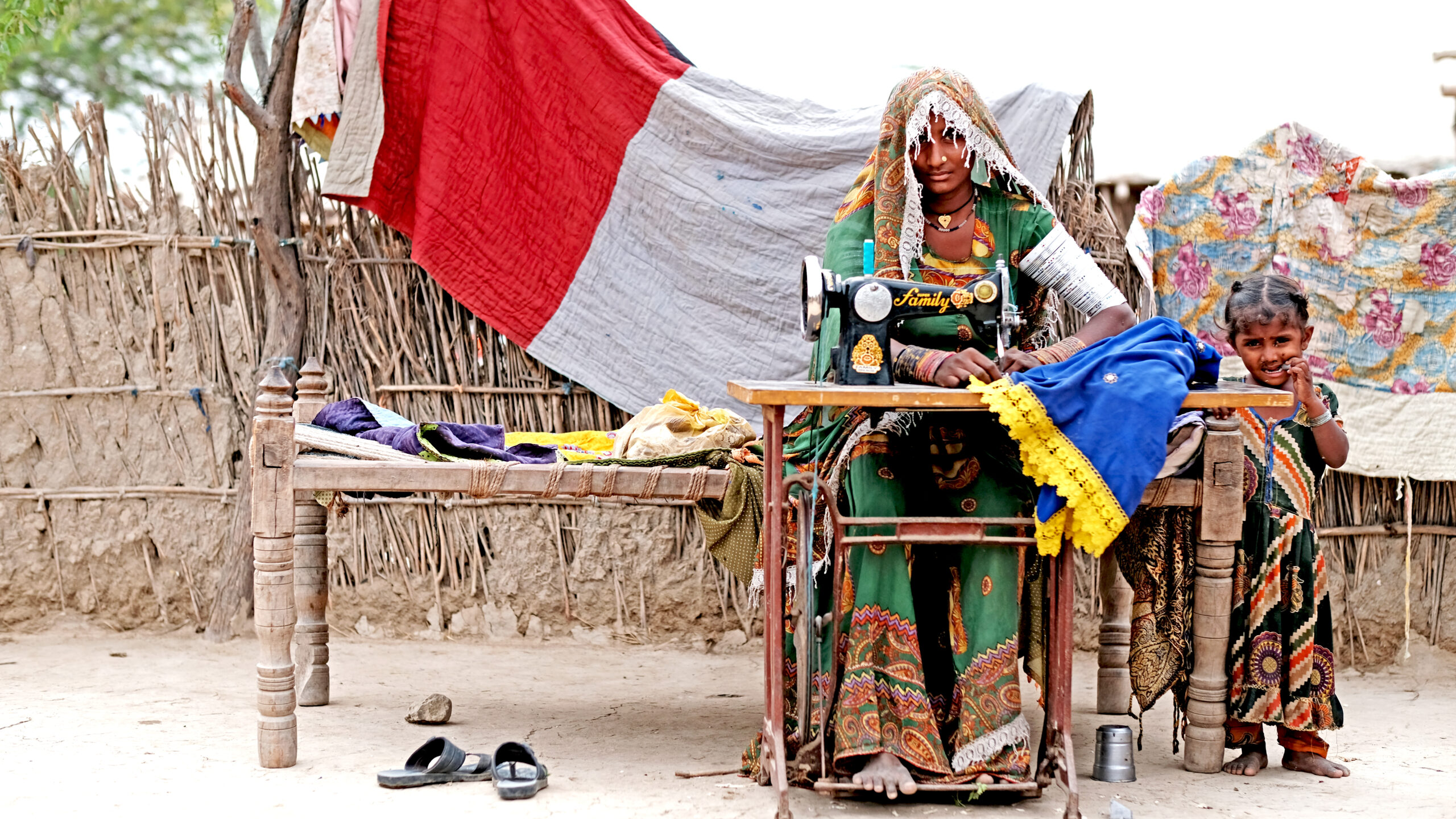
When floodwaters washed away Woudou Oumar’s home in northern Cameroon, he and his family lost not only shelter but hope. Then a government-supported cash transfer arrived. “The money transfer was a real boost for me and my family,” he says, explaining how he rebuilt his house, bought seeds for farming, paid for his daughters’ schooling, covered his son’s medical care after the disaster, and became more hopeful.
Stories like Woudou’s highlight how social transfers can shape more than incomes: they anchor people in their communities and influence how they experience and judge governmental support.
Governments and development partners around the world are now pouring unprecedented resources into social protection. From rural Bangladesh to urban Brazil, more than 120 low- and middle-income countries now provide some form of cash transfer to their poorest citizens. These programs have succeeded in reducing poverty in both the short term and long term, improving education outcomes and promoting better health.
But what else are they doing and at what cost, or benefit, to social and political life?
Our new study reveals that social transfers are systematically reshaping how citizens relate to their governments and to one another. We reviewed nearly 90 empirical studies across six continents in a bid to establish causal effects of social transfers on outcomes beyond welfare and livelihoods. We found that these programs influenced how people voted, how much they trusted institutions, whether they participated in civic life, and even how they felt about their neighbors.
The studies spanned Africa, Asia, Australia, Europe, North America, and South America. The review included studies in 11 African countries—some in fragile and conflict-affected settings. Our findings identified consistent patterns alongside important contextual variation.
The effects weren’t always what policymakers expected, and they depended heavily on program design, recipient characteristics, and political context.
As governments and donors expand safety nets, one reality deserves more attention: social transfers don’t operate in a vacuum. They shape how citizens perceive authority, belonging, and the fairness of their political institutions. They can strengthen political and social trust or erode it, build cohesion or fuel resentment.
Our review shows that design, delivery, and local context shape whether transfers unify or divide societies. While many effects are positive, they are neither automatic nor uniform. Getting this right means seeing social protection not only as a tool to fight poverty, but as a force that can help—or hinder—the building of political trust and community life.
Across settings, three things stood out: how transfers reshape state legitimacy, how they affect trust and political behavior, and how they alter relationships within communities.
Reshaping relationships with the state
Social transfer programs, such as cash transfers or food aid, are designed to reduce poverty and cushion households against income shocks. But they also shape how people understand the social contract between citizens and the state.
In fragile settings especially, even small benefits can become symbols of state presence and capacity. Good delivery looks boring—but it is powerful. Programs that pay on time and apply clear eligibility rules tend to build political trust. In these settings, recipients understand not only that help is coming, but why—and from whom.
Bad delivery, by contrast, often involves delays, opaque targeting, or inconsistent payments. When citizens cannot predict whether benefits will arrive, or suspect that selection is arbitrary or politicized, transfers lose their legitimizing effect and may even undermine confidence in public institutions.
When citizens perceive these programs as fairly targeted and effectively delivered, they often respond with higher satisfaction with public services and their political leaders, and increased political participation. Many begin to see their governments as more legitimate and responsive.
In fact, the most consistent empirical finding across nearly 90 studies was that social transfers boosted support for political incumbents, particularly when programs were seen as credible, well targeted, and appropriately delivered.
Still, not all effects were positive.
We identified conditions under which social transfers had little effect—or even negative consequences—for state-citizen relations. In some cases, this reflected poor implementation capacity. In others, citizens credited NGOs or donors rather than their government for program delivery. Where attribution was unclear, benefits didn’t necessarily translate into political support.
A mixed picture at the community level
We also examined how transfers shaped relationships between citizens themselves. Here, the evidence was more mixed.
In some settings, transfers increased community engagement, strengthened informal support networks, and built trust between groups.
But in other cases, transfers fueled jealousy or worsened inter-group tensions. The evidence suggests, for instance, that transfers can increase crime or conflict when benefits leak to better-off households or are perceived to help outsiders.
Equity and deservingness concerns emerged as especially important. When programs excluded those who perceived themselves as equally needy, or when non-beneficiaries perceived recipients as undeserving, political resentment built. These dynamics were especially salient in contexts of high displacement, high inequality, or deep social cleavages.
Design details matter
One of the clearest takeaways from our review is that the design and delivery of anti-poverty programs makes a real difference for political and social outcomes.
Inclusive programs that reached broader populations were less likely to generate resentment than narrowly targeted ones. Programs that come with conditions that promote the acquisition of civic skills (through job training, for example) and increase engagement with state and community organizations (through the receipt of a national identification card, for example) serve to more effectively boost political participation.
Attribution is also crucial. When citizens clearly associated benefits with their government, transfers were more likely to build trust in institutions. And having mechanisms for grievance redress, feedback and community dialogue amplified the positive effects.
We also found that trust and social cohesion impacts were greater among marginalized groups such as women, unskilled workers and the very poor. Citizens like these often have the most to gain from the material support and the recognition that programs represent.
Policy lessons for expansion
As social protection becomes more central to development strategies, understanding these effects is critical. Cash transfers are not just economic tools. They shape political attitudes, community cohesion, and perceptions of fairness.
The core message is simple but consequential: social protection is never politically or socially neutral. Its effects depend not only on how much is transferred, but on who receives it, how programs are explained, and whether citizens experience them as fair, corruption-free, and delivered by a state that is accountable to them.
To maximize the benefits of social transfer programs and minimize unintended harms, governments and donors should consider five key principles:
Target transparently and fairly. Programs should strive for clear eligibility rules that are well communicated. Programs must also actually deliver what is promised in a timely way that is visibly free from graft.
Design for dignity and civic engagement. Programs that provide opportunities for feedback, or positive interactions with those providing public services, can promote social inclusion.
Ensure state visibility and attribution. When recipients understand the government’s role in delivering benefits, they are more likely to see the state as responsive and capable, reinforcing positive relations and encouraging more political participation.
Promote social cohesion through complementary efforts. Transfers may strengthen community ties when paired with initiatives like local meetings or community-based trainings. These features can be just as important as the cash itself for ensuring broad program acceptance.
Measure relational impacts, not just economic ones. Evaluation should go beyond income and consumption to assess how transfers affect trust, cohesion, political efficacy and perceptions of fairness—among both beneficiaries and non-beneficiaries.
As social protection scales globally, the question is no longer whether transfers reduce poverty—they do. The harder question is whether they help build the kinds of states and societies that can sustain development over time. Getting the design right is not just good policy. It can meaningfully strengthen bonds among citizens and between citizens and the state.
Katrina Kosec is a Senior Research Fellow with IFPRI’s Poverty, Gender, and Inclusion (PGI) Unit and Interim Lead of CGIAR’s research on Fragile and Conflict-Affected Food Systems; Cecilia Hyunjung Mo is an Associate Professor in the Department of Political Science and the Goldman School of Public Policy, at University of California, Berkeley. This post first appeared in The Conversation. Opinions are the authors’.
This work was supported by the CGIAR Science Program on Food Frontiers and Security.
Reference:
Kosec, Katrina; and Mo, Cecilia Hyunjung. 2025. The unintended consequences of social transfer programs: Effects on conflict, governance, and social cohesion. Annual Review of Resource Economics 17: 467-491. https://doi.org/10.1146/annurev-resource-112923-094210