





Key takeaways
An AI image analysis system will evaluate tomato quality and quantify post‑harvest losses in Nigeria.
A pilot assessment in Jos, Nigeria, collected extensive visual and other data across multiple tomato varieties to train and validate the AI model.
The system will be scalable and applicable to other crops, with potential to reduce food waste, improve supply‑chain efficiency, and support smallholder farmers.
Fruits and vegetables are essential to good nutrition, but in low- and middle-income countries (LMICs), people often do not consume enough of them, with most falling short of World Health Organization dietary recommendations. One key reason for this problem is supply: in many LMICs, a substantial amount of production is lost before it reaches consumers due to the widespread lack of appropriate post-harvest handling and cold chains, limiting produce availability and affordability.
One challenge in reducing food loss and waste is understanding how quality deteriorates between farms and retail outlets. If weaknesses in specific links in the value chain can be identified, then solutions can be better targeted. To innovate on current, survey-based measures of food losses, we are developing an artificial intelligence-assisted, photo-based quality assessment in the tomato value chain in Nigeria. If successful, it will help us understand both the quality distribution (including the rate of spoilage) of tomatoes and the volume of loss in the tomato value chain through photos taken at wholesale and retail markets.
The new approach will inform the selection of effective interventions to address food loss in several ways. First, it will improve the accuracy of food loss assessment. Second, it will be implemented in close to real time. Third, it is scalable, i.e., we can assess food loss simultaneously in many locations. Once the program is fully developed, it will be usable in other settings within Nigeria and elsewhere.
Preparation work in Jos, Plateau State, Nigeria
A pilot assessment and data collection were conducted in Jos, Plateau State, January 12-23, 2026, by a group of researchers from IFPRI, DAJRHAS Health and Agric Development, and the World Vegetable Center, closely working with Inaho, Inc. in Japan. The pilot study facilitated important discussions between the research team and key players across the tomato value chain, including farmers, traders, market leaders, transporters, and input suppliers. These engagements provided the ground for technical work that will be implemented throughout the project lifecycle.
The research team focused on two primary objectives: training an AI image recognition tool to identify and categorize tomatoes by maturity stage, and collecting extensive visual data (4K videos) from real-world market environments to ensure the AI system can function effectively under varied conditions. We worked with five varieties of tomato, two local varieties (UTC and Roma) and three hybrid varieties (Belfast, Bellfort, and Dingyanfen No. 2).
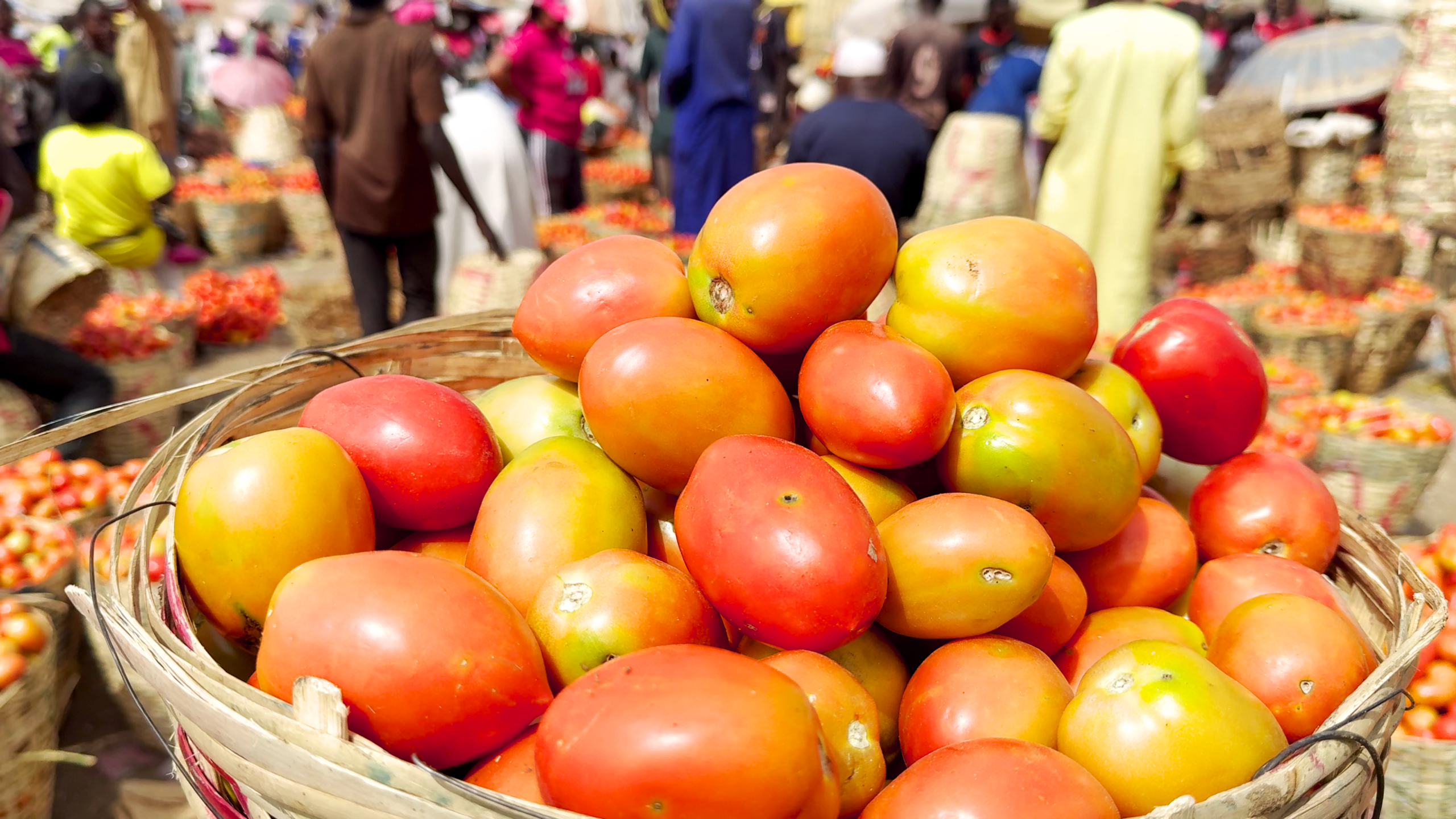
The team developed comprehensive visual reference charts for different tomato varieties. These charts documented different maturity stages: unripe (breaker, i.e., when the tomato is about to start changing color; and turning), ripe, fully ripe, overripe, and rotten or discarded tomatoes. This systematic classification system forms the foundation upon which the AI will learn to distinguish between quality grades with accuracy comparable to human assessment. The team captured extensive 4K video footage and photographs of discarded tomatoes at various market locations. 4K video footage is useful for this purpose due to the sheer number of images that can be collected at once to train the AI system. Videos and images of ripe tomatoes were collected from both retailers and wholesalers, ensuring that different stages of the tomato value chain were captured.
Crucially, the research team also conducted systematic weight measurements of both fresh and rotten tomatoes across the different varieties. This quantitative data will enable the AI system to correlate visual quality indicators with actual weight loss, providing a more comprehensive understanding of how deterioration affects the economic value of produce. By establishing relationships between visual appearance and weight reduction, the system will be able to estimate not just quality degradation but also the magnitude of physical losses occurring at different points in the value chain.
The researchers also visited greenhouses where hybrid varieties are cultivated. To understand the broader context of tomato production and marketing in the region, the team consulted with agricultural input companies to identify which varieties were most prevalent in the market and which farmers preferred to grow. We visited tomato farms to observe the traits of various varieties in the field to compare with the information obtained from input dealers. At Farin-Gada Vegetable Market (a major fresh produce market) in Jos, we assessed the extent of discarded produce and engaged with market unions to understand their operations. The discussions with tomato transporters added another crucial dimension to understanding how handling and logistics affect produce quality after grading produce received from smallholder farmers.
Next steps
The visual data, reference charts, weight measurements, and stakeholder insights gathered during these two weeks will now be used to train and refine the AI algorithms that power this new tomato quality assessment system. As the project progresses, the potential applications extend far beyond tomatoes. The methodology and AI technology being developed could eventually be adapted to assess quality and estimate losses for a wide range of fruits and vegetables, from peppers and onions to mangoes and oranges. Such a flexible tool could help reduce food waste, improve market efficiency, optimize supply chain logistics, and ultimately contribute to food security and improved livelihoods for smallholder farmers across Nigeria and beyond.
Futoshi Yamauchi is a Senior Research Fellow with IFPRI’s Markets, Trade, and Institutions Unit based in Washington, D.C.; Aoi Fukuhara is an AI Researcher with Inaho, Inc., Japan; Dauda Bawa is a Professor at the University of Jos and Managing Director, DAJRHAS Health and Agric Development Ltd., Nigeria; Caleb Olanipekun is a Nigeria-based Research Assistant with the World Vegetable Center; Olufemi Popoola is a Research Analyst with IFPRI’s Development Strategies and Governance Unit, based in Abuja, Nigeria. Opinions are the authors’.
This work is supported by the Government of Japan and the CGIAR Program on Better Diets and Nutrition.