





Key takeaways
•An indicator in the Women’s Empowerment Metric for National Statistical Systems (WEMNS) measures how women perceive women’s choices in marriage and childbearing.
•About one‑third of women in Liberia and Sierra Leone fully endorse women’s rights to family formation, such as marriage and childbearing decisions, with significant variations by age and region.
•Strengthening education outcomes, expanding ICT access, and using community dialogues to challenge restrictive gender roles can help shift norms and expand women’s empowerment.
A key component for promoting gender equality is understanding how women perceive women’s ability in society to make basic choices about family formation: when and whom to marry, whether to divorce, or if and when to have children. In some areas, cultural attitudes or norms limit these choices and how women see them; in other areas, they may exercise more autonomy. Understanding how women in different countries and cultural and economic contexts see these challenges is vital to devising and targeting gender equity policies.
Data collected using the Women’s Empowerment Metric for National Statistical Systems (WEMNS), a survey tool developed by IFPRI and partners, casts light on how women in Liberia and Sierra Leone view these important questions, and how these issues relate to other empowerment measures. Slightly more than one-third of respondents in each country agreed that women should choose when to marry or divorce, and whether or when to have children, or to have no more children. At the same time, there are substantial regional and age variations that provide important insights for policymakers navigating and changing the complex landscape of gender attitudes.
This blog post explores that data and what it means within the overall WEMNS framework that gauges women’s empowerment. Liberia and Sierra Leone used WEMNS to collect gender data in nationally representative surveys in 2025, with technical support from the UN Food and Agriculture Organization (FAO; read more about WEMNS scale-up and our partnership with FAO here). These efforts were part of the 50×2030 Initiative, which aims to transform agricultural data systems to improve rural livelihoods and food security.
Assessing women’s agency
The WEMNS metric highlights constraints on women’s and men’s empowerment across four domains, each with three indicators. Here we focus on the “intrinsic agency” domain, and the “endorsement of women’s freedom in family formation” indicator in that domain.
Intrinsic agency is defined as the power that women hold to develop critical consciousness, overcome barriers, and rise above internalized oppression (Yount et al., 2020). Another way to conceive of intrinsic agency is “power within,” or one’s self-confidence and self-efficacy.
While the intrinsic agency domain in WEMNS builds on previous empowerment metrics, this tool is unique, as it focuses on new indicators that are key areas of women’s critical consciousness: freedom in family formation, freedom in livelihood choices, and rejection of sexual harassment. Compared to other types of agency, intrinsic agency is challenging to conceptualize and measure, because it is not as immediately tangible.
Freedom in family choices
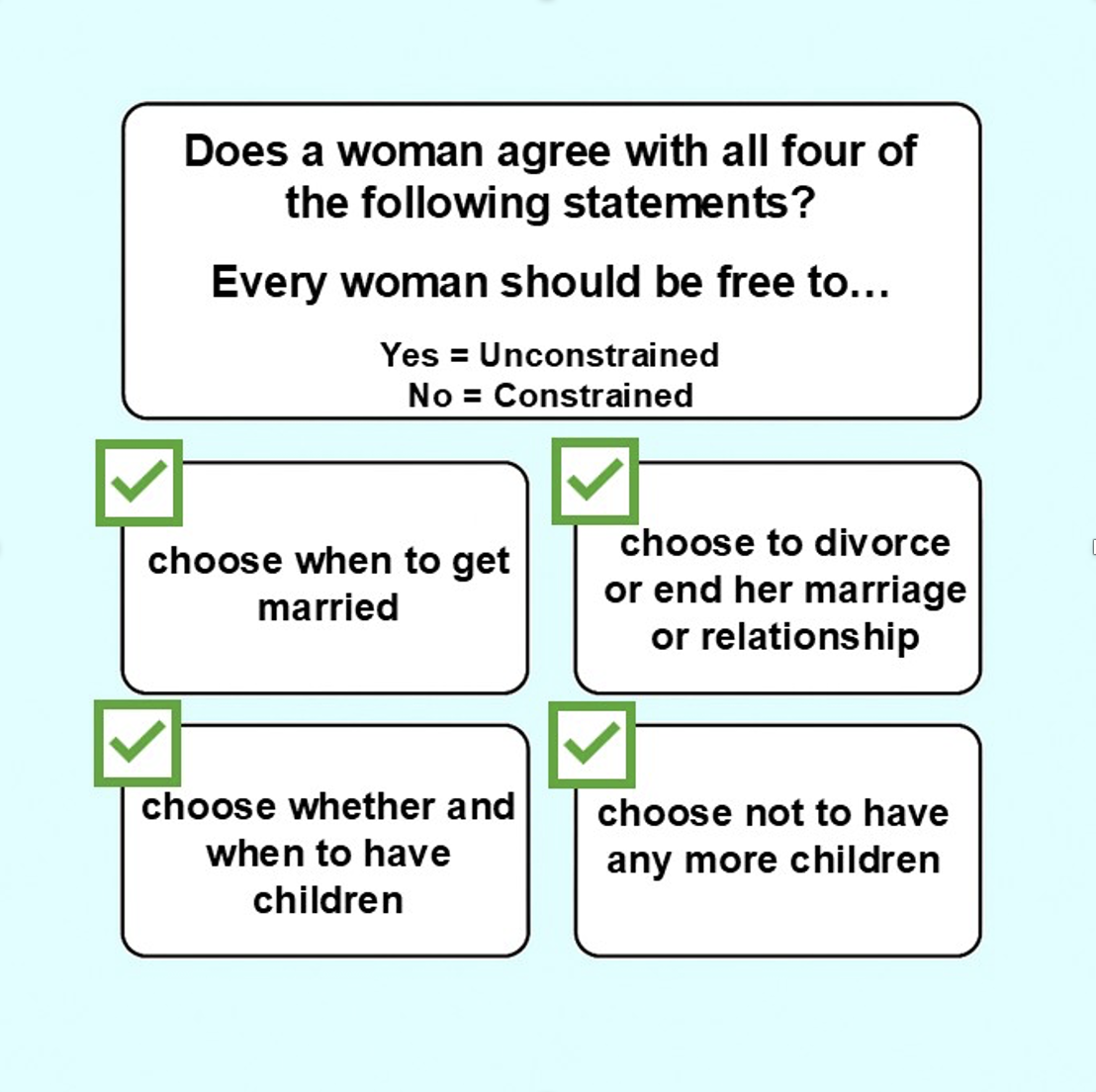
The “endorsement of women’s freedom in family formation” indicator consists of four statements (Figure 1). Agreement with all four indicates a woman is unconstrained—i.e., the respondent believes that women are free to make choices in this area. Note that the indicator asks about a woman’s beliefs, and not about their personal experiences with family formation. This is for two main reasons: first, because once a life event occurs, it cannot be reversed (thus an indicator will only change in one direction), and secondly, because a woman can have an opinion on a life event despite not (yet) having experienced it herself.
Figure 1
Determining whether a woman is unconstrained in women’s freedom in family formation choices
Findings on endorsement of women’s freedom in family formation choices
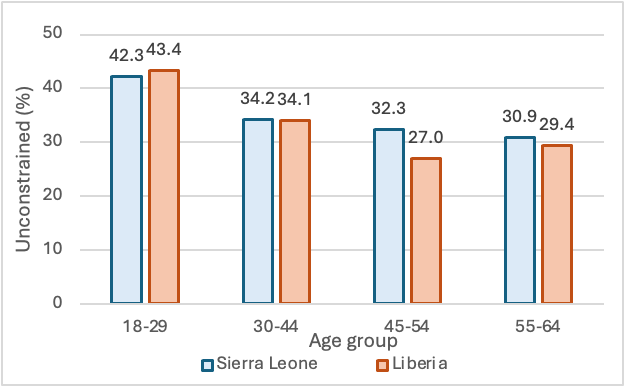
The percentage of women endorsing women’s freedom in family formation is similar in Liberia and Sierra Leone. In Liberia, 35.5% of women and 37.2% in Sierra Leone agreed with all four statements and are therefore unconstrained in this indicator. In both countries, younger women tend to be proportionally less constrained relative to older cohorts (Figure 2).
Figure 2
Endorsement of women’s freedom in family formation choices by country and age groups
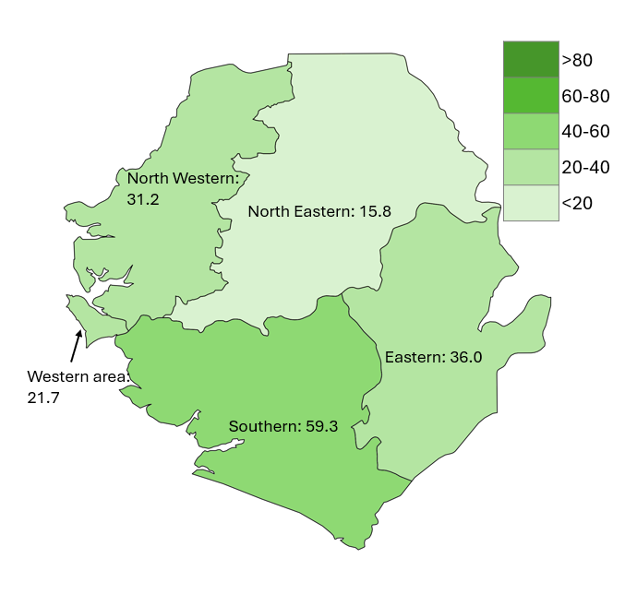
In both countries, there are vast geographical differences. In Liberia, the Montserrado region has the highest proportion of women unconstrained in this indicator, 49.0%, and the lowest is South Central with under 20% (Figure 3). In Sierra Leone, the Southern province has the highest proportion of women unconstrained in the indicator, almost 60%, while the lowest proportion is found in the North Eastern province, with 15.8% of women unconstrained (Figure 4). For the Liberia figures, please note that they differ slightly from the official reports available through the Institute of Statistics since as part of the anonymization process, some regional information may be set to missing, which affects the point estimates.
Figure 3
Endorsement of women’s freedom in family formation choices in Liberia, by region (% of rural women unconstrained)
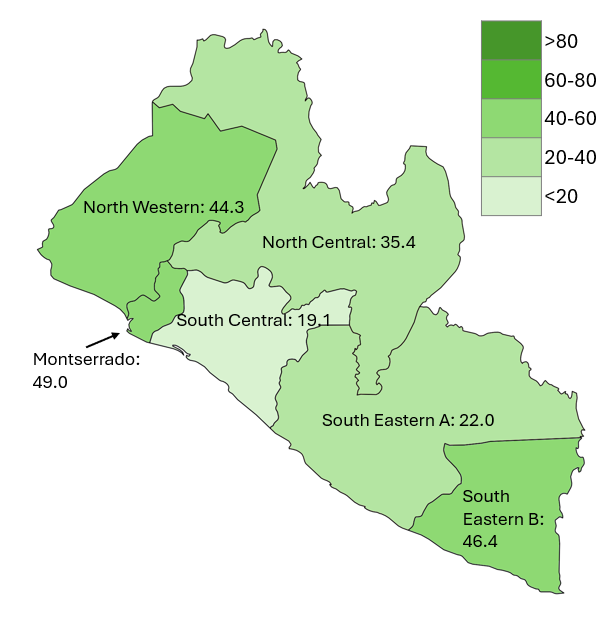
Figure 4
Endorsement of women’s freedom in family formation choices in Sierra Leone, by province (% of rural women unconstrained)
Potential empowerment strategies
These findings offer insights into potential strategies to address women’s empowerment and improve development outcomes in these two countries.
Marriage
How does child marriage relate to women’s rights regarding family formation? In Liberia, the Children’s Law of 2011 sets 18 as the minimum age of marriage for girls and 21 for boys, with some specific exceptions permitted. In 2024, Sierra Leone passed the Prohibition of Child Marriage Act, criminalizing marriage under the age of 18. Nevertheless, recent estimates find that over half of young women were married before the age of 18 in both countries (Reisz et al., 2024). These patterns suggest that legal frameworks to protect girls from early marriage should be expanded, alongside interventions that discourage child marriage, such as policies that increase girls’ education and gender-sensitive vocational and livelihood trainings (Male & Wodon, 2018). Bolstering education and vocational training could also be beneficial in shifting attitudes.
Childbearing
Strong pronatalist norms across much of West Africa also have an important influence on women’s opinions and choices and shape agency as measured by other WEMNS indicators. These include first births often occurring at a young age and large families. Contraceptive use is often perceived negatively, and women’s ability to freely make decisions about family formation is limited (Reveiz et al., 2025.
Lack of information is often cited as a top constraint women face in accessing sexual and reproductive healthcare. Increasing women’s use of information communication technologies (ICT)—an indicator in the agency-enabling resources domain of WEMNS—could be an entry point to help women gain such knowledge. For instance, a study from the Middle East found that using digital technologies (e.g., smartphone apps, web information) to access family planning information is perceived positively by women and healthcare providers (Yousef et al., 2021). With such knowledge, women may have increased intrinsic agency related to family formation and in making decisions over their own healthcare.
Importantly, social norms are not necessarily fixed, nor do individuals necessarily agree with them and embody them in their own lives. For example, evidence from Nigeria finds that married men who hold more egalitarian attitudes are more likely to want smaller families, and researchers attribute these desires to greater joint decision-making around family planning (Rusatira, 2024). If women had greater intrinsic agency around when and whom to marry, they may possibly choose to marry men who want the same size family they do, or who hold more egalitarian views around childrearing. Increased intrinsic agency in family formation may foster a virtuous cycle and continue increasing.
Targeted programs can help as well. Community dialogues, a popular intervention component that engages both community leaders and members in challenging harmful gender norms and attitudes, have been used with success in addressing norms around family planning and contraception. For instance, programs that promoted open discussions of family planning and its benefits were associated with an increase contraceptive use among men in Kenya, Senegal, and Uganda (Sileo et al., 2024; Speizer et al., 2018; Wegs et al., 2016). Additionally, edutainment programming around gender-based violence, reproductive health care, and child marriage are also successful in promoting egalitarian attitudes and encouraging norm change among women and men (Sengupta et al., 2020; The C’est la Vie! impact evaluation study team, 2024).
Continuing progress toward gender equality
Intrinsic agency is expansive and often intersects with other empowerment domains. Here we have only touched on a few of the questions raised by recent WEMNS findings in the “endorsement of women’s freedom in family formation choices” indicator. However, we see these interconnections as a strength in making progress on gender equality. They allow for multiple entry points where policymakers and development practitioners may engage, because progress in one area of intrinsic agency may spur and/or reinforce gains across other indicators, empowerment domains, and development outcomes more broadly. By continuing to scale tools like WEMNS, which allows us to measure these complex interconnections and design more effective interventions, we can make meaningful progress toward gender equality.
Emily Myers and Flor Paz are Senior Research Analysts with IFPRI’s Poverty, Gender, and Inclusion Unit. This post is based on research that is not yet peer-reviewed. Opinions are the authors’.