



Key takeaways
•A light-touch graduation model was assessed in a randomized trial.
•There were some positive effects on financial inclusion, assets, and income from livestock, but no effects on consumption.
•This light-touch model did not generally stimulate an exit from a poverty trap for the targeted households.
Republished with permission from VoxDev.
A randomized evaluation of a lower-cost poverty graduation-style program in rural Ethiopia finds modest gains in savings and livestock income but no sustained improvements in consumption or food security, suggesting that smaller cash transfers and lighter support may be insufficient to help extremely poor households escape poverty, particularly in shock-prone settings.
A long-running debate in development economics centers around poverty traps: the hypothesis that poor households, by virtue of limited asset stocks, low skills, or both, cannot access high-return economic opportunities that would shift their economic trajectory. However, empirically identifying poverty traps is extremely challenging, and the most compelling evidence to date is drawn from Bangladesh, where researchers found that the “tipping point” for escaping poverty was roughly $500 (Bandiera et al. 2017). Households whose asset stock exceeded that level were able to escape poverty, while households characterized by asset stocks below this level generally failed to do so.
The intervention that was effective in that trial was what became known as a “graduation model” intervention, an intervention that combines large asset transfers with training, coaching, and other support. These models have shown promise in multiple contexts (Banerjee et al. 2015), but are expensive and hard to scale. Our research seeks to explore whether a lighter-touch, cheaper version can be equally effective in reducing poverty.
Evaluating a light-touch graduation model in Ethiopia
We conducted a randomized trial in rural Ethiopia evaluating SPIR (Strengthen PSNP4 Institutions and Resilience), a program that targeted extremely poor households that were already beneficiaries of Ethiopia’s main government safety net, the Productive Safety Net Programme (PSNP) (Leight, Gilligan, Hidrobo, Alderman, and Mulford 2026). These are the poorest 20% of rural households, which receive food and cash transfers in exchange for work on public projects. On top of this baseline support, SPIR provided three main supplementary livelihoods interventions: a one-time asset transfer, training on livestock production and marketing, and the formation of village-level savings groups. The program also layered on nutrition and health services, responding to strikingly high child malnutrition rates in the study areas (around 40% of children under 2 had stunting (low height for age) at baseline).
The four experimental arms thus included one arm receiving PSNP only, two arms that received alternate combinations of lighter livelihoods and more intensive nutrition interventions, and one arm that received intensive livelihoods and nutrition interventions.
Importantly, the transfer was notably smaller than in previous graduation model studies: just $200 at market exchange rates (or about $374 in 2017 purchasing power terms). That is roughly half the size of what has been used in the most successful programs elsewhere. The trial also introduced experimental variation in the transfer modality: randomizing at the cluster level whether households received only cash or a poultry package (16 chickens plus inputs) of comparable value. Our sample covered 3,314 households across 192 clusters in two regions of Ethiopia, and we tracked outcomes at baseline (2018) and then one and three years after the program started.
Limited evidence of sustained poverty reduction
We observe a mixed pattern of results, with some bright spots but no clear evidence that households escaped poverty.
Figure 1
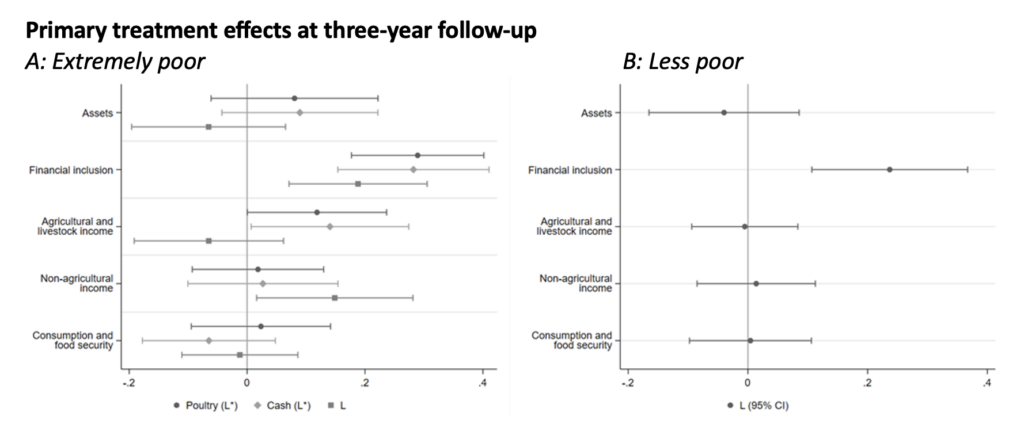
For the poorest households that received the full package—transfer, training, and savings groups—we saw some asset accumulation in the short term. But by the three-year mark, most of those gains had faded. The one area where effects were large and lasting was financial inclusion: the probability of having any savings jumped by more than 30 percentage points (relative to a control group mean of 40%), and access to credit increased by 8-10 percentage points. Income from livestock also increased, but there was no meaningful improvement in consumption or food security. The treatment effects were small, statistically insignificant, and sometimes even slightly negative.
For extremely poor households that received savings groups and training (no transfer), the picture was simpler: the only significant effect was an increase in savings. We observed a similar pattern for the less-poor households in the sample. Savings groups are clearly effective for encouraging household savings, but they don’t appear to be sufficient to transform households’ livelihoods.
Though we saw little difference in experimental effects on average by transfer modality, one of the more intriguing findings was the pattern of interaction between the nutrition programming and the asset transfer.Households that received cash transfers but were not enrolled in enhanced nutrition services showed sustained asset accumulation three years later. On the other hand, households that received cash in conjunction with enhanced nutrition services showed no asset growth at all. One plausible explanation: when a household receives a cash transfer while also being encouraged to invest more in their children’s health and nutrition, they spend the cash on food and health inputs rather than productive assets. This is consistent with evidence separately reported that children in the cash-plus-enhanced-nutrition group showed better growth outcomes at the three-year follow-up (Alderman et al. 2026).
Policy implications
Overall, the lighter-touch model had real but limited effects, with little evidence of the sustained consumption gains that would signal households have crossed a meaningful poverty threshold.What explains this pattern?
- The transfer may simply have been too small.
- Households in the sample were exposed to frequent shocks (including drought and a pattern of escalating conflict), that may have eroded their asset gains.
- This intervention did not include any intensive household or group-level mentoring or coaching, and this may have limited the returns households were able to achieve.
For policymakers, these findings offer a realistic check on what lighter, cheaper versions of graduation programs can achieve. They can generate some positive effects, but there may be trade-offs between gains in the livelihoods and nutrition dimensions. Shifting households fully out of poverty, especially in fragile contexts where households face repeated shocks, and transforming patterns of weak human capital, likely requires larger transfers, more support, or both.
Jessica Leight and Melissa Hidrobo are Senior Research Fellows with IFPRI’s Poverty, Gender, and Inclusion (PGI) Unit; Daniel Gilligan is Director of PGI; Harold Alderman is a Research Fellow Emeritus with IFPRI’s Director General’s Office; Michael Mulford is Senior Director, Global Poverty Research Lab, Northwestern University. Opinions are the authors’.
Reference:
Leight, Jessica; Gilligan, Daniel O.; Hidrobo, Melissa; Alderman, Harold; and Mulford, Michael. 2026. Can a light-touch graduation model enhance livelihood outcomes? Evidence from Ethiopia. Journal of Development Economics 179(February 2026): 103682. https://doi.org/10.1016/j.jdeveco.2025.103682