



Third in a series of blog posts summarizing impacts of IFPRI research over five decades. Read the first here and the second here.
In 2025, as IFPRI marked its 50th anniversary, it commissioned a review titled Taking Stock: Impacts of 50 Years of Policy Research at IFPRI to evaluate its standing as an international research institution and the influence and impact of its policy research and capacity-strengthening activities. The review drew on bibliometric data and about 45 independent assessments commissioned by IFPRI, its partners, or investors over the years.
This blog post provides an overview of the impact of IFPRI’s support for academic contributions, as described in that report.
IFPRI has established a reputation as a policy research institution that promotes evidence-based policy for food security and development. In many cases, producing policy-relevant research has led the Institute to make significant advances in the academic disciplines core to its work. This post summarizes three areas that speak to IFPRI’s success as a research institution: its research outputs; partnerships, rankings, and awards; and analytical tools. Taken together, the evidence suggests that IFPRI has advanced the study of policy for agricultural and economic development and is considered a trusted peer to research and policy institutions around the world.
Research outputs
Since 1975, IFPRI has published more than 4,000 peer-reviewed articles in journals tracked by the Institute for Scientific Information. More than 2,500 of those articles were published in the last decade (2015–2024) as the Institute’s productivity and staff size grew. In its first 40 years, IFPRI accrued an average of 14 citations per paper. In the last decade, it received an average of 29.5 citations per paper, which partly reflects IFPRI publishing more papers in high-impact journals. This high average citation statistic is bolstered by a few widely cited journal articles appearing in influential journals such as The Lancet or Nature. IFPRI’s top-cited papers are predominantly found in journals focused on agricultural economics or economic development, but the range of journals in which it publishes has broadened over time. An increasing number of high-performing articles are published in journals focused on nutrition, food, and the environment, indicating how the Institute has expanded the disciplinary breadth of its staff and research agenda.
Figure 1
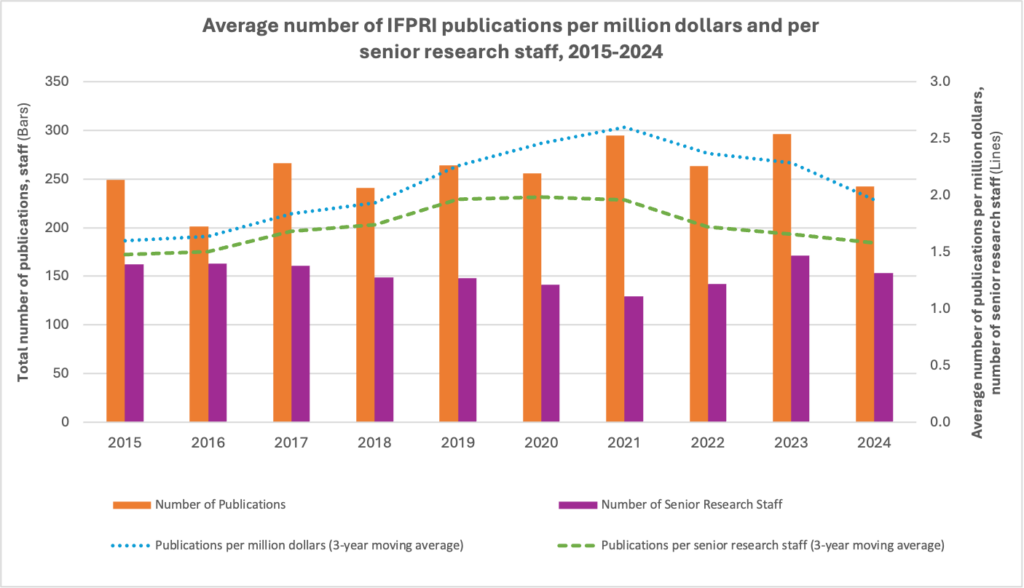
As a research institute that strives to share evidence with various audiences, IFPRI communicates its research through several other outlets, including books, working papers, reports, and briefs. Its most cited publications, according to Google Scholar citations, include the flagship Global Food Policy Reports, an annual publication that began in 2015, and books on the impact of COVID-19 on food security in 2020 and 2022. Between 2015 and 2024, IFPRI generated between 600 and 1,400 of these outputs per year, garnering a yearly minimum of 300,000 downloads. Comparing the influence of journal articles with these other publications is not straightforward, however, partly because of the difficulty in interpreting Google Scholar citations and the relative importance of downloads for IFPRI publications. Using Altmetric scores, IFPRI’s top journal articles were found to generate much more attention than its other leading outputs. Similar differences between journal articles and other IFPRI publications were noted for citations in policy documents and the number of news outlets mentioning IFPRI publications.
IFPRI’s policy is to make its datasets open access. Between 2015 and 2024, IFPRI published 579 datasets on a range of topics. In total, these amassed more than 2.2 million downloads by early 2025. The most popular were household surveys such as the IFPRI-designed Bangladesh Integrated Household Survey (BIHS) and Pakistan Rural Household Survey (PRHPS). In particular, the BIHS—the most comprehensive, nationally representative rural household survey in Bangladesh—has been widely used by researchers and practitioners worldwide (IFPRI 2020).
Partnerships, rankings, and awards
Core to IFPRI’s work is a network of partnerships, both across the world and along all steps of the research and policymaking process. The Institute has a history of co-creating research outputs with universities and research institutions in low- and middle-income countries, including the Bangladesh Institute of Development Studies, Chinese Academy of Agricultural Sciences, and AKADEMIYA2063, as well as universities in high-income countries such as Cornell University, Michigan State University, and Oxford University. IFPRI also collaborates with government ministries in most countries where it engages in research activity and with numerous high-level organizations such as regional economic communities, major United Nations agencies, and the World Bank. Attracting and maintaining partnerships with such a range of organizations is an indicator of IFPRI’s success as well as a crucial component of its efforts to advance research, achieve impact, and share capacities.
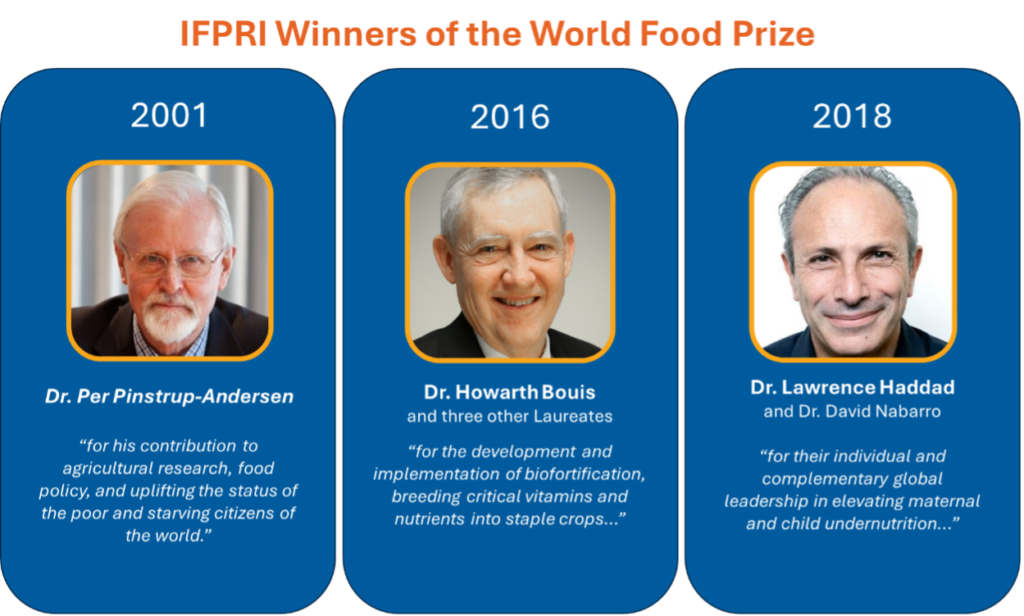
Rankings and awards provide another indicator of IFPRI’s academic reputation. The Research Papers in Economics (RePEc) database, which uses publication counts, citations, and download statistics to assess institutions, has ranked IFPRI first among agricultural economics departments every year since 2015 and first in the field of agricultural economics almost all years. IFPRI also consistently ranks highly among global think tanks, according to the Global Go To Think Tank Index. The Institute’s researchers have won numerous awards in recognition of outstanding papers, books, and presentations on timely issues or of lifetime achievements in the fields of nutrition, agricultural economics, natural resources, and more. Notable among these honors are three World Food Prizes, the premier international award recognizing individuals for their contributions to improving world food supply.
Analytical tools
IFPRI has made numerous other contributions to the study of food security and development, including models, indexes, and related analytical tools that have been used beyond the Institute’s own studies. IFPRI has independently or collaboratively developed modeling tools to support policy analysis since the 1990s, from country-level social accounting matrixes and economywide computable general equilibrium models to the International Model for Policy Analysis of Agricultural Commodities and Trade (IMPACT). Independent evaluations of economywide modeling (Anderson 2003; CGIAR-IEA 2015; Somwaru 2021) and IMPACT (Ryan 2003; Lowder and Regmi 2019) demonstrate how governments have adopted these models and applied their results to real policy questions. IFPRI’s modeling systems have been used to inform decision-making and achieve impact by examining alternative future pathways at the global, national, and subnational levels.
IFPRI has additionally developed quantitative and qualitative instruments for measuring and monitoring. Key examples include Agricultural Science and Technology Indicators (ASTI) and Statistics on Public Expenditures for Economic Development (SPEED), which have been shown to expose funding gaps and inform public investment decisions (Norton 2011; Lowder 2019, and Renkow 2010; Lowder 2018, respectively). As part of its pioneering work to understand gender gaps in development, IFPRI designed the Women’s Empowerment in Agriculture Index (WEAI) with the Oxford Poverty and Human Development Initiative, which serves to measure the inclusion of women in agriculture. Although developed initially for the United States Agency of International Development, 285 organizations in 70 countries have adopted WEAI tools since its launch in 2011. WEAI is a versatile tool that allows users to apply different modules and indicators to best fit their research needs.
Conclusion
In the past half-century, IFPRI has produced a range of publications and tools to answer relevant questions and respond to the evolving needs of vulnerable populations and the practitioners, funders, and policymakers serving them. The citations, honors, and external applications that these outputs have acquired over time demonstrate their influence. The success of IFPRI as a research institution is not based simply on the rigor of its scholarship—it is enabled by its open-access policy, communications strategy, and capacity-strengthening activities that empower partners with different capacities and demands to utilize the data, analyses, and tools that IFPRI generates. Through these complementary efforts, IFPRI advances its mission to provide research-based policy solutions for a hunger-free world.
Maria DiGiovanni is a Research Analyst with IFPRI’s Director General’s Office; Peter Hazell is an IFPRI Senior Research Fellow Emeritus; Frank Place is a former IFPRI Senior Research Fellow.
Reference:
Hazell, Peter B. R.; and Place, Frank. 2025. Taking stock: Impacts of 50 years of policy research at IFPRI. Independent Impact Assessment Report 48. Washington, DC: International Food Policy Research Institute. https://hdl.handle.net/10568/177103